 an hour ago
Rama for BBC: 30 years ago we were Afghans on the other side of the Adriatic coast
Periskopi(5 years ago)
(5 years ago)Albania has sheltered hundreds of citizens from Afghanistan. For the idea of Tirana providing shelter for Afghan citizens, Albanian Prime Minister Edi Rama said 30 years ago that the Albanians were <x0odgans” who made efforts to take refuge in Europe, while the doors of the Kosovo war were also opened to give [...]
Following Rama's interview on Wednesday morning at BBC World News, he said he well knows the sides of tyranny, be it when you remain in the hands of a cruel regime, even when you seek to build a new life as refugees in other countries.
The full interview of Prime Minister Rama:
BBC: Explain to me how Albania came to expect Afghan refugees
Rama: We were very natural, since only 30 years ago we were Afghans on the other side of the Adriatic coast, trying to take refuge in Italy and, further, in Europe, desperate to flee Tirana's red Taliban. Meanwhile, during the Kosovo war, the doors opened to provide shelter to half a million refugees seeking to escape ethnic cleansing from Slobodan Milosevic in Belgrade. Thus, we are familiar with all aspects of tyranny, whether it remains in the hands of a cruel regime or you seek to build a new life as refugees in other countries. Those experiences have taught us that, in reality, it is not the danger of fear, but fear of people who come to refuge as they escape death.
BBC: Do you think that most Albanians have the same feeling as you do, after seeing a number of countries that had themselves stories of being refugees that have closed the borders of Afghan refugees?
Rama: It really is something that breaks the heart, as, in fact, just a few weeks ago, all these countries, as NATO members, were the main source of support for the people of Afghanistan, and the setback as a shadow towards ideals, principles and the promise of freedom given to them over the past two decades, and the appearance of the most powerful military alliance in the world, established to preserve these ideals, as an organization with no backbone in the eyes of Afghans and millions of others elsewhere, who want to live in free societies, democratic rights, is not supposed to be what should happen, so it should not be.
BBC: Do you too believe that it is a spineless organization?
Rama: No! I'm saying how this looks now, unfortunately and how, unfortunately, this could affect the image of this side of our world, that millions, hundreds of millions of people see as their destiny in the future, hoping to have the same thing in their own countries, where they want justice, want freedom. In the meantime, to answer your question, first, I am very, very proud that most Albanians feel the same and would do the same. Meanwhile, I think these are times when, basically, targets matter more than polls.
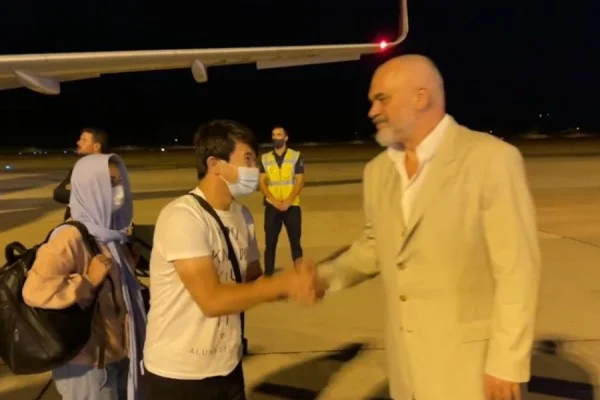
I'm looking at some pictures here, Prime Minister, which I want to describe to radio listeners. There are people who arrive from Afghanistan, coming down the steps of the plane of “QA Airlines”, and the American ambassador awaits them on the runway. Then a picnic is being arranged. You're playing basketball with some of the coming kids. It's extremely exciting, but how long do you think people who were evacuated will be here? Will they stay in Albania? Do you expect them to integrate into Albanian society or is this a stop before moving elsewhere?
Rama: First of all, several organizations, foundations, a body of civil society organisations across the ocean, in the US, including the “Yada Hakim” foundation on the other side, and we immediately said “po”. Furthermore, of course, the U.S. government asked for it and immediately said “po”. The reason for all this is that these people are able to qualify to obtain visas and go to the United States, what makes their attitude theoretically temporary, but, first of all, I think it will take time for this, as with so many people being taken out of American aircraft and having to go through the screening process in different parts of Europe and elsewhere, this will take time. Second, whatever you need, anything you need, we'll be there. We can't, we can't forget our history. We cannot fail to respect our code of honor, which we have for a long time, and which made Albania the only country in Europe that had more Jews after World War II than before, precisely because no Jew surrendered and had Albanians who paid life to save. I also firmly believe that we owe our children. Our children must inherit all of this, and we must honor this heritage, and they must likewise honor it when the time comes.
BBC: You mentioned the “Yalda Hakim” foundation. My radio listeners probably know Yilda is one of our foreign correspondents, who runs the “show. Impact with Yilda Hakim” on BBC World News. She herself is Afghan and has made a lot of philanthropy in her own country, but I am curious about what happens now to the prime minister. We're hearing from Secretary of State Antony Blinken that a new chapter of engagement in Afghanistan opens here and that it's closed the chapter for the war part in Afghanistan. The Taliban have taken control. Do you believe the promises the Taliban are making that they will respect the rights of girls and women, as they say, within the limits of Islamic law.
Rama: For the good of people who didn't have the chance to leave and who experienced for 20 years something different from what the Taliban offer, I would very much like it to be true, but because I've lived in a very brutal and very similar regime, though not Islamic but completely atheistic, who banned God in our lives, who blew up more than 2,000 churches, Roman shrines, monasteries, mosques, I can't lie myself and believe. It doesn't match, it doesn't match the world we believe in, the world we live in, and the world we represent, and certainly the world that Afghans dreamed of, followed and worked for us. I wish this were true, yes, unfortunately, I can't, I just can't believe it.
So you have scepticism, as we've heard a lot of it in this studio and at the Center for Afghans and Central Asia in West London. People who come here in desperate effort to get information, to find out what the possibilities are for them. Most of them hope that their relatives will come from Afghanistan and will be able to return here. Most think it will happen within the next few weeks and months, but what we hear in the meantime seems to take longer than that. Do you believe that those who want to leave will be able to leave the coming weeks, even though the Taliban control the airport? I got less than a minute.
Rama: Everything remains to be seen, but history can again come to our aid. There's no need for a crystal globe. Enough to look back from the history of the brutal totalitarian and entirely ideological regimes to realize that for them, anyone who is different from them is a traitor to be killed, imprisoned, tortured, and persecuted all life. Now, will they choose?











