9 minutes ago
North situation: Russia closely follows Jarinje
Periskopi(5 years ago)
(5 years ago)The presence of Russian officials at Serbian Army objects, located on the border between Serbia and Kosovo, is a confusing message from Belgrade, which can be condemned by Western countries, Serbian foreign policy analyst Bosko Jaksic tells Radio Free Europe. Since March 20th, Serbs in northern Kosovo have been blocking [...]
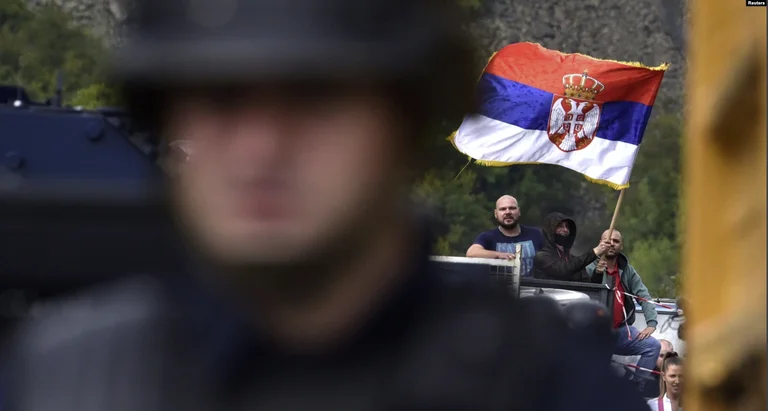
Since March 20th, Serbs in northern Kosovo have been blocking the two border crossings located in this area of Jarinje and Brnjak since the Kosovo Government's decision on reciprocity measures against Serbia's license plates.
With that decision, all vehicles from Serbia entering Kosovo must be equipped with temporary license plates. To monitor the process, Kosovo Police Special Unit has been deployed at the borders in the north.
Similar measures against Kosovo license plates, Serbia now implements many years.
On 26 September, Serbia's Defence Minister Nebojsa Stefanovic and Serbian Army Chief of General Staff Milan Mojsilovoq have visited several Serbian soldiers, who have been deployed to combat readiness at Rudnica military base. This base is located near the town of Raska in Serbia, en route to the Jarinje border.
With them was Russian Federation Ambassador to Belgrade Alexandr Botsan-Kharchenko, as well as Russian Defence Envoy Aleksandr Zinchenko.
It is said that they have gone there to personally obey “for the current situation”.
Jaksic estimates this is a diplomatic point for Moscow, but Belgrade's failure.
“Moscow continues to successfully use the Kosovo conflict as the most important channel for expanding its influence. On the other hand, Belgrade has taken the ambassador to the District without thinking and there is no doubt that the West will interpret this as provocation”, Jaxpic says.
The Serbian Defence Ministry website reports that Stefanovic has thanked guests from Russia “who have reported on the situation on the administrative line and on northern Kosovo and Metohija”.
The Russian ambassador has reportedly confirmed Russia's support for Belgrade's position and has voiced the concern of official Moscow.
This is aimed at ethnic cleansing of Kosovo”, Kharchenko has said.
The Russian ambassador has taken advantage of the visit to comment on the position of Western countries, which he has named as strange “ ” and <x2 mutative”. He has said those “close their eyes in a very dangerous situation”, though, according to him, the “all understand who is guilty and what is the reason for such provocation”.
Since the beginning of the crisis, the European Union, the United States and NATO have demanded that Kosovo and Serbia reduce tensions and open issues resolve with dialogue.
Serbian analyst Dragomir Anzhalkovic tells Radio Free Europe that the Russian Federation thus provides support to Serbia and conveys the message that it will stand behind the measures Belgrade will take.
“This message has been sent mainly to Belgrade, while all others, on the basis of that, can find Belgrade has more room for maneuvering, if necessary to protect Serbs in Kosovo”, says Angjelkoviq.
According to him, the presence of Russian officials in Serbia's military facilities contributes to calming tensions because “European Union, which is guarantor of Brussels Agreement [for free movement], there is nothing he has done to implement that” agreement.
Jaksic, on the other hand, says Belgrade's conflicting messages create a state of general confusion.
According to him, Serbia's president, Aleksandar Vuciq, reiterates that membership in the European Union is a geostrategic commitment of Serbia, but, at the same time, it “consistently makes moves that question this”.
This is always done because of concessions to Russia, says Jaksic.
“In this context, Ambassador Kharchenko's going south of Serbia is another confirmation of the Vuciqi Government's timid attitude towards the Kremlin”, Jaksic adds.
Serbia's Defence Minister Nebojsa Stefanovic has met with Russia's ambassador to Belgrade even 22 September.
According to a communique on the Serbian Defence Ministry website Stefanovic, that world, has expressed the strong and sustainable support the Russian Federation gives Serbia in maintaining its territorial integrity and sovereignty, especially in these difficult times that the Serb population in Kosovo and Metohija<1> is experiencing.
According to Stefanovic, the current situation -- “, which Pristina violates the freedoms of the movement, imposing new unilateral measures -- represents the continuation of the disrespect of the Brussels Agreement”.
Stefanovic has also invited Russia to attend the upcoming military-technical fair “Partner 2021”, which will be held in Belgrade in October.
Serbia and Russia have traditionally maintained close relations.
The two countries do not recognise Kosovo's independence, which was declared in 2008.
Russia votes against Kosovo's accession to the United Nations Organisation, while Serbia, in exchange, refuses to impose sanctions on Moscow.
Just because of co-operation with Russia, Serbia is the target of Western criticism because, as a candidate country for EU membership, it has not yet harmonised its foreign policy with European ones.
Serbia's military co-operation with Russia also worries the West.
In June, European Parliament rapporteur for Serbia Vladimir Bilchik has estimated that Serbia's joint military exercise with Belarus and Russia does not help Serbia's progress towards European integration.
Serbia has participated in the trilateral exercise “Slavic Brotherhood 2021”, with Russia and Belarus, which has been held from June 8th to June 19th on Krasnodar territory, southwest of the European part of Russia.
Pro-Russian accounts activities in Serbia
“Moscow is concerned about Kosovo”. This is just one of many titles distributed on Facebook by pro-Russian accounts in Serbia, since the crisis has begun at the border between Kosovo and Serbia.
It's about groups and they have pro-Russian elements in their names. The key words that connect them are: Putin, Serbia, Russia, Kremlin.
But they have another common feature: Each post is published at the same time.
A search for the Balkan Radio Service Free Europe has found six accounts of Facebook groups campaigning to be synchronized.
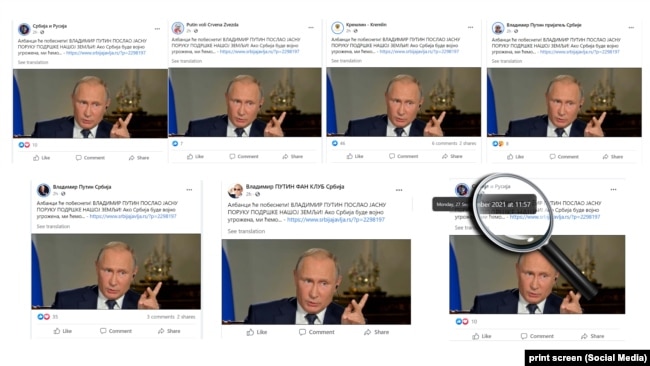
The posts speak positively about Serbia's activities at the Kosovo border and the involvement of Russian officials in the crisis.
This is not the first time these groups are activated.
They are involved in nationalist rhetoric even earlier this month, following tensions that have caused in Montenegro Disturbing Serbian Orthodox Church head Ionicije.