 6 hours ago
Kosovo nurse knocks: You can't take care of all the patients with Ovid 19
Periskopi(5 years ago)
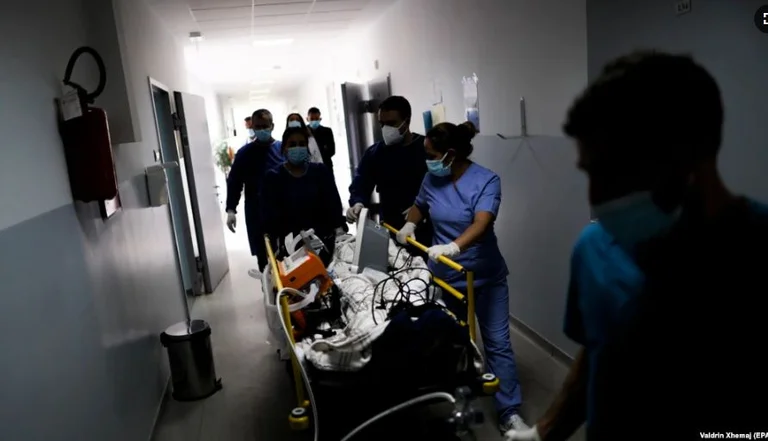
(5 years ago)One year he works in 12-hour shifts, takes care of nearly 20 patients with COVID-19, and admits he is unable to treat everyone properly. Lack of health staff is continuing to present problems at the University Clinical Centre in Kosovo in Pristina, where infected patients are dealing with [...]
The lack of health staff is continuing to present problems at the University Clinical Centre in Kosovo in Pristina, where patients infected with coronarys are being treated.
On September 6, a nurse whose identity is known for editing confessed to her work on the pit of pandemic.
Very large layout. Being a sister who cares for 20 patients is too much. Giving therapy, conveying oxygen, the temperature of many other jobs, and demands that you need to cope with”, it tells Radio Free Europe.
According to her, the challenges are numerous and in absence of staff, this nurse shows that there are times when she cannot give equal service to all patients, and occasionally they may even suffer.
For example, a patient's condition is exacerbated, and the doctor says quickly toėte is sent blood for tests on Emergency. You have to leave all of their patients and therapies in half and you can't refuse such an order”, the nurse shows.
Also, in a QKUK clinic, where some 60 patients are treated with COVIID-19 are just three small oxygen canisters for patients and they have to move these canisters when they go, for example, to the toilet or to conduct different photos outside the clinic.
You need to transmit that oxygen bomb and the patient's cart. And in the meantime you're with other patients... but you have to follow the bomb, the cart has no chance of doing it all because you're on your own. We only have three canisters, which you have to go fill, and all of this has work. It happens that we can't all serve”, she explains.
The deaths of patients and confrontations with their family are not rare events in this nurse's department.
“Crahas other jobs, the exchanger should handle the corpse himself, if it has been positive (with koronavirus) there are special procedures where it should be placed in the given bag, fill out the forms with patient data and other things”, she says.
I've had cases when, as family members show, there's never been any health problems, but within a week, they've changed their lives because of oxygen problems. Such occasions have a big impact on us. I don't have the case, it just came down to the oxygen level, pulse, and then he died. In it (within the ward) we feel intense pain because there are many touching moments”, the nurse adds.
In the public sector, the doctor's monthly salary is about 600 euros a month, while nurses are paid for their work at about 400 euros.
The Ministry of Health in Kosovo on September 6th has announced for Radio Free Europe that additional health staff engagements will be undertaken with the management of pandemic and the communication process.
“In the last week 200 nurses are engaged in the University Clinical Hospital Service of Kosovo, another 100 are signing contracts today (September 6th), until another 5,000 nurses are expected by September 6th to be ready for start-up work also”, a response to the Health Ministry's Information Office said.
On 18 August, the Government of Kosovo approved the decision to raise health staff.
During the past week, directors of general hospitals in several Kosovo municipalities, where infected patients with coronarys are being treated, had claimed to lack health staff.
Kosovo's Health Ministry has announced for Radio Free Europe that by September 6th, 17 per cent of the general population has been fully vaccinated against COVIED-19, the disease caused by the coronary.
The first dose has already taken 35 percent of the population.
In the last seven days, 181 cases of death and 8,901 new coronary cases have been recorded in Kosovo.











