6 hours ago
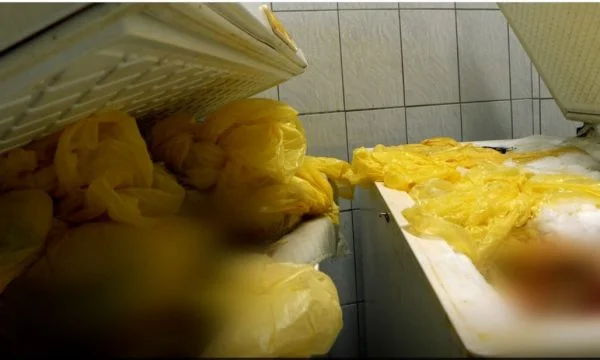
Gynecology clinic is threatened by refrigerators filled with placenta
Periskopi(5 years ago)
(5 years ago)Yellow bags full of placenta have filled five refrigerators at the Gynecology Clinic in Pristina. Because of the overload, the doors of the five refrigerators cannot be closed, and the melting has now begun. Placents are pathological waste from births and abortions. Three of these refrigerators are located near the eastern hall in [...]
Placents are pathological waste from births and abortions.
Three of these refrigerators are located near the delivery hall on the third floor of the clinic, and two others are in the first - floor warehouse.
Health risks especially present three refrigerators on the third floor. The birth hall is where about 700 children per month come to life.
The average weight of a placete is about two ounces [500 g].
We have 500 pounds of placentar tissue in a month, so they have to leave. We have nowhere to leave them. The fridge is not the solution. They must be eliminated, destroyed just as it befits a body tissue”, Free Europe Radio, Jakup Ismaili, director of the Gynecology Clinic, said.
There are some stuffed refrigerators, they don't get up, they smell, it's blood, it's heavy wind... The distance from the delivery room is 10 to 15 meters, so I appeal that as soon as competent ones organise the removal of these remains”, Ismaili added.
According to the University Clinical Centre of Kosovo (QKUK), their departure makes it a private company that should be contracted by this institution. However, QKUK said that to contract a company for such a service, the Pristina municipality must first assign a location where these remains should be buried.
Ismaili said this problem exists for two years and that the Pristina municipality has been asked several times for the division of a location.
If you continue to neglect competent organs, we should close the clinic or bankrupt. I don't know what we're going to do”, Gynecology Clinic Director Jakup Ismaili said.
Under the Law on Waste and Administration Management for Medical-Patological Waste Management, pathological waste is collected, stored and treated by burying/remanding in the designated location. During this procedure, material for disinfecting should be added.
According to the same direction, pathological waste in packing should be stored in hospital facilities with airtight closures at no more than 8 degrees, and should not last more than five days. Deep freezing can last a year to their treatment, while the conservation site should be maintained and disinfected.
Based on these legal and administrative provisions, Hospital Service Director and University Clinic (SHSKUK) Valbon Krasniqi, in December 2020, asked the Pristina municipality to grant a property for the burial of pathological waste under the Law for the provision and exchange of municipality property for special cases.
In an electronic address on June 15, 2021, which REL has seen, Pristina municipality officials have mentioned that space in the village of Vranidol, 15km from Pristina, would be destined for that purpose. It adds that the mayor of the municipality with his decision will allow the use of space in Vranidol to bury pathological remains. At QKUK, they said such a decision has not yet been taken, while the Pristina municipality has not answered Radio Free Europe questions.
And Ilmije Havolli-Lushaku, the leading nurse in the birth hall in gynecology, said that melting waste in refrigerators poses a major problem for staff, patients and newborn children.
These past few months, we have enormous problems with which we are directly endangered by personnel, patients, newborns and maintenance workers. I think it's the last time something has to be done, until it's done or not another infection has spread. We know how we have the situation in health, now that we're in the pandemic”, she said.
We'll have a problem with carrying if it's time to carry. How are we gonna get them out of here because they're melted? I risk all the space I go through while carrying them (placents)”, Havolli-Lushaku added.
The concern is that various infections can spread beyond the clinic's chambers during delivery.
Over the past few years, removal of placenettes and other remains from QKUK has been made by the public company “Horticulture”. This company cares for the establishment, regulation and maintenance of green public areas on the territory of the city of Pristina.
Meanwhile, the QKUK said it has carried out all procurement procedures for contracting services to bury pathological waste, but signing the contract with that company is pending appointment of a location.
“We are subjected to the cancellation of this procurement activity, and with this we will be faced with unaffordable difficulties, for the fact that these infectious wastes cannot be addressed, and as a result of this would come to the presentation of dangerously endangered infections at a large scale of”, it is said among other things in the last request addressed to the Pristina Committee on September 14, 2021 by Hawu Rexhepi, U.d. Director of USKKUK Technical Services. This request has been sent to the municipality through USKKUK General Director Valbon Krasniqi.
With similar problems in burying the pathological remains, in addition to the Gynecology Clinic, the Institute of Pathology, where tissue remains include amputated parts of the human body and other organs removed from surgery.
Within a year, according to the CKUK, about 30 tonnes of placenta and tissue waste are collected in these two institutions. / REL