 an hour ago
Dozens Injured in Montenegro Protests Report
Periskopi(5 years ago)
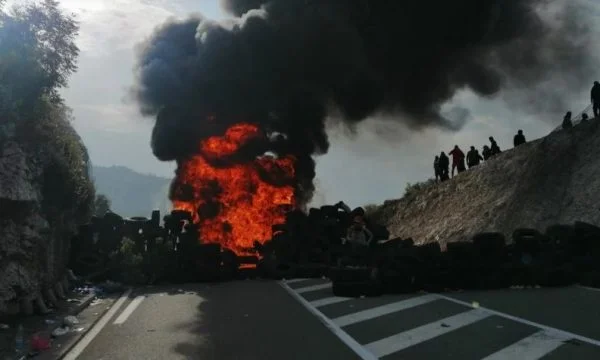
(5 years ago)Opposers of the protest ceremony of the head of the Serbian Orthodox Church in Montenegro set up barricades on the street. Tens of people have been injured in protests held in Montenegro on 5 September against the protest ceremony of the head of the Orthodox Church in Montenegro, Ionanikije in the town of Cetinje. Police [...]
Tens of people have been injured in protests held in Montenegro on 5 September against the protest ceremony of the head of the Orthodox Church in Montenegro, Ionanikije in the town of Cetinje.
Police used tear gas to disperse hundreds of protesters, some of whom threw stones, bottles and fireworks towards the police. Some people burned tires and sat on the street.
Montenegrin Deputy Police Director Dragan Gorovic told state television that 20 police members were injured, while a state clinic in Cetinje said about 30 civilians sought medical assistance.
Montenegrin Prime Minister Zdravko Krivokafic named the attacks on police as terrorism. He blamed President Milo Djukanovic's Democratic Party of Socialists for organising the protests.
Krivokapiq comes from the pro-Serbian Democratic Front, which leads with the Montenegrin government after last year brought down the Democratic Party of Socialists after 30 years in power.
Djukanovic, who rejected the ceremony, accused police of excessive force.
According to him, the great “of the Serbian Orthodox Church (KOS) and the Government of Montenegro” was witnessed in Cetinje, the REL reports.
The embassies of Germany, Italy, France, Britain, the United States and the European Union condemned violence.
Montenegro declared independence in 2006, but its church remained under the Serbian church.
In Montenegro there are deep divisions as far as their country's ties with Serbia and the Serbian Orthodox Church are concerned. About 30 percent of the country's 600,000 population are identified as Serbs and support the Serbian Orthodox Church.
Other Montenegrins want an Orthodox church separated from the Serbian Church.
Objectors of the ceremony held in Cetinje view it as a symbol of Montenegro's “invasion”.
They demanded that it be kept in any Montenegrin city except Cetinje. This town from Montenegrins is considered a cultural and historical centre.











