 7 hours ago
Vuciq: Serbian companies get big benefits from “Open Balkans”
Periskopi(5 years ago)
(5 years ago)According to Serbia's president, Aleksandar Vuciq, the Open Balkans “” is the idea of peace, security and stability, which was not imposed. Vuciq told RTS that this is a historic decision, and if countries participating in it will be able to implement it remains to be seen. “I hope we will have [...]
According to Serbia's president, Aleksandar Vuciq, the Open Balkans “” is the idea of peace, security and stability, which was not imposed.
Vuciq told RTS that this is a historic decision, and if countries participating in it will be able to implement it remains to be seen.
“I hope we succeed in this. I hope we have so much passion and confidence in action. There's a lot to do in a year and a half. You have to go not only to harmonize the VAT system, you have to trade. There are a million things to do and our administrations must do this, to allow people not to see borders when they travel to northern Macedonia or to Albania”, he said.
Vuciq stressed that Serbian companies have great benefits from this. He declared, as an example, the fact that there are 5,300 companies from Serbia working only in northern Macedonia, the newspaper Express broadcasts.
Vuciq said that the doors of the Open “Balkan” are open for all, but added that “we are not following anyone”.
Kosovo Prime Minister Albin Kurti has said yesterday that the mini-Schengen initiative that took a new name Thursday, calling itself the “Open Balkans” is the tendency of Serbia's President Aleksandar Vuciq to open the Balkans to Russia and China.
As the prime minister's office announced, the chief executive said that since Serbia's president, Aleksandar Vuciq, he refuses to face his country's past and his own, it seems his tendency for the Balkans to be open to powers from the East, especially for the Russian Federation, but also for China, as well as the “open to autocracy, oligarchy and war criminals, in opposition to the European values of democracy and the rule of law 111x1.
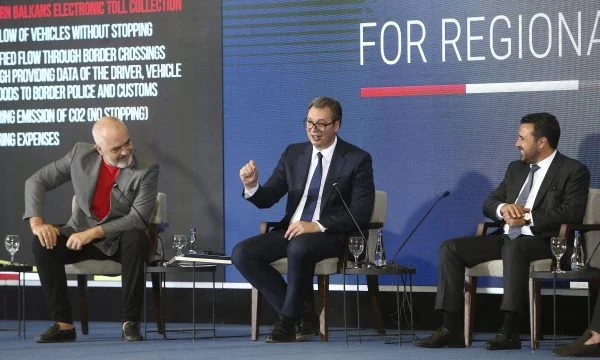
Albania's Prime Minister Edi Rama has said Thursday at the Regional Co-operation Economic Forum held in Skopje that he does not understand why other Western Balkan countries have not joined him, Northern Macedonia Prime Minister Zoran Zaev and Serbia's president, Aleksandar Vuciq, in the initiative of regional economic co-operation, known as the “mini-Schengen<18x>.
But Rama said he knows why Kosovo is not participating in the initiative that has now changed its name.
The “E know what Kosovo thinks about, and at this point I am absolutely with an opposite attitude, because for me all these countries must be part of this process and do their best for themselves, for their people, for their societies, and for all of them together”, Rama has said.
He said that the past should be left behind and that it should not denerate the future.
For Kosovo Prime Minister Albin Kurti's decision not to join this initiative, the president of Serbia, Aleksandar Vuciq, also spoke indirectly that day, saying some think only about the upcoming elections.
We'll always have options to this initiative. There will always be someone who wants to look for conspiracy theories, who don't think about the economy, which they don't think in the long run, and those who only think about the upcoming elections that come from”, Vuciq said.
Before him, Northern Macedonia Prime Minister Zoran Zaef invited Kurti and other Western Balkan leaders to join the initiative.
“Nism is open to all Western Balkan countries, so we invite and encourage our colleagues to unite because of our peoples. We are all Western and European Balkans. To create a vision of real development to benefit all our citizens”, Zaev has indicated.
Kosovo's prime minister had declared last year that “mini- Schengeni” could be Serbia's vision of a new Yugoslavia.
“I have to be honest that the Balkan mini-Schengeni is not reality, more is the idea than the project. To co-operate the six countries in the region, we have the Berlin Process framework. In that sense there is nothing new. The Balkan Mini-Schengeni has its own risks, I have said it represents the fourth Yugoslavia, which Serbia loves, that is Belgrade's initiative”, Kurti expressed.
But Kosovo had pledged to Washington's agreement to join the <x0mini-Schengen” initiative, but Kurti has since begun positioned himself as a sharp critic of this project. Kosovo President Vjosa Osmani is on the same line.
At the recent summit of Western Balkan leaders in Tirana, Kurti even declared that “mini-Schengeni” no longer exists.
“There is no more mini-Schengen, there is a joint regional market, and the Berlin Process, which will have the next meeting in the first half of July”, Kurti said.











