 5 hours ago
Is it Skenderbe's flag or dating earlier: Read 6 Facts About Albania's Flag
Periskopi(5 years ago)
(5 years ago)Albania's flag is the Albanian national flag, a red-field flag and a two-headed black eagle in the middle, writes Metro newspaper. The eagle has been a very important symbol since the beginning of Illyrian culture in the Balkans. Below, read six facts about the national flag: 1. The two - helmet eagle is an old symbol used that [...]
Albania's flag is the Albanian national flag, a red-field flag and a two-headed black eagle in the middle, writes Metro newspaper.
The eagle has been a very important symbol since the beginning of Illyrian culture in the Balkans. Below, read six facts about the national flag:
1. The two - head eagle is an ancient symbol used from ancient times in the Byzantine Empire and then became a symbol of Albanian nobles throughout the Middle Ages.
2. The Albanian national flag was formalised as Albania's state flag with its Ottoman Empire's Declaration of Independence in 1912.
3. The red field has the meaning of the blood that our ancestors shed, or it is also associated with bravery and power. The two-headed eagle represents Albania's sovereign state.
4. The view of the Albanian flag is legally assigned.
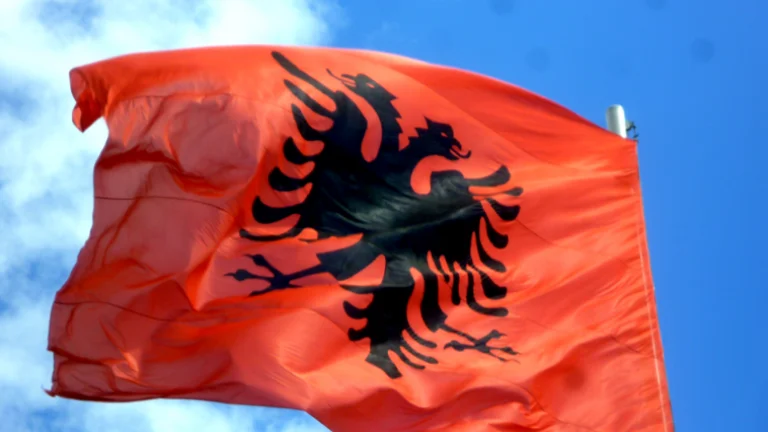
5. The state flag represents a red field with a two-headed black eagle in the middle, with outstretched wings. Each of the eagle's wings has nine feathers, and the tail has seven feathers. Sizes are determined in the ratio of 1 with 1.4 units (or, by 5 to 7 units).
6. The flag set up on November 28th 1912 in Vlora, which crowned Albania's Declaration of Independence, was the Kastriot flag, preserved by them during generations and brought to Albania by Eqrem Be Vlora, Ismail Kemal's cousin.
Skenderbeu
To date, most Albanians think their flag is the flag of Skenderbeu, unaware of its origin. Even today, we do not know exactly when Skenderbeu used the two - head eagle as a symbol of his state. The fact is known that he borrowed this symbol from the Muzakaj, replacing the coat that John had inherited from his father. The latter used the image of a tall - haired prince and platoon as a coat of mail. In Albania, as a symbol of power, the eagle has used medieval Albanian ruler families such as the Kastriots, the Aryans, Muzakaj, Topiaj, Zeta's Hunters, Lek Dukagjini, etc. Using the eagle as a symbol of their power, it proves that these families were high officials during the Byzantine Empire.
For the first time in history, Gjergj Kastriot's two - head eagle emblem appears in 1451. It is presented in a book of bridges that was donated to Skenderbeu by Alfonse V, the King of Naples on the occasion of signing Gaeta 26 March 1451.[4] He was handed over to Skenderbe's ambassadors who signed this treaty, Bishop Stefan of Kruja and Father Nikola Berguc from the Protonoter of Alfonso Arrnaldo Fonoleda.











