3 hours ago
Major tensions in Montenegro, US calls for calm
Periskopi(5 years ago)
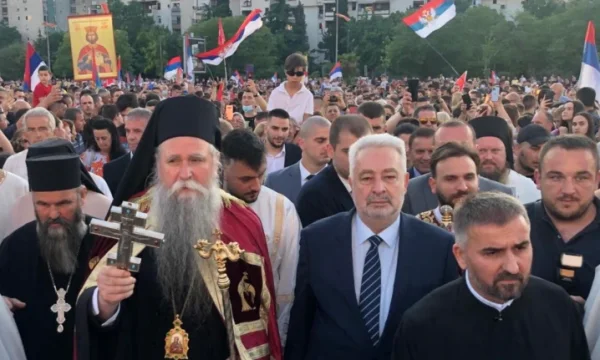
(5 years ago)The United States has expressed concern about “escalation of rhetoric” in Montenegro on the eve of the ceremony to take office of the Serbian Orthodox Church's Mitropolite in Montenegro, Ionikije. The US called on all sides to work to calm tensions. “We encourage the Montenegrin authorities and the Orthodox Church Mitrovica [...]
The US called on all sides to work to calm tensions.
“We encourage the Montenegrin authorities and the Mitrovica of the Serbian Orthodox Church to co-operate closely and, above all, ensure the safety of citizens”, a State Department spokesman for Voice of America has said.
The Serbian Orthodox Church has announced that taking office on the part of Ionikiye will take place on 5 September in Cetinje. The patriarch of the Serbian Orthodox Church, Porfirije, and other high priests, are expected to attend.
But this ceremony is rejected by the Cetinje Community, several Montenegrin organisations and the Democratic Party of Socialists led by Montenegrin President Milo Djukanovic.
A protest was held on August 22nd, where it was asked that the Ionanikije Concert ceremony in Cetinje be regarded as a cross-invasive <x0ukt”.
The State Department also estimates that Montenegro is long-known “as a tolerant country” and that all “citizens must perform their part of obligations to respect this proud tradition”.
“We call on all, citizens, political and religious leaders, to work at calming tensions”, a State Department spokesman said.
The United States supports religious freedom, including the right of individuals to practice their religion freely. At the same time, it also supports freedom of expression, including the right to peaceful rally”, he added.
The Cetinje Municipal Assembly will hold an extraordinary session on August 27th to discuss an appeal to the Serbian Orthodox Church to give up the ceremony and keep it elsewhere.
The town of Cetinje has once been the head centre of Montenegro, while today it is considered the cultural and historical capital of this country.
Vadicmir Veljkovic, a historian from Serbia who handles religious studies, told Radio Europe free of charge that claims by the Serbian Orthodox Church (KOS) and the Montenegrin Orthodox Church cross into Cetinje.
The “primarily Cetinje is Montenegro's old capital and, on the other hand, is also the seat of Montenegrin bishops, or Montenegro's Mitrovica, and now we certainly have two different concepts regarding the symbol of Cetinje”, says Veljkovic.
Cetinje is also considered the seat of the Montenegrin Orthodox Church, which is not recognised by any canonical church but has the backing of Ukraine's Kiev Patriarchate.
The conflict between the Serbian and Montenegrin Orthodox Church is beautiful.
The Serbian Orthodox Church has the backing of a part of the political elite in Montenegro and claims ownership of many churches and monasteries, which it considers its own.
The property issue had caused tensions during 2019 and 2020 in Montenegro.
The Law on Religious Freedoms was passed in 2019, at the time of Djukanovic's ruling party, and called on religious communities to prove they own property before 1918.
The new government that emerged after the August 2020 elections changed the law in order to ensure that property remains in the hands of the Church, which the headquarters has in the neighbouring state of Serbia.
Serbia and Montenegro have been part of a federation until 2006, when Montenegro declared independence.
Montenegro is part of NATO and aspires to become a member of the European Union.