 4 hours ago
Kosovo this year with less grain, expectations were bigger
Periskopi(5 years ago)
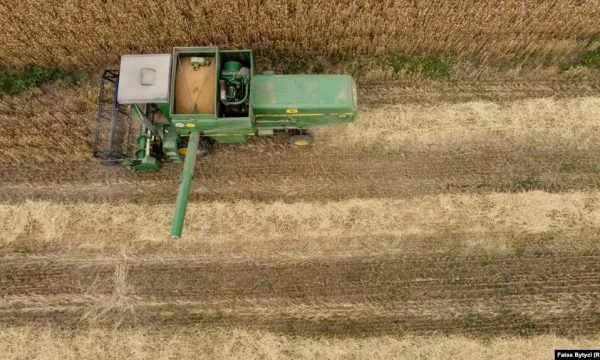
(5 years ago)Farmer Valon Vehapi, from the Lipjan municipality this year, during the harvesting campaign, has managed to secure only 3,000kg of wheat in a hectare, or half less than last year. The egg shows that it has cultivated over 60 acres [100 ha] of wheat culture. The climate conditions according to it have [...] this year
Farmer Valon Vehapi, from the Lipjan municipality this year, during the harvesting campaign, has managed to secure only 3,000kg of wheat in a hectare, or half less than last year. The egg shows that it has cultivated over 60 acres [100 ha] of wheat culture. The climate conditions according to it have been the reason for this year's decline in productivity.
From a surface hectare this year, we have accumulated between 2,800 and 3,300 pounds [2,300 kg] of grain, while last year it has been between 5,500 and 7,000 pounds [7,000 kg] per hectares”, says Vehapi.
According to reports by the Ministry of Agriculture, this year some 68,000 acres [68,000 ha] of land is cultivated in wheat culture. Isuf Cikaqi, director of the Department for Agricultural Policy at the Ministry of Agriculture, Forestry and Rural Development for Radio Free Europe, says that based on preliminary data, the amount of grain production is about 4,000 kilos per hectares, although according to him, expectations have been greater. He says that with this amount, Kosovo this year will meet about 65 per cent of the population's food needs.
“According to domestic needs, if 100,000 hectares of wheat land were planted, and if productivity were 44,000 kg, then Kosovo would produce 400,000 tonnes of wheat, while there are also requirements and the needs for” would be met, Cikaqi says.
According to official data, in Kosovo the need for this per capita product is 205kg, which is that 410,000 tonnes of wheat must be spent in Kosovo.
Last year, the quantity of wheat production has presented the record, as up to 4,700 pounds [4,700 kg] have been provided for acres on some 63,000 hectares of plant land.
That wheat productivity this year is not at the satisfactory level, says Tahir Tahiri, chairman of the Kosovo Association of Agriculture. He says if the farmer fails to obtain up to 500 pounds [4,500 kg] of wheat per hectares, then farmers have no account for the activity.
The perforation of the wheat surface is below 3,000 pounds [3,000 kg]. Those farmers who fail to obtain up to 4,500 pounds per acre, at the price of a kilo of wheat that picks up a mile [0.18 cents] respectively, fail to cover the cost of production. So farmers, for a year or two, cannot cope with this situation and give up the wheat productivity”, Tahiri points out.
Buyers and grain vendors dissatisfied with prices
Farmer Valon Vehapi shows that the price for a kilogram of wheat produced in Kosovo is 0.15 cents, while the sale becomes 0.18 cents. The award, according to him, is the same as wheat imported from countries in the region.
We make wheat and sell it in mills. As a producer, the price is 0.15 cents, and we sell it 0.18 cents. State policy is a disaster. The state does not advocate local production because in the period of the harvesting campaign, until the amount of local wheat is spent, institutions impose different wheat taxes imported from other states”, Vehapi says.
Bashkim Zejnullahu, chairman of the Kosovo Olive Association, in a proposal for Radio Free Europe, confirms that the collection of wheat from millers has begun at a price of up to 0.19 cents, depending on quality and quantity. However, Zejnullah points out that grain is also supplied by countries in the region because of a profitable price.
The most violated are the farmers, because we, as commercial companies, decide to buy where we have the biggest account. The farmer has little choice. The government needs to help farmers because the association can't be”, Zejrullah points out.
The low price of wheat and the failure to take measures by the Government of Kosovo to protect farmers is the main reason that Vehapi has influenced the area of wheat planted land.
“If the state takes measures and is serious on this issue, I planted 500 hectares of land with wheat”, he said.
At the Ministry of Trade and Industry (MTI), they say there have recently been requests from the Kosovo Millian Association for doubts about the branding prices of flour from several countries in the region, requests which are being analysed by the Department of Commerce, but there has been no requirement for protection of wheat on allegations of the price of wheat import.
Kosovo has never managed to meet its population's needs with flour from wheat productivity. It is constantly dependent on import, largely coming from countries in the region and the states of the European Union.
In 2019, Kosovo imported 146 million pounds [46 million kg] of flour and wheat, while last year, 159 million pounds [159 million kg] or 133 million pounds [13 million kg] more than the preceding year.
The wheat is the first substance for flour production. Taking into account that in Kosovo, the needs of the population with the production of local wheat are not met, in response to the MTI, the import of wheat remains very important for providing enough grain to meet the needs of the wheat processing industry and other industries that use wheat/meel to produce local products such as bread, pasta, and many other products.











