 4 hours ago
Hope, Skeptism for Kosovo War Crimes Lack Trial
Periskopi(5 years ago)
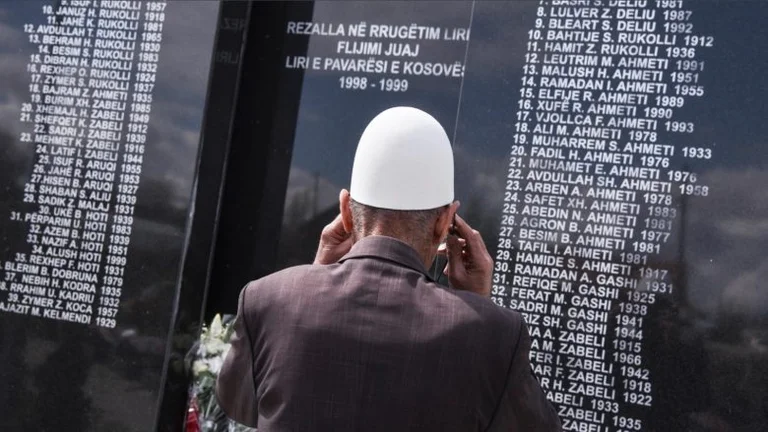
(5 years ago)Fadil Muqolli of the Polek of Drenas has been awaiting justice for the murder of his four children. Mounds in the 1999 war were also killed by parents and his wife. He has said that his expectation that justice for these murders would be put in place [...]
Fadil Muqolli of the Polek of Drenas has been awaiting justice for the murder of his four children.
Mounds in the 1999 war were also killed by parents and his wife.
He said that his expectation that justice for these murders would be brought to nothing until now.
“E knows there was an indictment in Belgrade in 2015. None of the institutions, not of EULEX, not of UNMIK, nor of these ours have done anything -- ”, said Muqolli.
During the last war in Kosovo, 13. 518 people, and 1,630 are still missing.
War crimes judgments have been taken over by UNMIK courts, EULEX, The Hague Tribunal and Kosovo courts.
For 22 years since the end of the war, some 70 people have been sentenced to firm war crimes acts.
On the other hand, a change of the Penal Procedure Code was adopted in the Government of Kosovo on Wednesday, which is expected to regulate the issue of judgment in the absence of indictees.
Government members have called this change a step away from leaving war crimes, namely, unpunished. However, field experts and activists are not seeing this legislative initiative as applicable.
This bill, following the adoption of government, must be sent to the Kosovo Assembly for approval.
Deputy Justice Minister Blerim Sallu, at the government's meeting, said that through this proposal, perpetrators of criminal acts, with particular emphasis on war crimes, would receive deserved sentences.
“wherever faced by law enforcement bodies, they will serve the sentence for war crimes committed in Kosovo”, he said.
Meanwhile, Kosovo Prime Minister Albin Kurti also stressed that the “Criminal Procedure Project Cod will enable no one to evade justice and criminal cases to have epilog”, he said.
IKD: Implementation of Trial in Lack Will Be Challenging
The case of the trial in the absence of indictees for various crimes, including war crimes, had undergone changes in several phases of meeting the Penal Procedure Code.
Gezim Shala, a researcher at the Kosovar Institute for Justice, said that judgment in absentia has some priorities in relation to war crimes, but implementation will be challenging.
“These challenges, especially when lack of international judicial co-operation between Kosovo and Serbia has been taking into account, have been impacted so far in the courts of the Republic of Kosovo still not to have any trial in absence of”, he said.
The lack of prosecutors has been one of the main challenges related to Kosovo war crimes investigation.
Until recently, only two prosecutors have been committed to these subjects.
Genc Nimoni, senior adviser to Justice Minister Albulen Haxhiu, had confirmed that four Kosovo Special Prosecutors, six professional collaborators and two translators, who will deal exclusively with war crimes.
“
In addition to implementing judgments in absentia is expected to be challenging, the Fund for Humanitarian Law (FDH) in Pristina has indicated against this kind of judgment.
Bekim Blakaj, from the FDH, said these judgments could cause additional costs in the judicial system.
I don't think that they will be applicable because, however, even if someone is tried in absentia, the moment they are caught to keep the sentence, it automatically has the right to seek retrial, and this shows that there may be extra costs for war crimes”, he said.
Blakaj stressed that he is not sure even if the <x0 war crimes victims and their families will be satisfied with the trials in absentia”.
The “may initially have enthusiasm, but later they will certainly not be pleased with the victims because what effect is there if someone who is tried for war crimes in absence will never hold the sentence”, Blakaj said.
Former permanent legal adviser to the American Justice Department, Lana Morton-Owens, in an interview for Radio Free Europe earlier declared that Kosovo has inherited about 1,000 war crimes cases from UNMIK and EULEX, about 15 years old.
But she has also stressed that lack of staff has affected slow justice.
A special war crimes department has been established under the Special Prosecutor of Kosovo in May 2015. /rel/











