5 hours ago
12 hours of daily work to save people's lives: Job burdened in Kosovo hospitals
Periskopi(5 years ago)
(5 years ago)The cameras that monitor the state of patients, in intensive care of the Infectious Clinic in Pristina, spoil the calm that reigns in the room where life is fought. “The only good time of work is when a patient manages to get it out of intensive care, and let's switch it into a regular building”, free Europe Radio, [...]
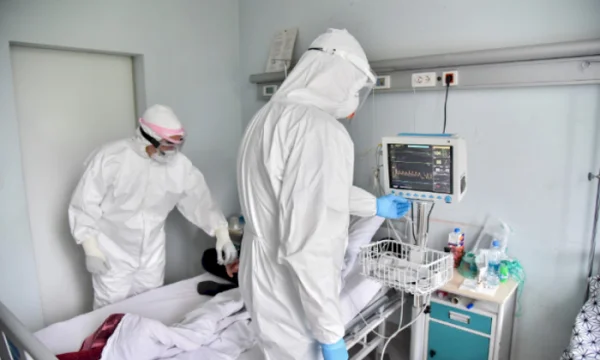
“The only good moment of the job is when a patient manages to take it out of intensive care, and move it into a regular ward”, says of Radio Free Europe, Faton Qolopaki, specialists at the Infectious Clinic in Pristina.
In intensive care, where serious health - care patients are treated, six were laid on 26 August.
These patients leave no 29-year-old specialisation moment alone, which a year and a half cares for seriously ill people with COVID-19.
“All the time you have to be on patient monitoring, their situation doesn't allow you to remain minutes without monitoring”, he says.
The bill stops an hour a day for lunch. At that time, caring for patients remains with one of the other colleagues.
The worst days for Faton are when there is no improvement in the clinical state of patients.
“Despite the maximum care we give, it sometimes goes wrong. And, they die”, he says.
Besides being seriously ill, these patients are also alone.
“Patients are feeling the absence of family members, but that's how the attention is made, says Faton.
The Infectious Clinic, in Pristina, is filled with patients infected with coronarys. On August 26, 117 patients were in treatment.
Nurses kept working without stopping.
They accept almost every day new patients as long as there is room for the clinic, which no longer had any spare beds.
Once a patient is released at home, his bed, within hours, another patient is caught.
On break and 12 hours at work
Remzie Mehmeti, who has been a nurse for 22 years at the Infectious Clinic. But, she says, within these years she has never seen such a situation.
There's never been more work until last year when we faced pandemic. But this year is much harder than a year ago. We have a lack of personnel”, she says.
In the F Department of the Infectious Clinic, where she works, there are eight rooms with two beds.
Work hours are 12 hours. Remzia cares for 16 patients, almost incessantly.
It's 1: 00 p.m., 20 minutes ago I ate bread, since I came to work at 7:158x1>, she says.
Each patient demands his own service, has long-term therapy, and nurse Remzie, alone in the department, should be close to patients.
With two hands you can't do all”, she says.
Due to the fraught situation with COVID-19, health staff have also been suspended from annual holidays. One of them was nurse Remzie.
My son came from America, I've seen him for a year and a half. I couldn't stay with her, I got fired, I had to go back to work”, she says.
The pandemic - laden situation at the Infectious Clinic in Pristina is described by the director of this clinic, Arben Vaj.
Besides working as director, he's infected at this clinic. Without stopping, he visits patients, trying to make time for everyone.
“The challenges that doctors face are difficult, described in tension and emotional situations. They face an extraordinary challenge, but we are trying to find the most appropriate solution”, says Vajaj.
The death of patients from COVID-19 is described as severe by all doctors and nurses. Sometimes two and three deaths occur at once.
I was a caregiver when the first patient was admitted to COVID-19, and when we had the first death of COVID-19. It was there that I have seen a remarkable illness, since I had visited the same patient who died only half an hour earlier”, says Vaj.
Now, after more than a year of pandemic, Vishaj appeals to citizens to be calm, aware that they are dealing with a serious illness, protected, respected, and vaccinated.
The “T obey the vaccine, that this is the strongest and most efficient weapon that will protect their families”, says Visaj.
In Kosovo, the number of infected over the past two weeks has marked increases.
On Thursday, 18 more victims have been registered in Kosovo, and 2,295 new cases of coronary cases have been confirmed.
Kosovo has administered 747,898 thousand vaccines, while fully vaccinated are 256,235 people. A person is considered completely immune, 14 days after taking the second dose of the vaccine.