 2 hours ago
Serbian World Vulin as Threat to Region
Periskopi(5 years ago)
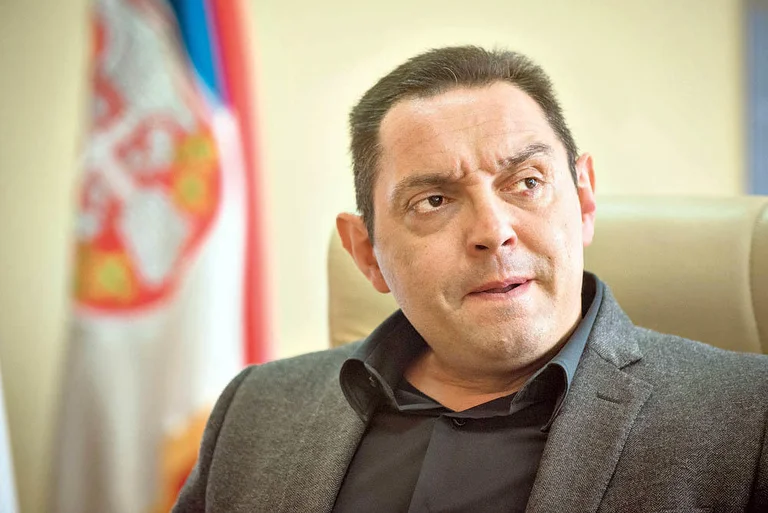
(5 years ago)Serbia's Minister of Internal Affairs Aleksandar Vulin's statement concerning the Serbian union project wherever they are, which would be guarded by the Serbian Army in the countries of the region, has been perceived as interfering with the internal affairs of sovereign states and as warning of Serbia's return of destructive policy. [...]
Serbia's Minister of Internal Affairs Aleksandar Vulin's statement concerning the Serbian union project wherever they are, which would be guarded by the Serbian Army in the countries of the region, has been perceived as interfering with the internal affairs of sovereign states and as warning of Serbia's return of destructive policy.
Bosnia and Herzegovina has called on Serbian President Aleksandar Vuciq to distance himself from the Vulin political agenda. Meanwhile, estimates come from Kosovo that the threatening Volin orders reflect Belgrade's official policy. From Montenegro, Volin supports the ruling Democratic Front.
Seal: I was placed on Serbian “Bota”
The idea of Serbia's “Bota”, which is now promoting Serbia's Minister of Internal Affairs, Aleksandar Vulin, and which he has replayed on July 18th, turns Serbia back in the 90th years of the past century and is the form of threat to countries in the region in general, have praised officials of the region's countries and recognition of political developments.
The statements by Serbian Government Minister of Internal Affairs Aleksandar Vulin, that the task of the current generation of politicians in Serbia is to create the Serbian world and unite Serbs wherever they live,”, has prompted numerous reactions in the region.
Such statements have been made to Voulin in the footnote of the 13th anniversary of the political subject he heads, the Socialist Movement, in which Serbia's president, Aleksandar Vuciq, was present as chairman of the Serbian Progressive Party.
In order for the Serbian world to take place, Serbia must be economically successful, Serbia must be well guided, there must be an army that is able to protect Serbia and Serbs wherever they live. To preserve such a Serbia, we have to do everything to continue Aleksandar Vucinqi's policy. Only that is victory, only it is a guarantee to the survival of our people and nothing else”, has said Vulin.
Meanwhile, Serbian President Aleksandar Vuciq, who was an honorary guest in marking the 13th anniversary of the Socialist Movement, has said that the party does not view “only as coalition partners, but as a co-ordinator for strong, modern and free Serbia”.
Kosovo: Volin's statement, continuing nationalist discour
From the Office of the President of Kosovo, they have stressed that Serbian Minister Aleksandar Vulin's statement does not present surprise.
Bekim Kupina, adviser to Kosovo President Vjosa Osmani, in a written response to Radio Free Europe, has stressed that Serbian Minister Voulin “is known for his ultra nationalist positions”.
This statement is nothing new. Serbia's major statements are only the continuation of the 90s, of the time of Milosevic's genocide regime, which produced wars and the consequences of which we are still carrying on. This rhetoric must also be judged by EU authorities, part of which Serbia intends to become. Such a statement is also in stark conflict with the positions of President Beden's administration for failing to change the borders of states in the region”, Cupina has said.
He has added that the state representing Vulin has yet to apologise for the crimes he has committed in Kosovo, so the return of the threatening discurs with “uniting Serbs” is an indication that Serbia is not even today reaching the genocide policy of the Milosevic regime.
“Vulin instead of projecting Serbia into the EU, is wanting great Serbia. In real-political, the first excludes the second powerful”, the Kosovo president's adviser has said.
Volin's statements were made a day before Kosovo Prime Minister Albin Kurti and Serbia's president, Aleksandar Vuciq, in the context of dialogue for normalising relations between the two countries, the process facilitated by the European Union.
Kurti: Sorry Vicciqi does not distance from the Vulin statements
Kosovo Prime Minister Albin Kurti, after meeting he had on Monday, July 19th with Serbia's president, Vuciq, has declared that the issue of the Volin's statement for the Serbian “Bot has also been affected during the meeting.
Prime Minister Kurti, responding to the journalists' question on the issue, has stressed that from the Serbian president, he has not distanced himself from Volin's statements.
Unfortunately, Serbia's president is not far from Vulin either (Ivica) Dacic or from (Slobodan) Milosevqi and whoever has been in power during the 1990s. That's really sorry. The fact that we have ten years of dialogue in Brussels, without a final agreement, is because there is this problematic resistance to confronting the past”, Kurti has said.
Bosnia and Herzegovina: To distance himself from the Volin's statement
Bosnia and Herzegovina Foreign Affairs Minister Bisera Turkovic said she expected Serbia's president, Aleksandar Vuciq, to be immediately distanced from the minister's statements by Voulin, to unify Serbia's “Bota”.
If Vuciq does not do so, Turkovic believes that it will only confirm that his and Serbia's official policy is overturning the Dayton Peace Agreement and aims to unite with Serbia part of Bosnia and Herzegovina.
The Vulin Declaration, in which he firmly said that the union of Serbs means a unified state, means flagrant violation of the Dayton Peace Agreement, destabilisation of the entire Western Balkan region, as well as an ominous threat to Bosnia and Herzegovina citizens who were protected from aggression and genocide 26 years ago. Such rhetoric makes all statements and policies of the Serbian president, Vuciq, with whom he claims Serbia wants peace and good neighbourly relations with Bosnia and Herzegovina” absolutely meaningless, Turkovic has said.
President @avuccic needs to root
Record his Minister Vulin, for his recent notes. Faith to do so confirmation of Serbia's support of the police of the Dayton Peace Accords, an omnipresent threat to ? who suffered from aggression and genocide 26 years ago!) Bisera Turkovovic (@BiseraTurkovic) Julie 19, 2021
Seal: The statements are just mine.
Volin, on 19 July, has reacted to the statement by Bosnia and Herzegovina Foreign Affairs Minister Bisera Turkovic.
He stressed that his ideas and statements were only his.
And if you have any questions regarding my views, send it to me, you'll get a sound answer you can understand. To get to the question with Vucinqi, you will still have to find his words and try to counter. But, in advance, you tell us who tried to kill Aleksandar Vucciq in Srebrenica and why there are still no names of authors and commanders”, Voulin has said, according to a statement from the ministry he runs.
His statement refers to the event from 2015, when Vuciq, as Serbia's prime minister, attended the commemoration of the victims of the Srebrenica genocide in Potocari, where some participants, dissatisfied with his presence, began throwing plastic bottles and other items to him.
Following the statement, Vulin commemorates that in his statement on July 18th, he has said that the “Serbs will join peacefully, without a single bullet when conditions for such a thing” are met.
If the Germans were defeated, why can't the Serbs, or are you even against a united Germany?
He also called on Turkovic to distance himself from the Bosnia and Herzegovina Presidency member Sefik Xhaferovic's statement that Kosovo is independent and that it would recognise Kosovo.
Otherwise, as he stated, “I will consider that you support the fragmentation of Serbia and that you want to cut off part of my country”.
In Montenegro, “for” and “against”
The first support for Volin in terms of the realisation idea of the Serbian “Bota” project, has come from the pro-Serbian representative of the Democratic Front, Andrija Ma persecuted.
On N1 television, Magoin has stated that the idea of the Serbian “Bota”, which Serbian Minister Volin has spoken about, has liked Serbs across Serbia's border. He has stressed that he is already working on realising such an idea.
“Serba from Montenegro, Serbs from Republika Srpska, Serbs from Macedonia (North), those borders that exist between us should not exist in their heads. Then we will co-operate better, we will be closer to each other, after all we are a people”, said Ma persecuted.
The URA Civic Movement estimates that all “projectesses” that propose the signing of new borders in the Western Balkans, including the Serbian “Bota”, are dangerous for the stability of the region and influence growing nationalism.
Party Vice President Jovana Marovic told Radio Free Europe that it is problematic that <x0] project” was publicly supported by Democratic Front leader Andrija Mandiaq, but that his position cannot be interpreted as the position of the government.
The government was formed on the basis of principles defined in the agreement from September of last year, and only a government that functions in accordance with those principles can have the support of the civic movement U. RA, instead of projects based on nationalism”, Marovic stressed.
Djukanovic: Same mistake, like Milosevic's
Two days earlier, Montenegrin President Milo Djokovic had talked about the dangers of the idea of a Serbian world.
At the “Western Balkans conference: A key part of the European security puzzle”, which was held in Bratislava on 16 July, Djukanovic said Serbia has never accepted Montenegro's independence and that he sees Montenegro as part of the Serbian “Bota”.
“When you see Serbia's position in the region, that role is potentially devastating, because Serbia has returned to policies of the early 1990s. Serbia is here to maintain the interest of Serbs wherever they live in the region. This is the same mistake Slobodan Milosevic had made in the 1990s. We know what happened in Bosnia and Herzegovina”, Djukanovic noted.
He said Serbia's president, Vuciq, was trying to present the protection of the interests of the Serbian people in Montenegro as a legitimate goal.
The intervention in a country's internal affairs cannot be a legitimate goal. I am sorry that Serbia is repeating mistakes and I fear it is a real potential for creating instability in the region. Serbia is doing it based on Moscow support”, Djukanovic stressed.
Maliqi: Serbia at zero point in the 1990s
The recogniser of political developments, Agon Maliqi, in a conversation with Radio Free Europe, stresses that Serbian Minister of Internal Affairs Aleksandar Vulin's statements should be seen in the region as a form of threat, and that they broadcast more clearly and directly what is Serbia's policy in the region.
According to him, Voulin has long more directly articulates those that are truly the positions of Serbian President Vuciq. As Maliqi says, this proves even with the fact that the vulin itself says the idea of the Serbian “Bota”, which is a euphemism for “Great Serbia”, can only be realised by following Vuciqi's policy. Meanwhile, the latter, according to Maliqi, has commented on the Vulin declaration, saying it has “more than coalition partner”.
I see this as a threat, as confirmation of the fact that Serbia has not only not changed, but has returned to zero point in the 1990s, with strategies and tactics differently, emphasising the economy first. But, pointing it out and always leaving the militant option open, which means the big Serbia project reconceptured, but also always allowing the return to war”, Maliqi said.
He added that the policy Serbia is pursuing, based on Volin's statements, is dangerous and real threat. That, according to him, is noted by the spirit, which the regime in Serbia is creating in public opinion.
“A state and a regime aimed at peace does not fan the war into public opinion and does not militarize to the extent to which Serbia has been militarized in recent years. So the threat is definitely real. Serbia, declaratively targets peace, but peace with its conditions, which conditions are unacceptable to neighbours. So I think that Vucin, in reality, leaves open the possibility of a war in this decade that we've entered”, Maliki praised.
Biserko: Set red lines for Serbia
Sonja Biserko, founder of the nongovernmental organisation Helsinki Committee for Human Rights in Serbia, tells Radio Free Europe that Volin's statements do not surprise him because, according to her, he had earlier such statements. It recalls the authorial text of Volin last year at the Serbian weekly “Pecat”, in which for the first time has said the task of his generation of politicians is to unite all Serbs.
Now, on the anniversary of the Movement of Socialists, which is somehow the beginning of the campaign for presidential elections, he told all those threatening and dangerous orders for the entire region, which, for the most part, exacerbates that President Vuciq was sitting there and did not distance himself from what was said”, Biserko stressed.
Referring to Serbian President Aleksandar Vuciq's presence at the celebration, at which the Vulin called him the future president of all Serbs, Biserko says Vulin says what Vuciqi thinks.
This is something they are tempted with every day to see how far they can go and how much the international community will tolerate. Of course, when that reality is created, then it is very difficult for him to return to the previous state of”, Biserko said.
The Helsinki Committee founder added that this is the beginning of the campaign for the upcoming presidential elections in Serbia, which will be held next year, but the touch of the international community's pulse, which she says hopes will set red lines when it comes to such statements and aspirations.
“red lines should be set up for such politicians in the region, taking into account that international borders in the Balkans are already accepted and that they no longer change. But, however, the incentives of this and in some way the contestation of the already accepted borders in the region imply serious destabilisation of the region, especially because it is about small and unsolemised countries, over which, Serbia, as a larger country in the region, could easily affect the sense of destabilising”, Biserko said.
Vujovic: Serbia is imitating Russia
Zlatko Vujovq, political affairs analyst from Montenegro, in a conversation with free Radio Europe, estimates that when it comes to ideological orientation, Serbia is moving increasingly towards Russia.
“Serbia, under President Vuciq, is trying to imitate Russia's behaviour as a regional power representing a dangerous neighbour for all those sharing borders with him”, Vujovic said.
But, as he puts it, Serbia does not have resources like Russia to create frozen conflicts, as Russia created in Georgia, Moldova, Ukraine, but to try to destabilise the region through media war, using its national communities living in other countries.
This creates conflict between Serbia and the West, Vujovic says, responding to the question whether he expects the European Union's response to the affirmation of the Serbian “Bota”.
This is something that leads deeper into conflict with US politics with President (Joe) Biden, but also with what should be European Union policy. However, the European Union, in the last seven or eight years, has no clear policy for the Western Balkans. For this reason, President Vuciq has opened up plenty of space to”, Vujovic said.
He estimates that Vuciqi himself uses this situation to implement his regional policy.
“If Vuciq makes some good tactical moves, he's making big strategic mistakes. By creating a gap with the United States and deepening Russia's influence in Serbia, becoming an instrument of Russian politics in the Western Balkans. It took place in long-term, medium-term terms and I am afraid even in the short term, it is undermining the position it built rule in Serbia”, Vujovic said.
Since when does the term “Serbian world say”?
The term “SerbianBota” was used for the first time by Aleksandar Vulin, on September 26, 2020, until he was chief of Serbia's Defence Ministry.
“Vucciq should create the Serbian World. Belgrade must gather all Serbs inside and around itself, while Serbia's president is the president of all Serbs”, Voulin had said.
He had later spoken in more detail about what he considered the term “Serbian world”, alluding to the need for the unification of the Serbian people into a single state.
Serbia highlights close ties, financing facilities with the Serb population in all countries in the region. During 2017, Serbia's president, Aleksandar Vuciq, and Republika Srpska's, entities within Bosnia and Herzegovina, Milorad Dodik, had also warned the Declaration of the survival of the Serbian people in the region, but it has not been adopted so far.











