 5 hours ago
Serbia forgives all authorities who do not recognise Kosovo
Periskopi(5 years ago)
(5 years ago)Kosovo, whose independence is not recognised by official Belgrade, serves as one of Serbia's main ties to many undemocratic regimes worldwide. Many of them -- like Belarus, China, Azerbaijan or Iran -- according to relevant international reports -- are those that violate human rights, take away media freedoms and implement [...]
In exchange for international support for the Kosovo issue, Serbia stands by when Western countries respond to the actions of undemocratic regimes with statements, resolutions and sanctions.
According to Serbia's Ministry of Foreign Affairs, out of 193 UN member states (OKB), 92 states recognise Kosovo, 96 do not know it and five states are in a non-composed “fluidd”, which, as they explain, means that those states “are primarily recognised but that they no longer vote for Kosovo”.
These data have been contested by Kosovo and the number of states that have recognised it, and those who have not recognised Kosovo's independence, is one more issue, about which the two countries disagree.
Cuba case
At a meeting with Cuba's ambassador, Gustavo Trista del Todd, on July 28th in Belgrade, Serbia's Interior Minister Aleksandar Vulin thanked Cuba for its support for Serbia “related to maintaining its integrity and territorial sovereignty” and its firm stance not to recognise Kosovo's independence.
According to a statement by Serbia's Interior Ministry, Voulin thanked the Cuban ambassador even for obstructing Kosovo's membership in Interpol, Radio Free Europe reports.
Vulin also stressed that Serbia “supports Cuba's right to make decisions independently and to regulate its policy without the interference of others in its internal affairs”.
The statement refers to the current antigovernmental protests that erupted in Cuba in July due to lack of food and medicine, rising prices and management of the country during the pandemic of COVID-19.
Hundreds of people have been arrested throughout the country since the beginning of the riots, and local authorities have also reported both the consequences of deaths.
Cuba's President Miguel Diaz-Canel called the protesters “antirevolutionary” and called on his supporters to oppose the protesters.
His government blames the United States and its economic sanctions for protests in Cuba and for problems in general.
In case of these events, US President Joe Biden stated that the United States supports Cuba's people in search of their freedom”.
On July 22nd, the United States has imposed sanctions on senior security official and the Interior Ministry Special Forces Unit, due, reportedly, human rights violations during the crackdown on anti-government protests.
After the sanctions were imposed, Beden said this was the first step of American response.
The United States and 20 other countries signed a joint declaration on July 25th condemning the mass prisoners and arrests of protesters in Cuba, as well as urging the government there to respect the universal rights and freedoms of the Cuban people, including free flow of information to all Cubans.
The declaration was signed, among other things, by representatives of Croatia, Montenegro, northern Macedonia, Kosovo, Poland, Ukraine, Greece, Austria and Brazil. Serbia is not on that list.
intensified co-operation with Iran
Serbian and Iranian officials have intensified meetings in recent years, expressing readiness to strengthen relations between the two countries. This was again told by Serbia's Parliament Speaker Ivica Dacic at the meeting with Iranian Ambassador Rashid Hassan Pouri in Belgrade on 26 June.
On that occasion, Dacic warned that as Serbia's president's envoy, he would participate in the inauguration of Iran's newly elected president, Seid Ebrahim Reis Sadat.
During the course of seven months this year, besides Serbia's Parliamentary Chairman, Iran's ambassador to Serbia has also met Foreign Affairs Minister Nikola Sakkovic, as well as Prime Minister Ana Brnabiq.
In statements that have issued after the meetings, they have expressed their thanks to Iran for <x0 principled attitude towards Kosovo's unilateral declaration of independence”, as well as “for support on international issues”.
After the April 18th meeting, Sekalovic said that <x0Iran supports Serbia in its efforts to stop Pristina when it is interested in becoming a member of several international organisations”.
Iran, now several years old, has faced criticism from non-governmental international organisations for violating human rights against its citizens.
In this regard, however, Serbia's officials have never publicly made criticism at Tehran's address.
Support for China
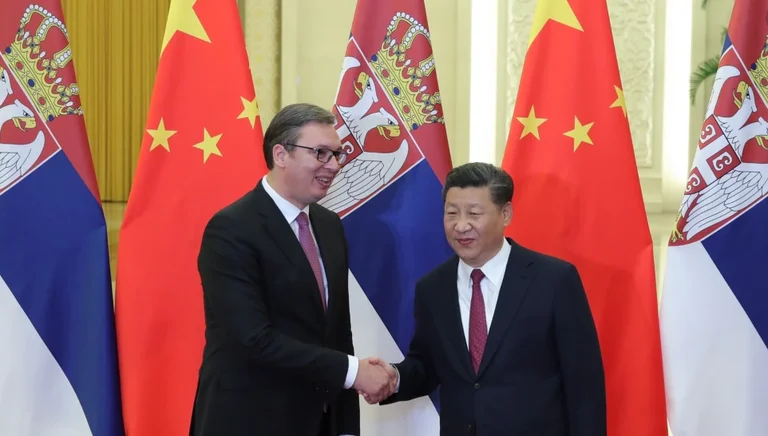
Serbia has a very positive experience in economic co-operation with China and aims to strengthen political, economic and cultural ties with that country”, Serbian President Aleksandar Vuciq said in early July, speaking at an online summit, in the case of the 100th anniversary of the founding of China's Communist Party.
Just days ago, Vucic announced that in a telephone conversation with the president of the People's Republic of China, Xi Jinping received the promise that the world's most populated head will visit Serbia, “at the end of the year or early next year”.
In March of this year, China's National Defence Minister Wei Fenghe visited Serbia, which, as Vuciq has said, was another confirmation of the “steel friendship and strategic partnerships encompassing between Serbia and China”.
“The steel friendship”, Serbia bases it on infrastructure projects, military and medical co-operation, which intensified during the Corleone pandemic, but also in the support Beijing gives to the official Belgrade policy towards Kosovo.
“Kina is one of our main supporters in the fight for Kosovo”, Serbian Foreign Minister Nikola Selakovic has said on May 21st in talks with Chinese Ambassador to Serbia Chen Bo.
In exchange, Serbia in international institutions stands near China, which Western powers criticise for violating human rights and suppressing minorities.
In July 2020, Serbia backed the declaration, which violations of human rights and water minorities in the Chinese province of Ksinjiang, defined as the “fight against terrorism and extremism”.
Out of a total of 46 signatories, Serbia is the only country to aspire to membership in the European Union (BE), but has supported China's policies and movements in Ksinjiang.
In the Chinese autonomous province of Ksinjiang, some 25 million people live, and more than half are mainly ethnic Muslim minority groups.
The largest group is the Turkish people Weigurs, who are closer to the peoples of Central Asia to the Chinese Han, who are the dominant ethnic group in China.
The rocks, along with other Muslim minorities, such as Kazakhs or Kyrgyz, have become a target for Chinese authorities to send to <x0...
This is not the first time Serbia has supported China's policies and movements, which are condemned by the international community.
In the case of the adoption of the Chinese National Security Law for Hong Kong, Serbia's president, Aleksandar Vuciq, on June 2nd, sent a letter to Chinese President Xi Jinping in which he declared that “Serbia firmly supports the sovereignty, territorial integrity and national security of China”.
It is the law that Western countries and the United States of America warn that it violates Hong Kong's high degree of autonomy, which was guaranteed to the city when it passed under Chinese administration on July 1, 1997.
Support for Chinese foreign policy, Serbia's officials have expressed it even in September 2020, when they addressed sharp reactions to the newspaper “Danas” in Belgrade, which published an authorial text of Taiwan Foreign Affairs Minister Joseph Wu.
In the text entitled “Taiwan can help the world recover from the virus”, Joseph Wu writes about Taiwan's inefficiency, which in times of crisis “participates and exchanges experiences within the United Nations system” because of China's opposition, which, like most UN member states, Taiwan considers it one of China's provinces.
In her statement, Serbia's Ministry of Foreign Affairs estimated that “the republic of such texts harms the reputation and position of foreign policy of the Republic of Serbia”.
Taiwan's status represents its “red box” for Beijing because, like Hong Kong, it considers it its “internal issues”.
China and Taiwan have divided governments since the end of the civil war in 1949, but Beijing has long tried to limit Taiwan's international activities.
Russia expressly rejects Kosovo independence
The Russian Federation's support for Serbia on the issue of dialogue for normalising relations with Kosovo is one of the adults, which official Belgrade often notes. Dialogue between Serbia and Kosovo should be brought to a legally binding agreement for normalising relations between Serbia and Kosovo.
The Kremlin is one of Serbia's strongest “support” at the UN Security Council, reporting every six months on the work of the UN Mission in Kosovo (UNMIK).
Aleksandar Vuciqi's statement, issued during Russian President Vladimir Putin's visit to Serbia in January 2019, that he will consult with his Russian colleague for any solution to Kosovo, also testifies how powerful Serbia accounts for Russia's support.
“Pa Russia, but also because of Russia's power at the UN Security Council, it is clear there will be no solution without Russia. Before any solution, I would consult with President Putin”, Vuciq said.
Meanwhile, Serbia provides support to Russia in international organisations on the issue of the Crime Peninsula, which Russia annexed in 2014.
Belgrade has voted several times against resolutions in the United Nations, condemning human rights violations in Crime, and where Russia is highlighted as an invading “ ” force.
Such was the case in 2019 and 2017.
Serbia also refuses to join sanctions imposed by the European Union on Russia.
Brussels expects Serbia to harmonise its foreign policy with the European one on the road to EU membership.
Belarus relies on Serbia
We look at world events in a similar way and support Serbia's territorial integrity. We count on Serbia's support for principled issues for us”. With those words, Aleksandar Lukashenko, who is now president of Belarus, addressed the public in Serbia during his official visit to Belgrade at the end of 2019.
His Serbian colleague, Aleksandar Vucinq, also did not save the beautiful words on Lucas' account.
Since President Lukashenko is in front of Belarus, it has never happened that Belarus will vote at the expense of Serbia”, Vuciq said.
The European Union has imposed several consecutive sanctions on Belarusan officials and companies in response to regime-repressive measures against supporters and opposition journalists.
The latest trigger for this was the government's decision in Minsk, to lower a passenger plane on May 24th, and to arrest Belarusian journalist Raman Protaschevich.
In June, the European Union adopted a joint statement condemning the act and called for the immediate release of Protashevic, as well as for an international investigation into the incident.
Serbia joined the statement, but Belgrade only partially respected the sanctions the EU imposed on Belarus.
Serbian representatives did not support the EU Council's punitive measures against 78 Belarusian citizens and seven entities, but their signatures put them in the decision to sanction the Belarusian air traffic control company. At the same time, the Serbian Army participated in the trilateral exercise “Slavic Brotherhood 202118x1>, along with Russia and Belarus, which the EU criticised.
Serbia also signed the EU's statement on Belarus at the end of August 2020, at a time when that country was facing massive civic protests, after Lukashenko announced victory in the elections held in August for the sixth term as president.
The European Union and the United States of America have refused to recognise Lukashenko as the legitimate president of Belarus.
In the declaration signed by Serbia, it is said that the citizens of Belarus “demonstrated the desire for democratic changes” during the electoral campaign, but that the presidential election “was neither free nor right”.
After that, however, Serbia's prime minister, Anna Brnabiq, said he hoped Belarus's president, Alexander Lukashenko, would not blame “Serbia.
Azerbaijan and Bilateral Support
Serbian Foreign Minister Nikola Sekalovic, during his official visit to Azerbaijan in late July, where he met with officials there, in particular stressed that the two countries are committed to respecting the principles of international law, as well as to provide mutual support for maintaining territorial integrity and sovereignty”.
According to a statement by Serbia's Ministry of Foreign Affairs, during a meeting with Azerbaijani counterpart Cejun Bajramov, Selakovi thanked Serbia's key principled and clear position when it comes to non-recognition of unilaterally proclaimed independence of Kosovo, as well as understanding and support in international organisations”.
The Human Rights Watch (HRW), in its latest report, writes that the regime in Azerbaijan is responsible for drowning media freedoms and exercising pressure on NGOs.
In February of last year, the European Court of Human Rights estimated that the Azerbaijanian authorities held researcher Khadija Ismayilova in prison from 2014 to 2016 in order to silence and punish him.
A month later, a court in Baku suddenly ordered the early release of investigative journalist Afgan Mukhtarli and allowed him to join his family abroad. Mukhtarli has carried out half of his six-year sentence on false charges.
In August, Fuad Ahmadli, a blogger and activist, was released after serving a four-year sentence on politically motivated charges. At least three other journalists and bloggers who criticised the government are still in prison on politically motivated charges, Human Rights Watch recalls.
In September 2020, Azerbaijan State Prosecutor's Office issued an international warrant for a group of persecuted political people critical of the regime.
The Parliamentary Assembly of the Council of Europe (PACE), in which Serbia has been a member since 2003, adopted a resolution early last year condemning Azerbaijan's abuse of the judicial system against political opponents.
Serbia's representatives were not present at that vote.
Diplomatic relations between Serbia and Azerbaijan were shocked in the middle of last year, when the internet portal “Hacqnjak.az”, known as close to the Azerbaijanian authorities, published claims that mortars produced by Serbia, as well as ammunition, were handed over to Armenia through Georgia and was later used in deadly conflicts at the Armenia-Azerbaijan border.
Despite that, the head of Serbian diplomacy announced during his recent visit to Azerbaijan that Azerbaijani President Ilham Aliyev will visit Belgrade in October.
A statue of his father, Heydar Aliyev, the authoritarian ruler of Azerbaijan, is in Belgrade's Tashmajdan Park since 2011. Not far from there, a monument was raised for Serbian writer Milorad Pavic. Both statues were financed by the Azerbaijann government.
“Vnezuele always on the side of Serbia”
While mass anti-government protests were held at the beginning of 2019 in Venezuela, while the international community was divided into those who supported opposition leader Juan Guaid and those on the side of controversial President Nicolas Maduro, Serbian officials officially adhered to the policy of “
However, a Venezuelan delegation met in February 2019 with members of the parliamentary Friendship Group with Venezuela and members of Serbia's Parliamentary Committee for Foreign Affairs.
Venezuela's ambassador to Serbia, Dia Nader de El Andari, also attended the meeting, and the session was conducted by a member of the Socialist Movement, a party of the then defence minister and current Interior Minister Aleksandar Vulin.
In a proposal to the newspaper “Politika”, Venezuela's ambassador stressed that her country has always been on Serbia's side, in all international organisations, and that “Serbia is also on our side”.
That country is also in the group of states that do not recognise Kosovo's independence.
The then ambassador of the United States of America to Belgrade, Kyle Scott, estimated Serbia is “on the wrong side of history” regarding the situation in Venezuela.
Venezuela's government, according to a HRW report, in 2020 imprisoned political opponents and prevented them from participating in political life.
According to Penal Forum data, the Venezuelan defence attorneys' Venezuelan network, as of September 30th 2020, had 348 political prisoners in Venezuela's prisons and intelligence headquarters.
The HRW report shows that Venezuelan intelligence and security forces have arrested and tortured army members accused of plotting against the government. Authorities have tortured various prisoners to obtain information about alleged plots.
So far, Serbia has not been critical of these claims











