3 hours ago
Kurti in Greece: We need help fighting corruption and crime

Periskopi(5 years ago)
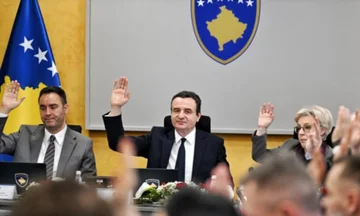
(5 years ago)Kosovo Prime Minister Albin Kurti has attended the opening of the 23rd edition of Symposium in Athens, Greece, which is being held according to Chatham House Rules Kurti, has published his full speech in this symposium saying this symposium gives the opportunity to meet [...]
Kosovo Prime Minister Albin Kurti has attended the opening of the 23rd edition of Symposium in Athens, Greece, which is taking place according to Chatham House Roules
Kurti has published his full talk on this symposium, which says this symposium provides the opportunity to meet excellent minds, academics and politicians, artists and activists, people with different experiences and profiles dedicated to the issue of progress.
In his address he said Kosovo has been recognised by 117 states and has already started to improve relations even with countries like Greece.
He said that if their governing programme for work and justice is implemented in Kosovo, then they will come out to convince citizens to pursue their happiness by staying in their homeland.
The setting, among other things, says more investments are needed to create jobs and that a state that protects the interests of its citizens and gives a sense of democracy.
Kurti's complete speech:
My word at the opening of the 23rd edition of Symposium in Athens, Greece, which is under the Chatham House Roules
Let me start by wishing Greece's independence anniversary 200 years ago, and also the 40th anniversary of its involvement in the European Union.
Dear friends and participants in emposium “Symi” 23rd,
Dear Mr. Peppas, dear friend George Papandreou,
It's my fourth time in “Symi”, on this quiet, movemental island of progressive thought. I remember coming here as a political activist and opposition MP, in my first participation. It was then between a release from prison and another arrest. So in the Egyptian islands of Rhodes and Crete, I was given the opportunity to rest in freedom, including a symposium.
Once again it was evidence that no one can suppress ideas that have come to their time. The list of candidates I led in the last elections won more than 50% of the vote, this year's Valentine's Day. On that day Kosovo citizens, with a gesture of love, decided to support and vote our programme for justice and work. We'll work hard, and we're working well. And we know we're not an island anyway. We're connected, and we need more connections.
Let's do a simple exercise, a Google search, writing in there just four words, and let's say those words are: “need for intermission operation”. Even if we limit the search for the last 24 hours, tens of thousands of results will still emerge. Among many others, a politician from India, an activist from Canada, a businessman from Taiwan, a philosopher from Ghana, a journalist from Serbia, a worker from Spain, a displaced Syrian, a refugee in Switzerland, a banker in Peru, a professor in the United States, and, humbly yours, Kosovo's prime minister here in this symposium that makes two prominent people from the region, our continent, and beyond.
I sincerely want to thank our dear friend George Papandreou. This symposium enables us to meet fine minds, academics and politicians, artists and activists, people with different experiences and profiles dedicated to the issue of progress. Official informal conversations here remind me of what the famous Athenian, Pericles, (as Tuccidi conveys to us), that discussion should not be viewed as a stumbling block to action, but should be thought as a necessary predecessor for any wise action. Before we implement our policies, before we take any action, it is necessary for us to confront our thoughts, to change our perspectives, to confront each other without fearing constructive criticism, and to learn from experiences throughout the world and throughout history.
It seems today that everyone is trying for more international co-operation. Even the extreme right hand and the ultraconservators, those who are so much involved in identifying and conflicting policies, are now building their so-called international organization. As far as Russian Alexander Dugin, one of the ideologies of this resurface of Hungarian «clashes between civilisations», writes anti-colonial texts on Africa or West Asia (Medium Order) today. Surely, everyone realizes that his use of anticolonialism in these cases is just an instrument to gain as much space as those great powers still think of in terms that Carl Schmitt loved.
But while their intentions are readable to us, we need to keep in mind that there are peoples and nations who are still struggling for relief and decolonization, for freedom and equality. Support for anti-colonial and decolonization movements is a must for us, the Progressives, so that we do not lose ground in front of the extreme right.
We need to protect the ground. Now when the extreme right is mobilizing workers who are so afraid of falling into an unstable economic situation during these times of global crisis, we need to be a little more careful about embracing liberal language. We all know the <x0-4 freedoms”. However, does the import of goods harm the local manufacturer? Does the import of workers harm labour unions and rights? These are the questions posed by populist right, which go straight to the heart when it is heard by workers, small businesses, producers, and unemployed people in many parts of the world. What should we say to these people? We have to protect them and their union rights, and at the same time we have to zealously promote fair trade, at national and international forums. In a broader perspective, I would say that the pandemic has already witnessed how important it is for economies to be balanced and integrated, widely being self-resistable and not heavily dependent on the chains of long distance supply. This lesson I think will make investment in nearby countries very important for Europe in terms of producing goods and services.
We have to explain every time, that exiles would not have left their homelands if other states had behaved responsibly with their countries. Inequality in the world, today in the blink of an eye it turns into inequality in your country. If we don't find an efficient way to distribute and redistribution through international tax systems, but also through international investment policies, then there will be more and more nomad proleers fleeing from countries more seriously injured by economic and climate crises. Thus, in the end, inequality will come to us, and a greater recruiting space for the extreme right will come along. As we clearly can debate the unannounced differences between social democracies, or between left in general, it's hard by any of us to overdo it in being anti-fascist.
Kosovo has been a source of exile for many years. But now things are starting to change. We are independent, we have been recognised by 117 states, and we have begun to improve relations with countries like Greece, whose leaders welcomed us in these last days. I am sure that even more countries will recognise our independence, while parallelly we are working for principled dialogue with Serbia, which will lead to mutual recognition, relief from the EU and assistance from the US.
If we succeed in implementing our programme of work and justice in Kosovo, then we will succeed in convincing our citizens to pursue their happiness by staying in their country. Most of our citizens, not unlike other peoples, would like to stay on their motherland, near families and friends, if they could see a good prospect there. But to achieve this, we must offer them quality education for children and good health care for everyone. We need a strong and independent judicial system, with active prosecutors and efficient judges. We need more investments to create jobs, we need to bridge the skills gap by connecting the labour market with professional education. We need a state that protects the interests of its citizens and gives meaning to democracy. This can't be done alone. We need help fighting corruption and crime. We need investors from outside. And we need dignity on the international scene, so that we can be treated as equal among states and not be humiliated or disinclined by our wings to be imposed, because we want people not to be, and believe that they are not without rights, stripped of their democratic power, just because they have happened to be born in a small, limited economic state.
We in Kosovo will keep our ground. We will help the world's progressive parties and politicians, helping our people. And we also expect progressive politicians from developed countries to help their people, helping us, or other movements in developing countries that have genuine commitment to governing well and to meet the needs of the people.
For our government, social justice is not a side goal, but the essence of government. We believe that our progress should be democratic, and that its measure is made by how much improvement there is in the end, not the top, the situation of the majority, of everyone, not the minority.
It is our duty to give in to such a used and misused form then called «international co-operation». We can do this if we come to realize that helping someone else means helping ourselves.
Symposium “Symi” is very helpful. It will continue to be the place where bright sun and bright minds shine together. So it's amazing that everyone goes back to “Symi”, be they resistance activists or republican prime ministers.