 4 hours ago
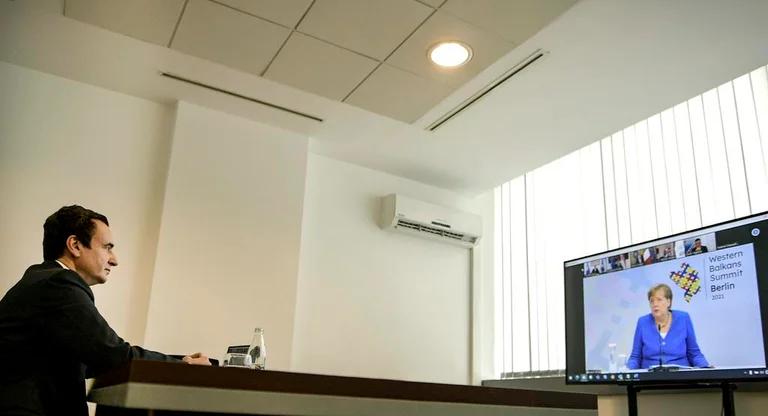
Kurti at the Berlin Summit: We must exert ourselves vigorously in the agenda of EU integration
Periskopi(5 years ago)
(5 years ago)Kosovo Prime Minister Albin Kurti said today that the EU and the countries of the Western Balkan region must take bold action to strengthen mutual ties in accelerating reforms that pave the way for accession to the large European family. He at the virtual Berlin summit said the Berlin Process was created in [...]
He at the virtual Berlin summit said the Berlin Process was created at a time when the region's prospects for EU membership seemed distant, but unfortunately seven years later the situation has not changed much.
This lays out the need for bold actions by both the EU and the Western Balkans to renew commitment and strengthen ties that would accelerate reforms. It is a pity there was no progress in negotiated agreements with the relief of the Regional Co-operation Council. Some parties are still pushing tongues that are not in line with reality, nor with the spirit of the Berlin Process. Kosovo is fully committed to regional co-operation and more economic integration, given the recognition of reality and truth, the balanced rights of minorities throughout the region, facing the past towards reconciliation and with citizens as the ultimate beneficiaries of dialogue”, Kurti said.
He has said he expects the European Commission to review the proposal for advancing the CEFTA agreement in SEFTA, based on the EFTA model. EEA would, as such, overcome current obstacles.
Otherwise, at the meeting invited by German Chancellor Angela Merkel, prime ministers of the countries of the European Union and the Western Balkans, senior representatives of the European Union and other important international institutions participated.
The summit was held at four separate sessions where the Berlin Process achieved regional co-operation between Western Balkan states and future steps in the process.
At the first session, Ursula von der Leenen, European Commission President Majlinda Bregu, secretary general of the Regional Co-operation Council (RCC), Emir Djikic, director of the CEFTA Secretariat.
Prime Minister Kurti addressed the summit's second session, where Albanian Prime Minister Edi Rama, Chief of the Council of Ministers of Bosnia and Herzegovina Zoran Tegeltija, Montenegrin Prime Minister Zdravko Krivokapiq, Northern Macedonia Prime Minister Zoran Zaev and Serbia's chief minister, Ana Brnabiq, spoke.
At the third summit session discussed Sebastian Kurz, Austria's Federal Chancellor, France's President Emmanuel Macron, Italy's prime minister, Mario Draghi, Prime Minister of Great Britain Boris Johnson, Poland's Prime Minister Matthews Morawiecki, Bulgaria's Prime Minister Stefan Yanev, Greece's Prime Minister, Kyriakos Mitsotakis, Croatia's Prime Minister, Andrej Plenkov, Slovenia's prime minister, Janez Jansha.
At the fourth session, Oliveér Várhely, European Commission Commissioner for Neighborship and Enlargement Albert Hani, Secretary General of the Region's Youth Co-operation Office Mathias Cormann, OECD Secretary General Dr. Hans Kluge, Regional Director for Europe O BSH, Dr. Werner Hoyer, president of the EIB, Odile Renaud-Basso, president of E BRD, Rolf Wenzel, CEB Governor Christian Schmidt, senior representative for Bosnia and Herzegovina.
The full word of Prime Minister Kurti at the Berlin Process Summit:
Your Lord of Grace.
Chancellor of the Federal Republic of Germany Angela Merkel,
European Commission President Ursula von der Leeyen
Partners, Prime Ministers of Western Balkan Countries
Leaders of the EU and Europe,
As prime minister of a country whose citizens are being kept isolated, not allowing visa liberalisation, we fully understand the frustration of Albania and Northern Macedonia for the lack of progress in opening negotiations with the European Union, but nevertheless we must exert ourselves vigorously in the agenda of EU integration, democratisation and economic development for our citizens.
As you know, in a set of unprecedented elections this year in Kosovo, more than half of the country voted for us and for our programme, for work and justice. This is the main agenda for our government today: strengthening the rule of law with an independent judiciary, fighting corruption and organised crime, developing a free and competitive economy, protecting human and civil rights, but also preserving fundamental freedoms of thought, speech, media and religion, because we believe democracy is necessary, not only to win elections, but also to govern.
For Kosovo, the European Union begins at home and we do not see it as a process of shifting to the EU, rather, we see it as a process of reforms where even those who left for better economic opportunities would return. We understand that we have to do our homework, but the EU has to do its own by keeping its promises.
Your Lord of Grace.
We know that the Berlin Process was created in the context of geopolitical challenges and uncertainties in the Western Balkans, at a time when the region's prospects for EU membership seemed distant. Unfortunately, seven years later the situation has not changed much.
This lays out the need for bold actions by both the EU and the Western Balkans to renew commitment and strengthen ties that would speed up reforms. It is a pity there was no progress in negotiated agreements with the relief of the Regional Co-operation Council. Some parties are still pushing tongues that are not in line with reality, nor with the spirit of the Berlin Process. Kosovo is fully dedicated to regional co-operation and more economic integration, based on recognition of reality and truth, balanced minority rights throughout the region, facing the past towards reconciliation and with citizens as the ultimate beneficiaries of dialogue.
Given that the current regional framework cannot prepare us for EU accession, in Tirana I have proposed to advance CEFTA to SEFTA (Free Trade Agreement for Southeast Europe) based on the EFTA model EEA, which would glorify the entire region and overcome current obstacles.
We hope the European Commission will seriously consider this proposal and launch a dialogue that will lead to concrete results.
Nicosia, Chancellor Angela Merkel, thank you for starting this process and for organising this important summit. I know this is the final summit of the Berlin Process under your leadership and in this format. Thank you for being a host leader and I hope your commitment to the region continues.
Thank you all and we await the continuation of the Berlin Process.











