 4 hours ago
Kosovo forgets demarcation with Montenegro
Periskopi(5 years ago)
(5 years ago)It has been three years since the ratification of the demarcation agreement with Montenegro in the Kosovo Assembly, and yet this process cannot be considered complete. Under this agreement signed in 2015 in Vienna, after ratification, the two states will review the border line and become corrections if [...]
Under this agreement signed in 2015 in Vienna, after ratification, the two states will review the border line and become corrections if there have been concessions.
Kosovo Prime Minister Albin Kurti, who was opposed to this agreement, has not yet formed the state commission for border demarcation.
Last year, on 26 August, as in opposition, Kurti had criticised the deal, which he claimed to have lost Kosovo 8,200 hectares.
The report and the work of the Bulliqi Commission is an indictment for the old regime (as soon as the State Prosecutor is released) and correctional orientation (as soon as the good government is restored)”, Kurti wrote on Facebook.
However, as prime minister in the second term, Kurti has done nothing in terms of this process.
In the Government of Kosovo, free Europe questions have not been answered, and have not indicated when the new commission will be formed that will deal with the border line review issue, as the agreement envisions.
The request to form this commission, the prime minister has also addressed Alliance for the Future of Kosovo chairman Ramush Haradinaj.
On the first day of his work as prime minister in 2017, Ramush Haradinaj had dismissed the commission led by Murat Meha and had appointed a new commission consisting of professors Florim Isufi and the Bulqi Rescue.
Now as opposition MP, Haradinaj asked Kosovo Prime Minister Albin Kurti on 25 June to form the state Commission as soon as possible for border demarcation.
It's the first action you have to take, so you don't leave the vacuum, so the government is not surprised by any nature, this commission should be functional. In labour procedures, the Kosovo and Montenegro commission have not been released to store the stones. Still, there are stones between Kosovo and Montenegro. The limit that is today is the limit we have found even before the” agreement, the Alliance for the Future of Kosovo chairman said.
According to him, if Montenegro does not express readiness to proceed in this direction, this issue should go to arbitration.
The agreement with Montenegro was signed according to the state Commission's findings for marking the border line, which was led by Murat Meha.
I can't say anything, because what I had to say I said. What we've been saying has been proven, and we've done that”, Meha briefly told Radio Free Europe.
Professor Florim Isufi, who was part of the state commission appointed by former Prime Minister Ramush Haradinaj and dismissed by former Prime Minister Avdullah Hoti, says that only with the goodwill of Montenegro, there may be revision of this demarcation line.
No one can talk to Montenegro anymore if it should be based on the find report, because there are findings that need to be improved, and the Montenegrin side if it refuses, is hard to improve. The border line cannot be defined or could not be marked, unless the two sides agree. This remains a dead end in the future until the” commissions are established, says Isufi.
He tells Radio Free Europe that Kosovo Prime Minister Albin Kurti must meet and talk with Montenegrin authorities.
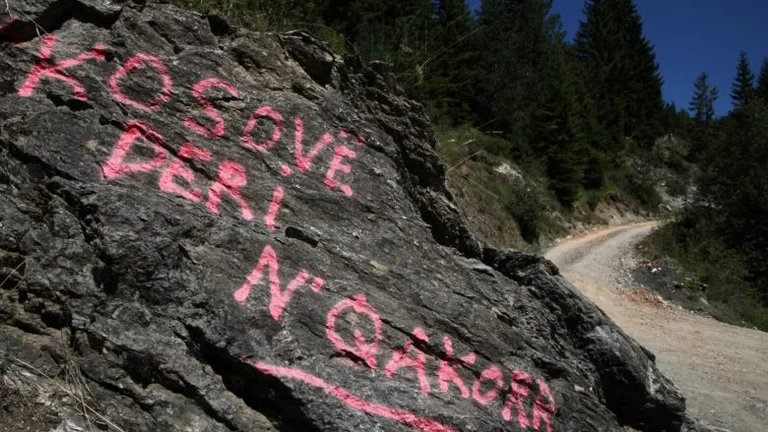
Each year, Rasim Mulaj and his wife remain at their stage in the mountains near the border with Montenegro for three months.
Mulaj is from the village of Luka Upper in the Decani municipality, which along with other residents on this side rejected the demarcation agreement with Montenegro, signed in 2015.
He says that these inhabitants have been wronged.
“11 villages have left us without mountain”, Mulaj says in a conversation with Radio Free Europe, adding that as a result of the agreement signed between the two states, the border line is now about five kilometers deep in Kosovo.
According to him, Montenegro has never checked this part and that the Juliet Tower, Mulaj says, has never been part of Montenegro.
“E check, have placed nets on the upper side to prevent rocks from slipping, have made new visas, clean the road. Everything means and controls these (Montenegrins), the forestman is Roshaj, controlling Mount”, Mulaj says.
When three years have passed since the ratification of this agreement in the Kosovo Assembly, Kosovo has had four governments.
None of the governments have taken any step as far as the revision of the border line is concerned, to make needed corrections if there has been any concessions.
I expect from these (Kosovo government), because they have been insist that no demarcation be voted on. I expect from them and the Foreign Ministry to handle this job, to negotiate with Montenegro”, Mulaj says.
Between 2015 and 2018, the Vetevendosje Movement as opposition parties, but other opposition parties also strongly opposed the demarcation agreement with Montenegro.
Numerous protests were staged against this agreement, both in squares and in the hall.
Under the smoke of tear gas, on March 21, 2018, Kosovo Assembly deputies voted to ratify the agreement on demarcation with Montenegro, which was seen as criteria for visa liberalisation for Kosovo citizens.
The agreement for demarcation with Montenegro, signed in 2015 in Vienna, Austria, has also been met with an annex-agreement between the two former Kosovo presidents, Hashim Thaci and Montenegro's Filip Vujanovic.
In the agreement signed between the two presidents, it is said that after ratification of the demarcation in the Kosovo Assembly, the two countries will review the border line and make corrections if there are concessions.











