 4 hours ago
Attorney Williams: Terrible crimes committed against Kosovo Albanians
Periskopi(5 years ago)
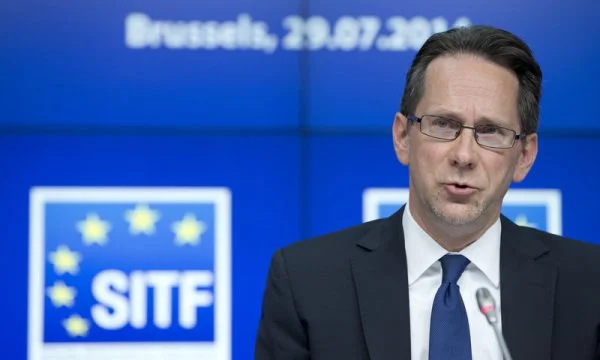
(5 years ago)The American prosecutor, Clinton Williams, who led the investigative group set up by the European Union for investigating claims by the Council of Europe's war crimes report in Kosovo, said that the non-light of claims on those crimes left black clouds on the region. He made these comments in a longer interview for the program [...]
He made these comments in a longer interview for the Serbian-language Voice of America programme, in which he commented among other things the work of the Kosovo Special Court, with headquarters in The Hague addressing claims for the involvement of former leaders of the Liberation Army in war crimes and postwar.
From 2011 to 2014, Mr. Williams began investigating claims filed by Council of Europe envoy Dick Marty in 2010, on which the Special Court was established in the summer of 2015.
He appreciated the work of Specialised Chambers, the name of which the Special Court is known.
“are ignoring political rhetoric and doing their job. It is a broader international effort that included investigators, prosecutors, and analysts from eighteen member states of the European Union, the United States, and Canada while I was there. It's a multinational effort to find the truth. Throughout this period, they did a tremendous job. It's hard to get back to crimes that happened more than 20 years ago; Evidence disappears or gets old, witnesses get sick, some lose their memory, some are dying. So the more time it takes, the harder it is to follow the”, he said.
Currently, there are eight former members of the Liberation Army, six of whom, charged with war crimes, including its top leaders, Hashim Thaci, Jakup Krasniqi, Kadri Veselin and Rexhep Selimi.
Directors and members of this army have also faced international justice, including two former commanders -- Ramush Haradinaj and Fatmir Limaj -- who were acquitted.
The founding of the Special Court has conveyed more criticism to Kosovo, where war crimes cases are said to have been handled by several rings of international justice.
But, prosecutor Williams said that “had many problems in cases involving leaders of the former Kosovo Liberation Army. And I handled this case when I made a preliminary statement on the findings of the Detective Group in 2014, that in cases handled by the War Crimes Tribunal in the former Yugoslavia, as well as by EULEX-I and UNMIK, there were many cases of witness intimidation and political interference by key government officials, supported by many people in the media, who damaged the possibility of fair trials in these cases”.
But he says that this time he hopes to be different.
Of course I don't want to judge the outcome of the cases. I saw what evidence he had when I conducted the investigation. But my term as chief prosecutor ended seven years ago. So, I am convinced that these cases have changed significantly in terms of additional evidence, since some evidence may have been lost by that time, or there have been cases of witness death. I am convinced that the prosecution will have a strong case otherwise it would not have brought charges against those individuals. I think they're pretty convinced that the evidence they have is convincing and that the court, considering them, will give a proper decision. But these individuals have the right to promise innocence and will be protected by highly skilled lawyers from the best in the world. After all, all you can ask for or desire is a fair judgment. A trial that will be carried out without fear of witnesses, as well as no political interference, which contributed to the deterioration of processes in the past. If you do, it's a success. The judgments should depend solely on evidence and that judges should do the proper and objective analysis of the” evidence, prosecutor Williams said.
He does not expect the outcome of the judgments to have any quick impact on relations between Albanians and Serbs.
Whatever the outcome of these issues, someone will be disappointed. If individuals are convicted, many of Kosovo Albanians will be disappointed and mean decisions are politicised, anti-Albanian, and so on. If they are acquitted, there will be similar reactions from the Serb side. This is the story of all courts (for war crimes). Very few judicial decisions have satisfied all parties. But that's the nature of the court cases and I don't expect it to be different. I think it is unlikely that in the short term, the decisions of Kosovo's Specialised Chambers will accelerate the reconciliation process. I think this is something that takes time to overcome and that people eventually have an understanding of the evidence. Such an approach enables reconciliation and progress of the political processes”, he said.
Prosecutor Williams is not sure that the work of Specialised Chambers will help the current political processes between Kosovo and Serbia that are in a process of normalising relations between them.
I would like the Kosovo Serbs and Albanians to understand that it is in their common interest to resolve differences between them. I am aware that many problems and differences are deep. These are not easy to solve because otherwise they would have been solved a long time ago. This will be a multi-year process. It is important for progress to be seen along the process, to see that both sides are ready to release and to be able to accept some of the arguments of the other side. You have to listen to the other side and try to find a way to overcome divisions. Accounting can be an essential element in this. As I have said in 2014 with the unfolding of the investigation findings, the fact that these issues from the Kosovo war have not been resolved, leaves black cloud over the region. And it's in everyone's interest to resolve these issues. The formula that without justice there is no peace means that there must be accountability to ensure lasting peace. Justice is essential to achieving genuine reconciliation”, said Mr. Williams.
In Kosovo critics of the Special Court say that with its establishment it is drawing on atrocities committed by Serbian forces during the 1998 war of 1999, which ended with NATO intervention. The Kosovo government already warned that it is preparing an international indictment against Serbia for genocide.
Horrible crimes were committed against Kosovo Albanians during 1998 and 1999”, said Mr. Williams, who in 1999 investigated crimes against Albanians as sent to the war crimes tribunal in the spaces of the former Yugoslavia.
“I was on the ground shortly after NATO forces entered in June 1999 and co-ordinated exhumations operations from the mass cemetery in which the bodies of nearly ten thousand Kosovo Albanians were found who were killed. No one can deny that these things happened. I saw them with my own eyes. I noted that when I published the investigation findings in 2014 and was not trying to rewrite history, saying Kosovo Albanians committed crimes against Serbs. This does not mean that you have to hide under the carpet the crimes committed against Kosovo Albanians by Serbs in 1998/1999. But the fact is there have been crimes on both sides. Many more Kosovo Albanians were killed than Serbs. But that does not diminish the suffering Serbian victims face and do not change the fact that they too are entitled to justice for crimes against them. So whether you call crimes against Kosovo Albanians genocide or as we define it before the International Court for the former Yugoslavia a crime against humanity, which I think is a more appropriate description, it is still a terrible crime. The fact is, thousands of people were killed and hundreds of thousands were forced to flee their homes. Terrible things happened. After that, some terrible things happened to Serbs who remained in Kosovo. The proper approach is to investigate the crimes committed by all sides and account those responsible for their carrying out”, said prosecutor Williams, who stressed that responsibility is individual and not collective.











