 6 hours ago
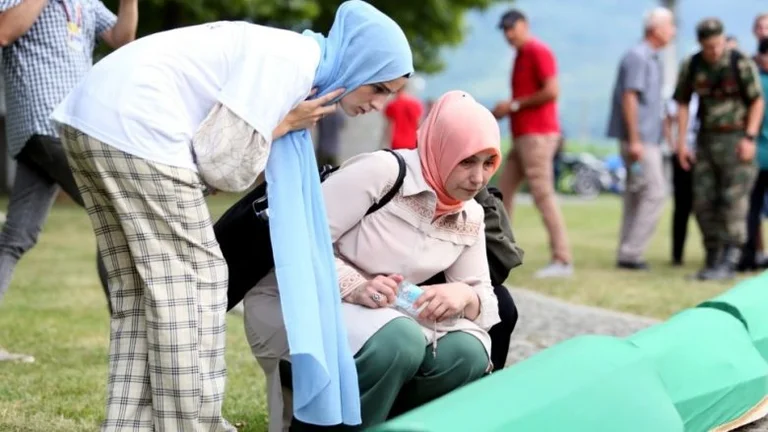
19 victims buried in Srebrenica's 26th anniversary of genocide
Periskopi(5 years ago)
(5 years ago)The remains of 19 victims of genocide in Srebrenica are buried today at the Potocari Memorial Centre. The youngest victim to be buried is Azmir Osmanovic, who was 16 years old when he was killed. His remains were found in a mass grave and identified in May of this year. The oldest victim to be buried is [...]
The youngest victim to be buried is Azmir Osmanovic, who was 16 years old when he was killed. His remains were found in a mass grave and identified in May of this year.
The oldest victim to be buried is Huseyin Kurbashiq 63 years old at the time he was killed.
Bosnia and Herzegovina marks today's 26th anniversary of the Srebrenica massacre.
Women in Srebrenica attended the session, where she was sentenced to life imprisonment by Bosnian Serb Army chief Ratko Mladic.
On July 11, 1995, Bosnian Serb forces entered Srebrenica, in the area that had been declared secure by the United Nations.
In the days that followed, they killed over 8,000 Muslim men and boys, while their bodies were thrown into pits in surrounding forests.
The murders took place for a few days, but the process of finding troops took years and the identification and burial of bones still continues.
At the Potocari Memorial Centre, so far, over 6,650 victims are buried among them over 430 minors.
In other locations, according to the family's wishes, more than 230 victims are buried, while the search still continues for about 1,000 missing.
The Srebrenica massacre, which took place five months before the end of the war in Bosnia, was named the worst in Europe since the end of World War II, while the International Court in The Hague was recognised as genocide.
So far, 47 people were sentenced to more than 700 years in prison for the Srebrenica massacre.
Former Bosnian Serb leader Radovan Karadzic was sentenced to life in prison, as was former Bosnian military leader Ratko Mladic.
In 2010, Serbia's Parliament adopted a resolution, with which it apologised for the Srebrenica massacre. Serbia has had to do more to prevent tragedy, it said in the text.
There are two other resolutions in Serbia's Parliament in one called for Srebrenica to be convicted as a crime, while in the other as genocide '%s', but the discussion about them has not yet been implemented.
This week, the Kosovo Assembly adopted a resolution, with which it condemned genocide in Srebrenica.
A similar resolution was adopted in Montenegro's Parliament on 17 June and the Assembly of Northern Macedonia in 2010.
Albania, so far, has not adopted any similar documents.
The European Parliament has declared July 11th the Day of Memorial of genocide throughout the European Union and has called on Western Balkan countries to do likewise.
The area where the Srebrenica massacre took place was guarded by Dutch UN peacekeepers.
In 2019 a Dutch court found that the Netherlands was partly responsible for 350 deaths in the Srebrenica massacre. /rel/











