3 hours ago
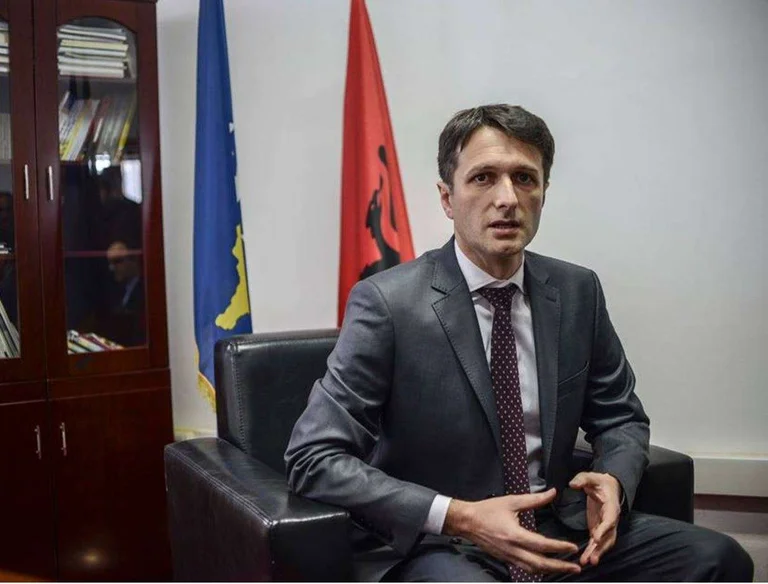
Valon Murati: Kurt is interested in continuing the status quo
Periskopi(5 years ago)
(5 years ago)Movement for the Union Chairman Valon Murati has said he does not expect any quick agreement between Kosovo and Serbia. In this interview given the newspaper “The new age”, he has said that Prime Minister Kurti is much more interested in continuing the status quo. Murati has shown that this is happening because solutions can [...]
In this interview given the newspaper “The new age”, he has said that Prime Minister Kurti is much more interested in continuing the status quo.
Murati has shown that this is happening, because the solutions that may come out of the dialogue process are not populist. According to him, Prime Minister Kurti has at no moment shown any willingness to approach these talks with the seriousness they deserve.
Murati has indicated convinced that redefining borders between the two states is the only option Kosovo makes functional.
He has stressed that Brussels dialogue dynamics can only speed up Americans.
Muhammad KOCI
“Mr. Murati, at last, has taken place the first meeting between Kosovo Prime Minister Albin Kurti and Serbia's president, Aleksandar Vuciq, within the continuation of the Kosovo dialogue Serbia. What is your assessment of this meeting?
Murati: Within the Kosovo dialogue, Serbia this was Prime Minister Kurti's first participation in such a meeting. It was, too, his first meeting within dialogue with President Vuciq. In no option have I expected any results from this meeting, not only for the fact that it was the first meeting and it would be naive to revive hopes for any outcome, but, above all, it seems clear that Prime Minister Kurti, as well as most of Kosovo's prime ministers in the past, are more interested in continuing the status quo than in achieving any concrete results in talks with Serbia. None of the solutions that can come out of the dialogue are populist, so even our prime minister, established in politics with the populist agenda, would prefer to walk the hard roads. The roads that true citizens and visionarys would have to walk and who would courageously work to exploit dialogue, free Kosovo from the burden of problems with Serbia. Prime Minister Kurti has actually taken advantage of this meeting and the attitudes he has presented in the post of domestic political agenda. Above all, with strong pre-Vucinqi positions, he has made efforts to neutralise criticisms of participation in this dialogue table, without meeting the conditions he has put in the past as condition for his and Kosovo participation in the dialogue. But at no moment have I managed to read any willingness by Prime Minister Kurti to approach negotiations with the seriousness they deserve. On the other hand, Serbia, being in a more favourable position, is also not deeply interested in the results of the dialogue. Even President Vuciq in his now recognised role of the '%viktimjaʹ dialogue and its positions formulated in relation to domestic opinion, especially in light of next year's Serbian spring elections. The approach of both sides is to make good before the international factor and to try the other side to present it as a barrier to dialogue. The presentation of four points from Kosovo's prime minister had this goal as well, to show the EU that Kosovo is constructive, given the fact that in recent years it has been treated as a barrier to dialogue.
“Kurt made public the proposals he submitted at the meeting. How have you seen these proposals?
Murati: As I pointed out, I have not seen it as proposals to solve problems, but as a tactic to put the other side in a defansive position in relation to the EU and, above all, to achieve a victory in the internal plan. The first point, that of converting CEFTA into SEFTA (so with involvement in the free trade agreement of only Western Balkan states, which are not part of the EU), and the creation of a common economic zone between SEFTA and the EU under the EU and EFTA (European Economic Zone) model is, more or less, a proposal packaged by other name for ideas and projects that circulate in the Balkans in recent years under the Berlin Process as the Black Line, the Balkans, the Economic Zone, etc. This proposal is a signal that the Kurti government is willing to enter the integration processes that have been rejected so far by Kosovo, but seems to be giving its original inputs in the process. After all, commitment, whether of the EU or of the Western Balkan countries, to regional integrations proves that the region's EU integration process will be longer than originally thought. On the other hand, the point on the pact for nonattack between Kosovo and Serbia, although at first glance it may seem very dignified, because it leaves the possibility that Kosovo can have offensive capacities, and not only Serbia, is actually completely disconnected from reality in the context of regional security policies. Security responsibility in Kosovo is KFOR, NATO, respectively, and not only is Kosovo and our army intended to be a NATO partner, but it is still the main associate today that has NATO's main power and pillar. So neither can we speak of any Kosovo offensive potential in opposition to NATO and the US. On the other hand, despite Serbia's aggressive policies as well as its continued arming, as well as Serbia, while KFOR is here, poses no danger to military attack -- this does not mean that it will not work on the destabilisation of Kosovo, especially in the country's north. Kosovo to boost its security would have to work earnestly on resolving problems with Serbia, NATO membership and unifying defence policies with the Republic of Albania until the union. The pact for nonattack in the context without the US, without NATO and without joining Albania would have little practical value. At the third point, reciprocity with Serbia is mentioned, which would be in order if handled in the context of talks with Serbia and the location at the negotiating table of Eastern Kosovo and with reciprocity of the rights of Albanians there with those of Serbs in Kosovo, especially those in the country's north. But no, Prime Minister Kurti strangely sets reciprocity as a principle after mutual recognition (reciprocity in relations between the two sovereign states is an inevitable and common principle). He even proposes that the model of the National Council of Albanians be applied to Serbs in Serbia (intinent, but not as a counterweight for association). This still seems attractive and even populist because many have implied that with this point of three it is thought that many of the privileges of the Serb community in Kosovo will be removed. In reality, though, the reality of this proposal is quite different. With this approach, there is no change in Kosovo's constitutional structure to make it more functional. This means maintaining all privileges for Serbs that through the Ahtisaari Pack are guaranteed by our constitution, which harm the functionality of our state and instead of the association, we have the National Council of Serbs. This aside from not being a solution to the functionality of the state of Kosovo, because the talks should be used to functioning it, it leaves Albanians in eastern Kosovo in a serious position because it does not belong to the solution. Furthermore, a harmful message is sent that they are good enough to take an example for Serbs in Kosovo. In contrast, they are very bad, and the talks should be where their position will be addressed. The fourth point is typical populist for domestic consumption: to leave the former Milosevic regime talks like Odalovic and Angjelkovic, but is accepted, though he has been the exhibition of Milosevic's government during the war, as well as the loyal tool of the Serbian Radical Party of Sheshel, respectively.
“Prime Minister Kurti has rejected talks with Serbia throughout his political career, but is claiming that in this process he will open new topics, bypassing old topics like association. Is it possible to change the approach of this process?
Murati: Prime Minister Kurti is actually packing old topics so he can look new and sell to his supporters that he hasn't changed. But, basically, as I stressed, he is becoming part of talks like all other Kosovo prime ministers, not disseminating before our opinion the importance of these talks and our interest in him, but as an obligation imposed by internationals. This is a major problem of our entire political scene, which has never been explained to citizens that solving problems with Serbia through dialogue is in our interest. So I don't think he's giving any signal that he wants to change course, or that he has the courage to deal with bold political solutions. Courageous political solutions are not populist. As a result, the course you are taking will not be able to avoid pressure to implement association, however long it may be due to circumstances that the realisation of this pressure may last.
“The American ambassador to Pristina has declared that Kosovo is tasked with forming association, while the prime minister has rejected that. In this way, can good US reports endanger Kosovo?
Murati: There is no doubt that implementing association is a legal obligation of Kosovo with the 2013 agreement. The other thing is that in all its variants, association is very harmful to Kosovo's functionality. Furthermore, implementing association, whether by executive competency or without, is not part of any package for Serbia's recognition of Kosovo. Such an association that would, for the inside, increase Kosovo's defunctness, only enhances Serbia's appetite to add its demands as autonomy for the north (as the Southern Tyrol model is mentioned), extorial for Orthodox churches, etc. To escape implementation of this association Kosovo opened a door in 2019, even from the US administration when it was allowed part of the solution to be redefining borders. This door, although easily moving toward closure, narrowing space, has not closed if it has will. And I'm really confident that it will never be completely closed, and it can be opened if the parties express their will for it. I personally have no doubt that this is the only option that Kosovo makes functional, addresses the issue of Eastern Kosovo, and opens the possibility of joining Albania if it is willing. Even since Serbia's recognition will be very difficult, the redefinition option is the only one from which internal functionality is no longer dependent on the expert recognition. At this moment, however, there is no will to walk this path, much more so that the solution was followed by most political subjects, but never showing which option they will pursue. And many options don't. And they're all worse than the other: association, association with executive competencies, autonomy for the north, extremity for Orthodox churches. And, surprisingly, he does not hear from the prime minister or other opposition political parties that as counterweights of these options, if not redefining the borders, be at least reciprocity on the right: if association is required for Serbs in Kosovo is also guaranteed for Albanians in Serbia; if autonomy is required for the north, it is also guaranteed for eastern Kosovo. By not moving our policy in that direction, of course pressure will increase to implement harmful agreements on Kosovo, because it is the commitment we have taken. And at no time should we grieve with our allies, especially not Americans, who have opened the doors to us in recent years for other solutions. However, I must stress that I am very skeptical about the possibility of implementing association or any model of Serbian autonomy in Kosovo. In all variants these models will fail both in implementation and in their functioning, and at the end of the process, which may be several years old, it will still remain as the only solution to redefinition of borders. I am afraid, however, that in such a situation, we will lose much more than if we make that solution from 2018 to today, and not talk about the losses we will have as a society from delaying Serbia's problems and spending energy on internal political warfare rather than focusing on economic development, rule of law, progress of education and culture, etc.
“Even at Tuesday's meeting, Kurti éciq saw the opposing positions of the parties. What are the chances that at the end of this process we will have a final agreement?
Murati: I don't expect a quick deal, and that's the space that Kurti government has to maneuver for a while. A meeting will take place in July of this year, which will be more or less similar to what we saw, though the parties may set a broad framework of what will be discussed. Then European institutions go to summer break. In September are German elections and the removal of Chancellor Merkel from German politics; in October there are local elections in Kosovo; in the spring the Serbian elections; and then there are French presidential elections. All of this will slow down the dynamic and pace of the dialogue process and do not expect any results or even great pressure, especially from the EU in this period. The only ones who can ruin this comfort are Americans if they decide to get more directly involved in the talks.
“The opposition, which has led this process until last year, is refusing to participate in the dialogue. What should be the attitude of opposition parties towards this process?
Murati: Talks with Serbia have long become part of the electoral battle between Albanian political parties. Of course, LV has placed this political battle at its edges, making every normal debate about negotiations impossible, even making it impossible for constructive criticism of the process. Since even the parties of the old establiable, dialogue with Serbia has never dealt with it seriously, they are trying to bring more or less to the same disk as the LV once. The right path, in my opinion, is reaching a consensus about dialogue, and in this direction it is quite insignificant whether the opposition is involved in the talks. However, with these options that favour our political subjects at the moment, and with their approach I find it impossible to reach consensus. Neither is really interested in resolving problems with Serbia through negotiations. Most of them survive on the political scene with Serbia's theme and its risk.