 an hour ago
Serbia demonstrates air and land military force
Periskopi(5 years ago)
(5 years ago)From air and from land, from the Peter Plain to the south to Kraguyevc in Central Serbia, with heavy arms and soldiers, Serbia over the past two weeks demonstrated its available military force. Russian jets MiG-29, Airbus H-145M helicopters, T-72-type tanks and armoured vehicles [...]
From air and from land, from the Peter Plain to the south to Kraguyevc in Central Serbia, with heavy arms and soldiers, Serbia over the past two weeks demonstrated its available military force.
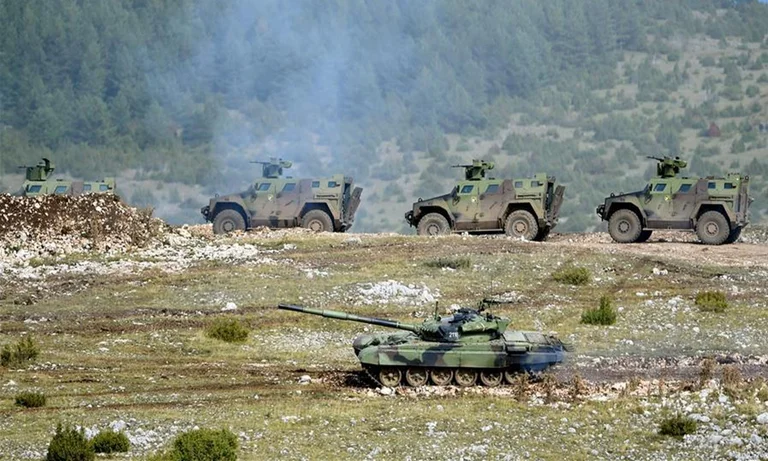
Russian airplanes MiG-29, Airbus H-145M helicopters, T-72-type tanks and BRDM-2 armoured vehicles from Russia, CH92-A fighter drones purchased From China As well as the equipment produced in Serbia, they were exposed to the public.
Common two-week tactical exercise, titled “The lightning explosion” in Peshter has ended, and the following day, on June 28th, part of the weapons and other equipment were sent about 200km north to Kraguyevc, central Serbia.
Military force demonstrated before citizens near the memorial park “Majorce” in Kraguyevc, which was built to remind 2,796 civilians shot in 1941 during World War II, including 300 students and professors from the first high school of this municipality.
The so-called “Open Day” in Kraguyevc, according to the Ministry of Defence, was the biggest event of its kind ever held. It was held on June 28th, when Serbs mark Vidovdan, the national holiday in memory of the Battle of Kosovo, which took place on June 28th of 1389.
Since the beginning of the year, Serbia has shown military weapons and equipment seven times through military exercises, reports the data published on the Serbian Defence Ministry website.
Vuciq announced new military investments
During the demonstration of weapons and other military equipment, Serbian President Aleksandar Vuciq announced that the army will continue to equipment with new weapons.
The next year, which will make the Serbian Army twice as strong as it is today”, Vucinqi said in Kragujevc.
He added that “dare not talk about new purchases (of weapons and military equipment) by January or February” of next year.
The announcement of new arms purchases and military equipment comes a year and a half after Vuciqi himself said Serbia would ban the purchase of weapons and that “the military will modernise”.
We will target additional reforms in our army, in order to make it more mobile and faster. This does not mean buying weapons, rather”, had declared Vuciq in December 2019.
Messages from the Peter Table
On June 27th, Serbia's Defence Minister Nebojsa Stefanovic said the “exercise The lightning explosion” at the Pester Plain range was “an excellent opportunity to control operational capacity of Serbian command and army units”.
“The exercise also showed how much has been invested in the equipment and arming of our people”, Stefanovic said.
Vuciq stated in Peshter that Serbia “is not interested in any war or conflict”, but it is “strengthening the army for defence purposes”.
In response to REL questions, the defence ministry said the purpose of the military exercise at Peshter was to present the force that the Serbian Army has “to respond to challenges, risks and threats to state security”.
According to the ministry, more than 2,300 members of army units, air forces and air protection, the 72nd Special Operations Brigade and the 63rd parade brigade” participated in that exercise.
The ministry added that Serbia's army has many equipment, which has been purchased by the Soviet Union and over the past few decades by the Russian Federation.
“From military equipment recently acquired by the Russian Federation on 27 June, T-72 tanks appeared in Peshter. MS, BRDM-2M combat vehicles, air defense systemPancirAnd Mi-17 and Mi-35 helicopters. Meanwhile, equipment purchased by the People's Republic of China (in this exercise) introduced CH-92-”, the Defence Ministry said.
The Effect on Reports With Neighbors
This show of Serbia's military force could cause nervousness in the region takes into account the past, James Ker-Lindsey, professor at London School of Economics, told Radio Ker-Linds.
“We can understand that things have changed now, but this is still something that makes the neighbours nervous”, Ker-Lindsey said.
Of course, there's another side of this story. Many would view such training as natural, run by Bosnia and Herzegovina or Kosovo. But, in reality, what leads to increased military spending and which is more disturbing is the report with neighbouring Croatia”, he says.
He believes the display of the military force on the part of Serbia “will not be understood positively in many countries”.
I think it's disturbing because I don't see how this can benefit Serbia's international reputation. There is also a stance, not in all, but in a large number of European Union countries, which parades and military exercises belong to the past”, Ker-Lindsey estimates.
Why all this?
Geopolitical analyst, meanwhile retired general from Montenegro, Blagoje Grahovac, tells Radio Free Europe that this populism is directed by the public in Serbia and not towards other countries.
“The philosophical and historical posters say that a state that supports its defence in the weapons force is a vulnerable state. A state that develops friendly relations with its neighbours is a protected state. According to these two parameters, it seems Serbia is on the wrong track because there is no answer to the questions why or why it is doing all of this. It's a population aimed at militarizing the mood of citizens. What can this serve? For unreasonable policies to be again abused by citizens”, Grahovac said.
Grahovac adds that Serbia spends means for arming the army, weapons that will not be used against anyone and that military exercises are not causing concern in neighbouring states.
“Who can make war in the Balkans today? Nobody. If anyone starts a war, he'll lose it. Neither the European Union nor the international community would allow such a thing”, Grahovac said.
For whom do military training serve?
With the 2021 budget revision voted by Serbian deputies on April 22nd, the military budget increased by 44 per cent, compared to the budget originally planned to divide for the sector.
According to Maja Bellosh of the Belgrade Centre for Security Policy, the demonstration of the military force is seen as an excuse for boosting the budget for the military.
She said about REL that military exercises targeted the interior audience.
“I think that the purpose of this training, this show, was primarily directed towards the local public, to demonstrate the force, to show the strength of the Serbian Army and perhaps to justify the increase of the budget for 40 percent for the Serbian Ministry of Defence and to increase investments for the Serbian Army”, Blodos estimates.
According to her, President Vuciq and the Serbian government want to show the military is powerful. However, she believes citizens have other priorities.
The exercise is only strong if there are people who know how to use equipment, especially if we talk about equipment that has been bought by Russia or China, if (the army) is depoliticised and professional, not being instrumentalised by politicians and political parties. On the other hand, the priorities of Serbian citizens are to have clean water and air, better health and more jobs”, she says.
When it comes to buying military equipment, it says, there is great room for corruption. It also says that integrity and political responsibility are important for the defence system, when agreement is reached on purchasing military equipment from Russia, Turkey, China or Western European countries.
What we've had the chance to see is that the citizens of Serbia don't know how much these devices cost us, which we could see in Peshter, during military training, as well as other military equipment Serbia learns to buy”, Bollosh said.
With the budget review, the defence ministry budget increased by 46 billion dinars (391.2m euros) in proportion to preliminary budget planning. With this increase, the budget for this ministry has already reached 148 billion dinars (1.2 billion euros).
During the budget review, the Fiscal Council said the main reason that <x0 regulations had significantly increased” for the defence dictatorship was the purchase of weapons and other military equipment.
This independent state body, which reports to the Parliament of Serbia, also estimated that increasing investments for the security sector “on the economic side, is a fully unwarranted thing”, taking into account the fact that the fight against the COVID-19 pandemic is still continuing in Serbia. Additional investments in this sector, as this Council has said, are expected to have an impact on public debt growth.
Because it is primarily about buying military equipment, which is largely imported, the effect of these investments in economic growth is insignificant while having a direct effect on the growth of the fiscal deficit (which is already only high) and public debt in 202118x1>, the Fiscal Council said.











