4 hours ago
Gashiqi is making living in Gjakova impossible: They attack me, they shoot me, I don't even go to the store without the cop.
Periskopi(5 years ago)
(5 years ago)The return of Dragica Gashiqi, with Serbian affiliations, to live in Gjakova has prompted reactions within this municipality, but a protest before her residence on the part of family members of undiscovered persons, warned of Monday, has been cancelled. Dragica Gashic says she is facing attacks by fellow citizens, but she has [...]
The return of Dragica Gashiqi, with Serbian affiliations, to live in Gjakova has prompted reactions within this municipality, but a protest before her residence on the part of family members of undiscovered persons, warned of Monday, has been cancelled.
Dragica Gashic says she is facing attacks by fellow citizens, but she has decided to live in Gjakova.
Nysrete Kumnova from the association “mothers' calls”, stresses that they will not allow Serbs to return to Gjakova.
Bekim Blakaj from the Fund for Humanitarian Law in Kosovo expresses the opinion that any displaced person's return should not be conditioned. Nongovernmental organisations, at the country's central level and neither the Government of Kosovo, have so far reacted to the case.
Gashiq: They're attacking me.
Dragica Gashic, on June 6th this year, has returned to Gjakova, as the first person from the Serb community to return to this town after the 1999 war, when she was displaced from there. It does not plan to leave anymore because its “wish has been satisfied to return to Kosovo”. She has so far lived in Serbia.
In a statement to Radio Free Europe, Gashi says that no one has done anything wrong and that he will resist all temptations.
But, she says it's heavy for her that it's undesirable in Gjakova and that, as she says, her fellow citizens attack “almost every day.
I call the police that they attack me, that they shoot me, they shoot me, they take pictures of me at the door of the apartment, they knock at my apartment door, which has faded like a rose. If you kick him with a kick, we'll blow him off”, Gashiq said.
She added that without escorting the Kosovo Police, she does not even go to the store, while hoping that this situation will change because, she says, her best years had been spent in Gjakova, in which town had come from neighboring Cline when she was only 18.
Dragica Gashic explains that prior to the war and before being moved from Kosovo, she had worked in Serbia's Police in Gjakova, but only as a janitor of the facility.
She adds that she has no clear reason why someone is holding back from returning to her residence.
I know I didn't do anything ugly to anybody. I had two kids born here”, she said.
The director of the Office for Kosovo in Serbia's Government, Petar Petkovovic, has met with Dragica Gashiqi in Gracanica, in the vicinity of Pristina. After this meeting, he has said Serbia's “State Office for Kosovo and Serbia's president, Aleksandar Vuciq, will do everything possible so that Dragica Gashici can enable dignified human life”.
However, Dragica Gashic, now not sure of anything, nor of promises many people give him in recent days.
I've been promised everything since the cameras at the entrance. I've been promised everything, but whether they will be fulfilled or not, I don't know, just lie to you”, she said.
Gashiq, now a few years ago, has asked the Kosovo Property Agency (Kosovo Agency for Comparison and Verification of Property) to release her residence in Gjakova. It's already been enabled. As she said, her apartment has been evacuated for several years.
I promised: We don't want Serbs in Gjakova
On the other hand, Dragica Gashiqi's return to Gjakova has triggered different reactions that have rejected this return.
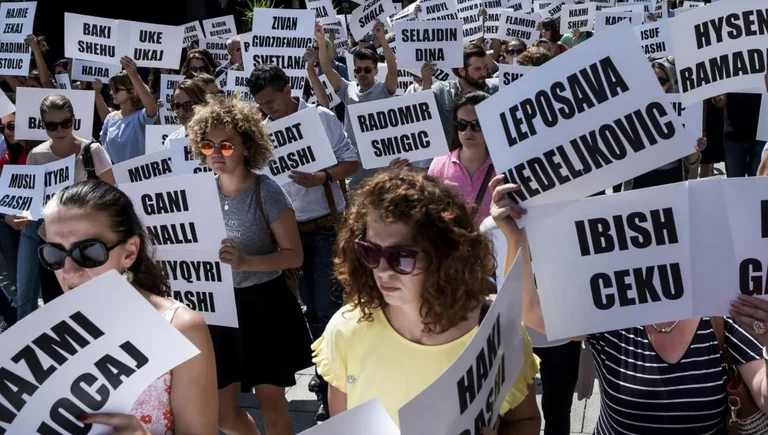
A protest in front of Gashiq's building was also initially warned by representatives of the family of missing persons, but, however, it has not been held. So the representatives of these family members had decided on their own after talks on Monday, June 28, with the chairman of the Gjakova municipality, Ardian Gjini.
This confirmed, Nysrete Kumnova from the <x0 mother's calls from Gjakova. This association has gathered women who lost children or men during the war, who were violent by Serb forces in 1999 and then killed or disappeared.
Kumnova is still searching for her son, whom Serbian forces had kidnapped from home, along with five other men, as well as Albanian civilians. Mortories of five have already been found in mass cemetery in Serbia and have been returned to family members.
Kumnova says representatives of the family of the missing persons have decided not to protest “without proving Gashi's return”, for which the chairman of the Gjakova municipality, Ardian Gjini, had told them that on Monday it was not in her apartment.
But, as Kumnova says, the annulment of the protest does not imply that the family of the missing people approve Gashi's return to Gjakova.
She's not gonna live here. All (Serbs) have committed crimes and wounds are open. Among the group that's taken is my son, my sixth himself, here at home. Five of them are back and I fucked up the boy I didn't find. And come here to live? No. And not only that, but no Serb will allow”, Kumnova stressed.
Confrontations within the War Striked Town
In the Gjakova municipality, 11 non-governmental organisations have said they would hand over the Kosovo government a petition for the removal of Serbian national Dragica Gashic.
She is seen as an unwanted person in this municipality for working in Serbia's Police during wartime in Kosovo.
Gjakova is one of Kosovo's worst-hit municipalities from the 1998 and 1999 war, where more than 1,000 Albanian civilians, most of whom men were killed. The fate of a number of them is not yet white, and they figure like dead persons.
Towards the return to Gjakova of Dragica Gashiqi has reacted to the political subject Alternative, whose chairman is Kosovo Parliament MP Mimoza Kusari Lila.
This political subject is part of governance in Kosovo, which Prime Minister Albin Kurti heads.
The alternative has accused the Gjakova municipality, as it has been said, “of returning the Serbian citizen to Gjakova and lack of transparency”.
The branch of this political subject in Gjakova has asked the mayor, Ardian Gjini, to show that “when communication has begun with Serbian national Dragica Gashiq for her interest in returning to Gjakova”.
The alternative further stressed that from the apartment where Dragica Gashic, which according to this political subject, is municipal property, a family named Emra has been expelled. This political subject has also published documents in which it finds Dragica Gashic's residence address.
According to documentation provided by the Alternatives, “Dragca Gashiq has submitted the request to the Kosovar Agency for comparison and Verification of Property” to return to the apartment in which it is already located.
Ginny: AKP has decided in favour of Gashi
Even the Chairman of the Gjakova municipality, Ardian Gjini, who comes from the ranks of the Alliance for the Future of Kosovo, has told the media that regarding the Gashi case and, in its favour, as the owner of the residence, the Kosovo Property Agency, and not the Gjakova municipality.
He said Gashi had registered the apartment as her property in 1997, naming it a time of contention.
However, he has stressed that he has talked with the Kosovo Police, so that no incidents occur. He has stressed that he understands the pain of family members of those who are not found, but according to him, all specific conflicting circumstances should be clarified in legal ways.
“Today, Kosovo has institutions, has its own government, has its own police, has trials, has its own municipalities. It means, we're living in a democracy and everything has legal solutions”, Djind has stressed.
Blake: Returns of Displaced Persons Should Not Be Conditioned
Bekim Blakaj from the Fund for Humanitarian Law in Kosovo has expressed the opinion that each displaced person enjoys the right to return to his own property and to the place he lived before, in case he expresses his wish.
This cannot be conditioned to anything else. I fully understand the families of the victims in Gjakova and I understand that there are huge numbers of deaths and disappearances in Gjakova and that their families have so far seen no justice. But, however, it should not be conditional on the return of persons to their properties, to their homes. In this context, even Mrs. Gashiq has returned to his apartment and I think security institutions, in the first place, should offer security and make sure no one bothers him”, Blakaj stressed.
He added that the Fund for Humanitarian Law is waiting to co-ordinate with other non-governmental organisations, for a response to the Gashiq case, and for the right to return to its property, any citizen who has been displaced from Kosovo.
Government and NGOs keep quiet
Regarding Dragica Gashiqi's right to return to her living estate so far, none of the non-governmental organisations in Kosovo has reacted.
In regard to the Gashic case, so far, there has been no reaction either from the Kosovo government.
Free Europe has been addressed to the executive Radio with questions about what their position is regarding the Gashiq case, as well as whether the Government of Kosovo has any plans on the issue of returning displaced Serbs from Kosovo. But until the publication of this text, no answers have been returned.
Processing Return of Displaced
The process of returning displaced persons to Kosovo began after the end of the war in 1999, when over 800,000 Kosovo Albanians who had been expelled during the war returned, and later, at the same time, Serbs left.
According to data from the Kosovo Ministry for Communities and Return, since June 1999, after the war ended in Kosovo, about 226,400 Kosovo citizens, mostly Serbs, Roma and other communities, fled their homes. By 2020, about 28,500 citizens have returned to Kosovo.
Meanwhile, in Zvecan, this predominantly Serb municipality in northern Kosovo, on an area of 15 hectares, Serbia and the Serbian Orthodox Church, in September last year, were finishing construction of 300 residential units within the settlement “Sun Valley” These residential units are destined for displaced persons from Kosovo, the Serb community.
Official Pristina has said there is no evidence that this settlement has received the necessary permits from the local government.
Based on UNHCR data, 2016, it is believed that displaced outside Kosovo are about 107,000 people, out of whom 88,000 in Serbia, more than 1,400 in Montenegro and over 600 people in northern Macedonia.