 4 hours ago
For the fourth time in a row, repetition of the AIP commissioner selection process is required
Periskopi(5 years ago)
(5 years ago)Much noise and disagreement has triggered the process of selecting the Agency for Information and Private Commissioner again. This is the fourth time of the repeat of this competition, because three other times due to the irregularities outlined in the contest, the process had turned to zero point. Returning the competition for the fourth [...]
This is the fourth time of the repeat of this competition, because three other times due to the irregularities outlined in the contest, the process had turned to zero point.
Returning the competition for the fourth time to zero this time the opposition is demanding.
Since the competition was declared and immediately after reviewing candidate applications, in the field of interviewing candidates, the Commission for Security and Defence Affairs had not reached consensus on forming the interview panel for the recruiting process for the position.
The dispute had come due to the commission members' request from the Vetevendosje party ranks, which have demanded that all members of this Commission be included in the assessment panel, while the request of other Commission members from the ranks of other opposition parties has been to go with one representative from each party, as they have said happened other times.
After a lot of discussions, since disagreements had failed to survive, the opposition, comprised of MPs from the LDK ranks, The PDK and AAK had boycotted participation in the evaluation panel for this recruiting process.
Despite this fact, however, members of the Commission from the ranks of the incumbent parties, the Vetevendosje Movement, the Kosovo Roma Progressive Movement (LPRK) and the Serbian List, have continued further with the candidate interview process.
Despite reactions to the opposition and several civil society organisations' demand that this process be reversed, the same has not been reversed, but the report with the names of the candidates recommended to be selected as the Commissioner of the Agency for Information and Privateness has been approved to be sent to the Assembly for voting.
Enver Bujar, Crenare Sogoyeva Dremak and Edon Miftar are the names of candidates who will be sent for a vote at the next session of the Assembly, and one after the vote is expected to lead with the Agency for Information and Privateness.
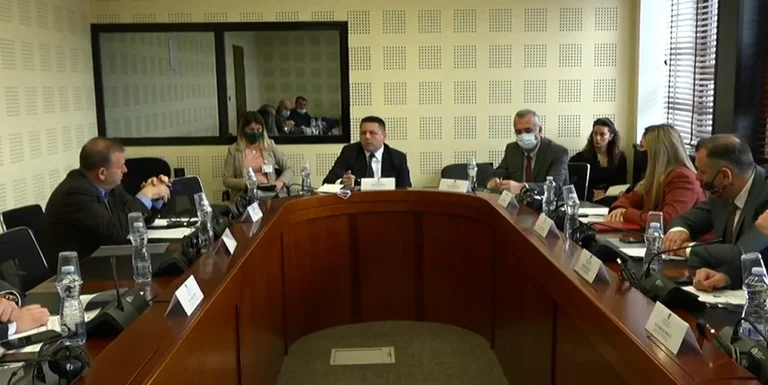
The Commission's present-day meeting was called by the chairman of this Commission, Beke Berisha, who, during the meeting, at the point of discussion on the issue of appointing the Commissioner for Information and Privateship, said much revolted with the work of deputies of office and after the release of the hall by PDK and LDK deputies and the leader himself released the meeting. Berisha even declared the meeting complete, but despite that MPs from the ranks of office continued the meeting with the reasoning that they had the same quorum to continue.
The first to release the meeting was PDK deputy Elmi Recica.
Recica said they stand behind the decision to withdraw and reject this process, which she called compromised.
We as a parliamentary group are not interested in being at such a meeting and hearing the report, so the only solution that has now been left is for the process to return to the starting point. We're withdrawing, you're continuing and I believe it will be a good lesson to distinguish many jobs in commissions and parliamentary groups. You have broken that rule and I refuse to be either part of the physical presence that breaks up what's built to be”, Recica said.
Even LDK deputy Anton Chunn issued the meeting on the grounds that since the beginning they have rejected such a development of the process, staying at meetings during the discussion of this report considered it unnecessary.
“We're dealing with an issue on which from the beginning we have separate attitudes and as a result of this, of course, we have instability. The very fact that the basic rules that have so far guaranteed a balance of political parties have been changed at first, now when this process from the beginning is considered such I don't see any obligation to stay at the hearing of the” report, Chun said.
While MP from the AAK ranks Beke Berisha, candidate Enver Bujar's maximum score vote, called it a state capture action. According to Berisha, such people should not be selected as security guards.
You've changed the practice with the societies, then you've independently kept it and you've determined the winner from here, Enver Bujar has voted at full score, the same man I voted with one and two, I wish this man never solves anything. Here is where your goal is to be on this panel. For Enver Bujar comes and swims with 10 of you, but I wish that people would never have the yoke, nor the keeper, and let them lead institutions. This is just about capture the state. These have arrived, unless you continue, I close this meeting here”, Berisha said.
After the chairman's release of the meeting, Deputy Chairman Enver Dugolli led the meeting.
“I honestly tell you that we are legally obliged to push the process forward, there is no legal possibility to interrupt this” process, Dugolli said.
Following the release of the assembly by MPs from the opposition ranks, MPs from the compound position: Enver Dugolli, Erdjan Galushi, Arber Rexaj, Fatmir Humolli, Albanian Selimi and Mefail Bajcinovci approved the panel's assessment report on the recruiting process for the selection of the Commissioner for Information and Privateness, and at the next session the Parliament MPs are expected to vote for the commissioner's election.
We remember that so far three times in a row the vote of candidates elected by the Commission for Security and Defence Affairs Commissioner for the Information and Private Agency has failed.
The Kosovo Assembly had failed three times to appoint the Agency for Information and Private Commissioner.
At the session of August 14th, even after two rounds of voting, the Parliament failed to appoint the Agency for Information and Private Commissioner.
This competition was cancelled three times.
Initially, this competition had failed its first in May 2019 and then its second attempt in July 2019.
About the selection of the Agency for Information and Privates' commissioner, there had been many reactions to the public.
Some civil society organisations that had asked the contest's annulment commission in May last year under suspicion that some of the candidates who applied have political ties. According to them, no one could risk European Union funds dedicated to the Agency for Information and Private.
Apart from civil society organisations, the Commission for Internal Affairs, Security and Supervision of the Kosovo Security Force and the British Embassy had recommended canceling the process.
But although the first time the British Embassy itself had recommended canceling this process with the reasoning that neither of the candidates had been named, for the third time, British BDO experts have recommended the appointment of two candidates.
But even in spite of the British Embassy's recommendations, Kosovo's Assembly for the third time in a row had failed in the selection of the Commissioner for Information and Private.
The failure of the contest for the third time led the British Embassy to react and express disappointment over the contest's failure.
On this occasion, the British Embassy had even announced that British BDO experts have withdrawn from the recruiting process for the position.
The embassy in reaction had said it would not bring down British taxpayers' money in repeated processes that were transparent and well-developed, and that issued candidates who met the terms for appointment.
It is noteworthy that the candidate for the Commissioner for Information and Private Agency, Enver Bujar, who this time received maximum scores from the assessment commission, earlier when representatives from the British Embassy were included in the process, was considered unnamed by embassy representatives.
Objections about the course of this process have also had a group of civil society organisations, which the process has called nontransparent and non-region, demanding that as a result of irregularities, the process for the fourth time turns to zero point.











