 4 hours ago
Fear of Afghan employees: “The Taliban will kill us”
Periskopi(5 years ago)
(5 years ago)The Taliban, for years, have pledged to kill every Afghan that has worked for US and NATO forces in Afghanistan. Militants name them “traitor”. Now that foreign troops are expected to leave Afghanistan by September, tens of thousands of Afghans who have worked in supporting roles are locked in fear [...]
Militants name them “traitor”.
Now that foreign troops are expected to leave Afghanistan by September, tens of thousands of Afghans who have worked in supporting roles are locked in fear and panic.
Their concerns are well based. The Taliban, over the years, have killed hundreds of Afghans who have worked for foreign military forces and their family.
Fear has increased by intensifying violence and the victories of the Taliban on the battlefield, in recent months.
Since the beginning of the withdrawal of foreign forces on 1 May, the militant group has taken control of dozens of West-backed districts, military bases, and cities, inciting fears that it could also bring down the Afghan government.
The United States and several other countries that are withdrawing troops from Afghanistan have established special immigration programmes to help endangered Afghan workers escape Afghanistan.
But many Afghans who have applied complain that they have been left in nobody's country because they have received no answers ever to even years by foreign immigration authorities.
Lawyer groups say programmes are developing very slowly and that they may not cover all former Afghan workers, who may be in danger.
Some 300,000 Afghan civilians have worked for international forces since the invasion of Afghanistan in 2001. They have worked as cooks, cleaners, mechanics, translators, and security guards.
“
“We are at great risk”, says Abdul Wakil, who worked as a security guard from 2004 to 2008 at Bagram ʹ the largest American Army base in Afghanistan.
Not just us, but our families. The Taliban will kill us”, he says.
After the departure of foreign troops, the Taliban can regain control of the country. In that case, everyone would be in danger, but especially at”, Wakil says.
About 300 Afghans who have worked for the American army or their family have been killed since 2016. These are American nongovernmental organisation “data No One Left Behind”, which works with Afghan translators to help them move to the United States.
The group estimates that, on average, two translators per month were killed this year. The death toll has increased to five during the month of May.
Afghan translators working for foreign forces are especially vulnerable to militant attacks. They are often wanted by militants, who are named as “spija”, who act like eyes and ears for “foreign invaders”.
On June 7th, the Taliban have issued a statement providing Afghans who have worked with international troops in the past, that they will not be targeted if “opens regret for their past actions and does not engage in such activities in the future, which constitute treason against Islam and the country”.
For these, however, there is great disbelief.
The Taliban are strengthening every day”, says Abdul Karim, a 28-year-old translator who has been working for the American Army since 2015. “This means that our lives are being endangered every day and more”, he adds.
The militant group has long targeted civilians, accused of working for Afghan government or foreigners.
In January, the Taliban have killed an Afghan, who has been working for the American Army for about 12 years and has been awaiting a visa to move to the United States.
Other former Afghan translators say they have received death threats from Taliban.
Infatuated in red tape
Lawyer groups and human rights watchdogs have called on Western countries to accelerate programmes to shift former Afghan workers, who are increasingly endangered by Taliban.
About 18,000 Afghans are still awaiting the answer for their US Special Migration Visa applications. The programme known as SIV was established in 2009 and modeled after a similar scheme for Iraqis.
To secure the visa, Afghans must prove they are constantly threatened and have worked at least a year for the American government.
The Pentagon has said it is developing opportunities to evacuate Afghans considered endangered by Taliban because of their work with American troops. But the White House has not yet authorized an accelerated plan.
American lawmakers have called for thousands of Afghans to be evacuated before international troops are withdrawn, fearing they can be “sized by Taliban”.
Lawmakers say visa processing could last more than two years.
British Defence Secretary Ben Wallace said on May 31st that “was a right to speed up the shift of those who might be in danger of revenge”. Britain owes “a gratitude” to local staff employed by British forces, he has said.
More than 1,360 former Afghan workers and their families have already moved to Britain. But thousands of apps have not been processed yet.
The government has eased the requirements for applicants.
But, Alliance Sulha, a group campaigning for Afghan translators working for Britain's military, has said London's policy of refusing applicants who have been laid off for small offenses is disturbing.
Other countries that had troops in Afghanistan's war, such as Australia and Germany, have not accelerated the shift.
The “countries currently withdrawing from Afghanistan have been very slow in developing evacuation plans and displacement for their former Afghan workers”, says Patricia Gosssman, director for Asia in the international human rights organisation Human Rights Watch.
“They must know that normal roads will be very slow and that quick deadlines are needed for Afghans and their families, which can be pursued because of their work with coalition forces”, Gossman says.
Betrayed
Afghans who have worked for foreign forces usually hide their identity and maintain a low profile. But many of them have recently expressed disappointment publicly.
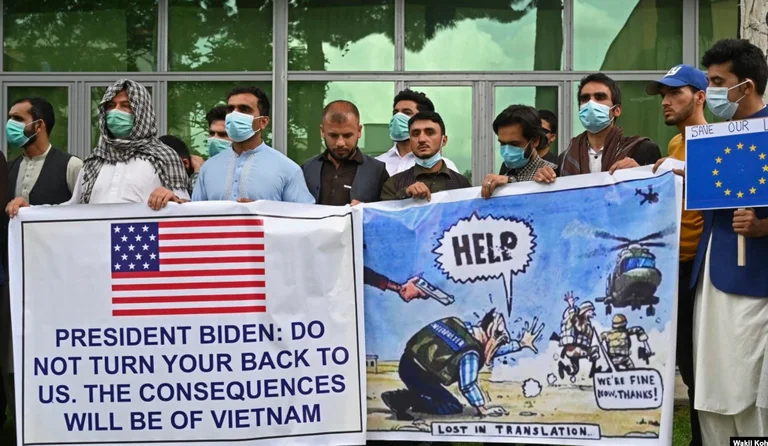
Hundreds have organized gatherings in Kabul, asking the Western countries they worked for, to move them out of Afghanistan.
Many are angry and feel betrayed because they have risked their lives to help foreign allies. They also complain that the visa-taking process is too complicated.
An American soldier and an Afghan soldier shake hands during a duty delivery ceremony in Helmand province on May 2nd.
An American soldier and an Afghan soldier shake hands during a duty delivery ceremony in Helmand province on May 2nd.
We helped the Americans and now we want them to help us, says Baryalai Rahimi, a Afghan translator who worked with US Special Forces.
Mohammad Wassel, a 32-year-old from the northern province of Kapisa, says he has medals of praise from an American commander for whom he has worked. But he says he does not know why his request has been rejected.
“We've helped [Foreign forces], we've risked our lives and now they're leaving”, says Wassel, who worked as an interpreter for American forces from 2009 to 2012. “It is their turn to help us”, he says. / REL/











