 2 hours ago
All that Albin Kurti said after meeting with Vuchy
Periskopi(5 years ago)
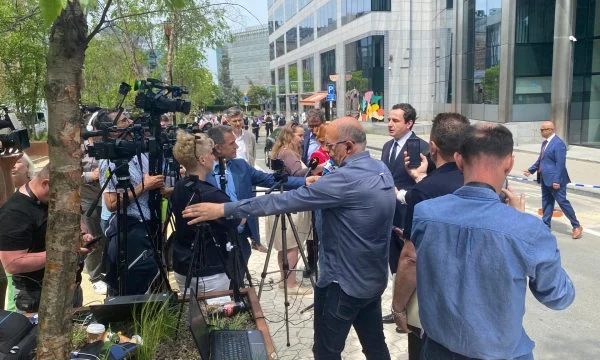
(5 years ago)Prime Minister Albin Kurti after meeting with President Alexander Vuciqi has spoken to the media in Brussels. The prime minister's office has published Kurt's statement fully after the meeting and answers to journalists' questions, Periscope reports. Kurt's full statement from Brussels: The first meeting in Brussels with the delegation from Serbia was held today. I [...]
The prime minister's office has published Kurt's statement fully after the meeting and answers to journalists' questions, Periscope reports.
Kurt's full statement from Brussels:
The first meeting in Brussels with the delegation from Serbia was held today. I was together with my deputy Besnik Bislimi, who is responsible for European Integration, Development and Dialogue, and that became the mediation of gentlemen Borel and Lajcak.
The meeting was constructive for us. We will participate in this process which is difficult, while the other side was talking about old ideas, we gave four new proposals. The first proposal was to advance the Western Balkans' CEFTA agreement in the SEFTA agreement with which we will use the model of states such as Iceland, Lintenstein and Norway, which have with the European Union so EFTA-EA.
The second proposal was a day after the NATO summit yesterday, where very clear and unanimous orders were given to Kosovo and Serbia to sign a peace declaration, where we pledge as states we will not attack each other and thus contribute to peace, security in our region and beyond.
Our next proposal we made was that in the matter of the unknown, those who disappeared violently must leave the Serbian delegation, Mr. Velko Odalovic, who otherwise was a notorious leader in 1997-99 and along with Agjelkovijqi led occupied Kosovo, as they then called Kosovo's Arch.
So, Sir Nenad Canak himself has confirmed that there are 16 mass cemeteries in Serbia, but only 5 of them have been opened. Over 1,000 Albanians have been exhumed, of them 744 alone in Batajnica, but there are 11 other mass cemeteries and we don't have to complicate the issue, when the Odalovic and Angjelkovik gentlemen know what those other cemetery are, while Nedad Canak had said he heard this from former interior minister at the time of the late prime minister, Zoran Djindjic, Mr. Dusan Mihajlovitch.
Our fourth proposal, in terms of the minority issue, was bilatheral reciprocity, which is a general principle, but in particular in Kosovo, for Kosovo Serbs, we could have a National Council, as it is in Serbia for Albanians and Bosniaks.
Our last three proposals were rejected. Our first proposal for SEFTA did not answer, but I sincerely hope that they will seriously consider this our proposal, which we made today when they return to Belgrade.
Meanwhile, the next meeting will be before the summer break, which if I'm not mistaken on July 25th.
So we're going to be ready for participation in the process, but there's still no agreement on the future dialogue on this meeting, the first one, which was held today.
Press:
Why did the issue of the missing rise, considering that in September of last year Lajcak himself has said the parties agreed on the issue. Do you have information on what the parties agreed on, on the dialogue, which was stopped in September of last year, when this subject was officially closed? Why do you get back on the surface?
Answer:
We dialogue see it as dialogue for mutual recognition. President Biden said that, and we fully agree with this statement, mutual recognition. Serbia must recognise Kosovo and a Serbia that recognises Kosovo, Kosovo recognises later. Thus, our two republics create good neighbourly relations, according to the European model.
However, from previous agreements that have been held, you should remember that they were made by a government that turned out to have been not only unregistered but also unconstitutional.
On the other hand, none of the previous agreements are valid, since there is no general agreement for all.
Consequently, it cannot be said that there was an agreement in the past, but it is our pledge as Government of the Republic of Kosovo, that if there is one thing that does not expect, it is the question of the dead, those who disappeared with violence, since families do not live in pain, sorrow, but also in anxiety. And if, in other cases, time may even soften some wounds, the opposite is true of the homeless, those who disappeared violently.
So we, too, have handled this issue, but there seems to be no willingness to deal with the people responsible at the time, who are unfortunately still in important state positions. So, it's not about people who have become citizens' votes, it's about people appointed by power there in their positions.
Press:
Mr. Prime Minister, you said there is no readiness on the other side. Even Serbian President Vuciq said it has been one of the most difficult meetings to date, this time. From the first meeting you've had, you have hope, however, that a quick deal with the Serbian side can be reached or the process will be extended as from 2011 to now?
Press:
I have hope that if we discuss them from the beginning, without equivoke, sincerely and seriously, the main issues at the top of the time, then surely there is no room for scepticism, since the approach is right. Will it be difficult? It'll hardly be. But I wouldn't say that I'm pessimistic, since we're now treating things at their core, and we're not trying to avoid the elephant in the room, and that's because President Biden has requested mutual recognition, since we currently have mutual non-recognition.
Serbia does not accept the Republic of Kosovo, Kosovo does not accept the Republic of Serbia, and this has to change.
Press:
Mr. Kurti, as has been the atmosphere, because Serbia's president said that the Albanian side, as he said, has come to prove that it does not want any agreement, does not implement any agreement and that he sees absolutely no issues on which the parties have agreed. Also, about the missing, he repeated what they often say, let Albanians show where they think there are graveyards, and we will go and look for them, while from the Kosovo side there is no readiness for research where they seek.
Answer:
Yes, this was a meeting in which the physical distance was maintained, so we were more than two meters apart and I can say that my conviction was not very surprising, but I present the interests of the Republic of Kosovo, the rights of the people of Kosovo, and in particular I try to have the process of principle, because it is only that way sustainable. We can't ask Albanians the quarter of the information they have where there are mass cemeteryes in Serbia, when we can very easily ask Velko Odalovici, Zoran Agjelkovinqi, Dusan Mihalovijqi. They know. While Serbia's president is saying he doesn't know anything, but even if he doesn't know anything, there are others who know there and let them ask, because if in Bosnia and Croatia it has probably been possible to say that Serbs there are involved in the conflict, although Serbia has not been neutral, of course, in every respect, there have been non-state crimes anywhere.
Therefore, the truth about Serbia and Milosevic's crimes in Kosovo is again in Serbia, that is, Belgrade.
Therefore, we urge, that those who are alive, have been in power at the time, to be removed from their current positions in Serbia and questioned about the criminal truth of Serbia and Milosevic at the end of the last century.
Press:
Mr. Prime Minister, have you heard from EU representatives say that finalising dialogue is mutual recognition and that Serbia's membership passes through recognition of Kosovo's independence?
Answer:
Maybe they don't say it that way, but I believe it's obvious. Kosovo and Serbia will not be able to integrate into the European Union without mutual recognition and the sooner it is realised, the better.
I stressed that, under the mandate of the European Union's High Representative for Foreign Policy and Security, Mr. Borel and under the mandate of President of the United States of Anerica, Mr. Beden, there should be a deal, but the earlier there is, the better the chocolate is. Since the longer you spend and no agreement, the harder it will be to do so.
Therefore, we must use the beginning of both our government and President Beden's mandate so that we can reach this agreement. So within that time, how long does the mandate of Masters Beden and Borel last?
Press:
You said some of the politicians who have such time in power are now. You mentioned the possibility of genocide. Is there gonna be something in this direction? Will you accuse Serbia of genocide?
Answer:
We've started with the first preparations of the genocide indictment against Serbia, but every time we mention it, we're calling on both Kosovo institutions and citizens of the Republic and international partners to help us document and prepare, so there's work to prepare this genocide indictment, but since genocide has occurred in Kosovo, the indictment for this genocide must also occur.
How much longer it will take is the issue of the working teams and experts and the speed of recording and preparation we will make.
Press:
Mr. Kurti, about implementing the Association Agreement, even the Serbian side, but the EU insists this should be implemented?
Answer:
The Association of Serb majority municipalities as a one-ethnic entity has been toppled by the Constitutional Court, since it is not in line with 23 articles. Also, citizens of the Republic have carried out mass petition, and the opposition has made radical actions contrary to Association.
The association is not for Serbs, but against Kosovo as it has been designed, so we want citizens of the Republic of Kosovo who are of the Serbian national belonging to have all rights like all others, so we don't want the majority to be privileged against the minority, but at the same time we cannot allow the repetition of the Bosnia and Herzegovina scenario.
We know very well that there on April 26, 1991, 14 Serb majority municipalities were joined, who on January 9, 1992, declared independence. On February 28, 1992, they approved their constitution, and on October 14, 1995, in Dayton, Ohio, they gained international recognition of what is known as Republika Srspka. So we are for citizens' rights to meet them but not to territorialise within Kosovo Serbia's ambitions, which suffers for the loss that Milosevic's regime has caused. I believe that power in Belgrade today would have to blame the guilty. Serbia has had Kosovo occupied and lost it in the past century by the Milosevic regime. And it shouldn't be right now to mourn Serbia's losses as a state, but they will have to co-operate with us for good relations in the Balkans and European character.











