 5 hours ago
How Periscop warned of the danger Kosovo faced with “Reciprocity” a year ago
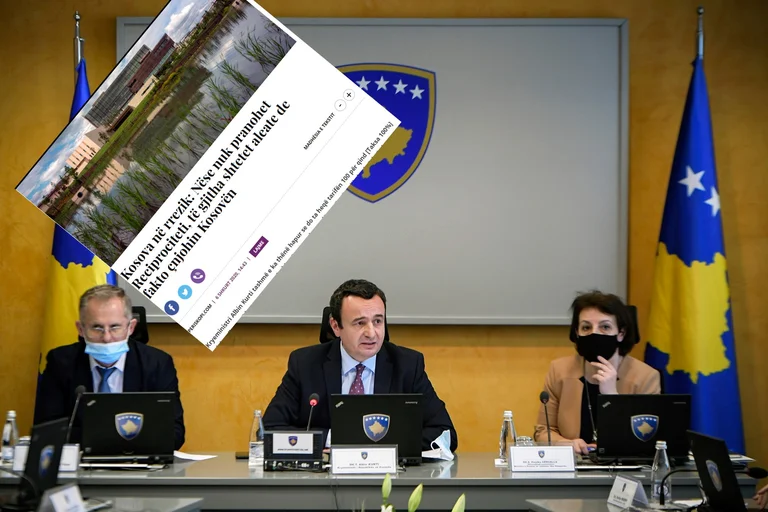
Periskopi(5 years ago)
(5 years ago)63 days after Albin Kurt's arrival in power, Reciprocity is missing. But it seems that this measure will not be decided at all after what Minister Roseta Hajdari declared today, who said that, instead of that measure, the “mocanism regional” would be used. Unfortunately, Kurti Government I with the establishment of this measure [...]
Unfortunately, the Kurti government, with the establishment of this harmful move for the country in the past year, exposed the stance of the allied states of Kosovo to our independence.
Serbia rejected the principle of Reciprocity, as opposed to the 100% tax against its goods.
This put the United States, the EU and EU member states in a very difficult position, as non-reciprocity's move meant de facto that they do not recognise Kosovo independence.
Periscope on February 6, 2020, had written a detailed article showing the danger facing the country. And now all that was said in that article has been accomplished, but Kurti II Government seems to have understood it very late.
Currently, the position of Kosovo's Allied states is regidh on Kosovo's independence, which, although known, requires mandatory participation in negotiations with Serbia.
Albin Kurti has confirmed participation in the June meeting in these negotiations.
February 6, 2020:
Kosovo at risk: If Reciprocity is not accepted, all Allied states have no fact recognised Kosovo
Prime Minister Albin Kurti has already said he will lift the 100 per cent fee [Taxa 100%] to goods imported from Serbia to impose a more radical measure, such as that of Reciprocity.
In statements to the media, government officials have said that this move towards Serbia would not wake up the reaction of international and Serbian factors. But, now the coalition is divided over this “-reaction”.
Isa Mustafa recently spoke against Reciprocity, while neither Vjosa Osmani denied that internationals could oppose it.
But what's the measure of Reciprocity in International Relations?
In international relations and treaties, the principle of reciprocity is one in which all favors, benefits or penalties made by one state towards the state or citizens of the other state return in the same way.
For example, reciprocity has been used for reducing tariffs, guaranteeing copyrights for foreign authors, mutual recognition, lifting travel visas and others.
Some teroits of international relations have suggested that there is a difference between specific forms of reciprocity and “reciprocity distributed” [Keohane, 1986]
But Kurti has promised “Reciprocitys to complete”. What may be the political implications for the Republic of Kosovo?
In fact, such an act is completely legitimate from the governments of any independent state. In the case in question, it would mean that Serbia would not have to pay the fee 100%, but would have completely been forbidden to export goods to the Republic of Kosovo if that would not be Kosovo.
In addition, this could include any relationship between Kosovo and Serbia, including the judicial system.
Of course, such an action is expected to exacerbate Serbia, which is not expected to return to the negotiating table without being allowed to export its goods to the Kosovo market and make up approximately 3 per cent of its overall exports.
And meanwhile, internationals are ahead of a very difficult position: accepting the move from Kosovo and stopping Kosovo- Serbia or non-recognition of the move by Kosovo, which would imply de facto recognition of Kosovo as an independent, sovereign and democratic state.
Kosovo is at risk and all we can hope for is that the internationals will accept the full resolution imposed by the Kurti Government. /Periscopi











