7 hours ago
Why is the mosque “Aqsa” in Jerusalem a Arab-Israeli fuse
Periskopi(5 years ago)
(5 years ago)The mosque stands in a holy place for Christians, Muslims and Jews and is a hot spot in the long Israeli-Palestinian conflict. Violent clashes between Palestinians and Israeli security forces in Mosque “Assa” in Jerusalem this month reflect the importance as part of one of the most controversial areas of religious territory [...]
Violent clashes between Palestinians and Israeli security forces in Mosque “Assa” in Jerusalem this month reflect the importance as part of one of the most controversial areas of religious territory in the Holy Land.
Here are some basic information on the mosque complex, from its importance throughout the centuries to why it is such a hot spot for conflict today.
What's the ass mosque?
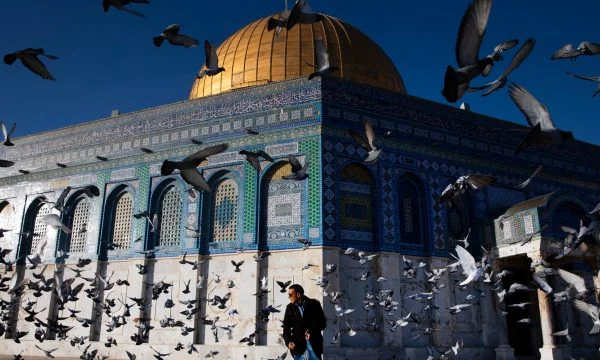
The mosque is the most sacred structure of Islam. The mosque is located within a space of 14 hectares known by Muslims as Haram al-Sharif, or noble signpost, as well as Jews like the Temple Mountain. The location is part of the old city of Jerusalem, holy to Christians, Jews, and Muslims.
In Arabic “aqsa” is translated as a distant, and in this case is a reference to Islamic holy writings and the account of Prophet Muhammad traveling from Mecca to mosque in one night to pray and then ascending to heaven, writes The New York Times, broadcasts the Express newspaper.
The mosque that could occupy as many as 5,000 believers is believed to have ended at the beginning of the 8th century and has the Rock Cup, the Islamic golden dome shrine that is a popular symbol of Jerusalem.
Muslims consider the entire sacred space complex with crowds of believers filling its courtyards to pray during the festivals.
For the Jews, Mount Temple, known in Hebrew as Har Hablay, is the most sacred place because it has been the space of two ancient temples ʹ the first was built by King Solomon, according to the Bible and was later destroyed by Babylonans, and the second has remained for nearly 600 years before the Roman Empire destroyed him in the first century C.E.
U n NESTO has classified the Old City of Jerusalem and its walls as the World Heritage site, which means it is considered “of enormous international importance and therefore deserved a special defence”
Who's got control over the glass?
Israel conquered East Jerusalem, including the Old Town, from Jordan during the 1967 Arab-Israel War, then annexed the area. Israel later declared a unified Jerusalem as its capital, although this move has never been recognised internationally.
Under a delicate agreement of the status quo, through Islamic assistance to charity known as Waqf, financed and controlled by Jordan, continued to manage the Aksa Mosque and the Rock Cup, as it had done for decades, a special reconfirmed role in Israel's 1994 peace treaty with Jordan.
Israeli security forces hold a presence at the mosque site and they co-ordinate with the Silamic Waqf. Jews and Christians are allowed to visit, but unlike Muslims, they are forbidden to pray on the basis of the status quo agreement. (Hebrews pray a little under the sacred tablet on the West Wall, the remains of a holding wall that once surrounded the temple Mount. )
Tensions over what critics call discrimination of the deal against the non-Muslims over the years have heated up in violence.
Tensions are added to Israel's annual observance of Jerusalem Day, an official festival to commemorate the conquest of the entire city. The festival, which was recently held Monday, is a provocation to many Palestinians, including the inhabitants of the eastern part of Jerusalem. The Palestinians want East Jerusalem to be the capital of a future Palestinian state, an increasingly distant prospect.
Do you want Israel to take full control of the complex?
Israeli officials, including Prime Minister Benjamin Netanyyah, have said they are not meant to change the status quo.
But some Israelite religious groups have long sought the right to pray in the complex. In April, Jordan's Foreign Ministry officially complained of a large number of Jewish visitors to the mosque's location, calling it a violation of the status quo.
What's different for the latest protests?
In the weeks prior to the outbreak of violence Monday in Al Aqsa, tensions were rising between some Jews and Palestinians on issues that had nothing to do with the mosque complex.
These included violent clashes between Israelis and Palestinians that erupted several weeks ago around the Old Town. Some Palestinians attacked Orthodox Jews in Jerusalem, and an extremist Jewish group developed a march in which participants cheered “Death for Arabs”.
The Palestinians also became angry that police had banned them from gathering in a favourite square from the Old Town during the first weeks of the holy month of Ramadan.
In a further fuelling of tensions, Palestinians have clashed with Israeli police for the expected expulsion of Palestinian residents of the Sheikh Jarrah neighbourhood of eastern Jerusalem to pave the way for the construction of Israeli settlements.
The clashes have come as long as the Israeli government is in unclear political policy, following four unresolved elections over the past two years, and after President Mahmoud Abbas of the Palestinian Authority indefinitely postponed the Palestinian legislative elections scheduled for the end of this month. It would be the first such vote since 2006.