10 minutes ago
All that is known about the Chinese missile that is expected to fall on Earth today
Periskopi(5 years ago)
(5 years ago)Part of a missile issued by the Chinese space agency is projected to make a quick and uncontrolled return to Earth late Saturday night, but until it is still unclear where and when the 30m reinforcement section will descend, most experts think the danger of striking [...]
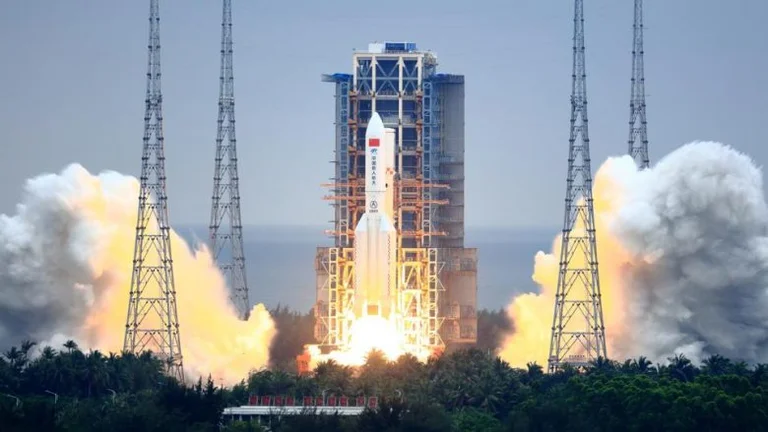
According to Forbes, the Long March-5B missile is tracked It was launched last week to transport a module for a Chinese space station, but unlike most missile launchers, the resurgeon entered the Earth's orbit at high speed instead of falling back to Earth, and gravity is now drawing it back to the planet.
The missile section is moving as fast as it's hard to predict where it's going to go back: The Aerospace Corporation expects it to re-enter the North Atlantic outside Spain, but earlier assumptions placed it near New Zealand, Madagascar and Bermuda.
Researchers say that the chances of ruin falling into a building or a person being extremely few, mainly because oceans cover over 70 percent of the earth's surface.
China's Foreign Ministry said on Friday that most of the rocket waste will be burned during the entrance, although the engineer of the Aerospace Corporation, Marlon Sorg, said that up to 10 tonnes of waste metrics could be rescued from landfall.
China's Ministry of Foreign Affairs confirmed this week that it is the usual <x0 malpractice” that missiles like Long March burn after entering the atmosphere.
Experts say, however, it is not common for mass missile parts to present this kind of threat.
Under normal conditions, missile reinforcers are designed to secede and purposely direct to the ocean in a controlled way, rather than enter orbit and tilt to Earth.
And Harvard astrophysicist Jonathan McDowell told CNN that the rocket is travelling 18,000 miles per hour (about 300 thousand miles per hour), meaning that a slight change in its orbit would change its trajectory considerably.
Most of the missile will likely burn during the re-entry, but experts worry some might fall back to Earth.
Although it may strike a populated area, it is unlikely to happen. Most of the earth's surface is ocean, and most of its land is uninhabited.
The last time a 5B Chinese rocket, similar to what was launched this time, entered the atmosphere dealt with, and debris was said to fall into buildings in two villages in Côte d'Ivoire.
Allowing “to enter the atmosphere, uncontrolled, is unacceptable “”, estimates McDowell for Space News.
Nothing over 10 tons has been deliberately left in orbit since 1990 to return uncontrolled”, he said.