 7 hours ago
China boosts influence in Balkans through universities in Serbia
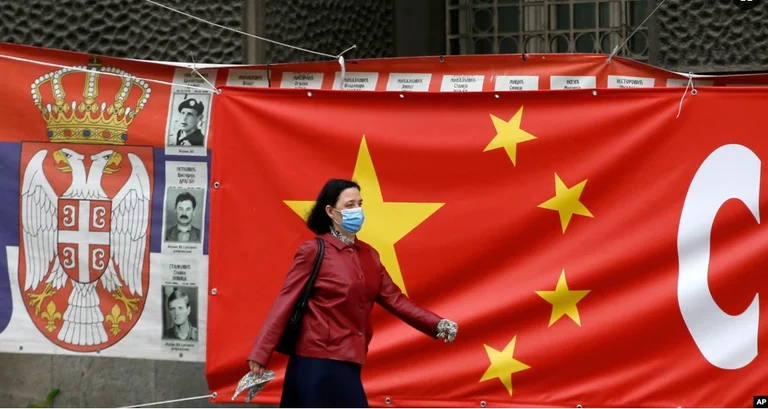
Periskopi(5 years ago)
(5 years ago)With the Chinese university project in Hungary promoting controversy due to lack of transparency and concerns of academic freedom, Beijing's influence on higher education in Serbia is continuing to grow. A strategic agreement signed in April between Hungary and Shanghai's prestigious university, Fudan University, became international news [...]
A strategic agreement signed in April between Hungary and Shanghai's prestigious university, Fudan University, became international news and provoked discontent in Hungary.
The decision to build in 2024 campus in Budapest, using 1.5 billion loans from a Chinese bank, highlighted Hungarian Prime Minister Viktor Orban's close relations with China and increased concern over the long-term impact such a project can have on the higher education systems.
But in Serbia, where China has close relations with Serbian President Aleksandar Vuciq, and in the last two decades these two countries have deepened growing co-operation with schools and Chinese universities is continuing unhindered.
Currently three Serbian universities -- University of Belgrade, Novi Sad University and Nis University -- have signed co-operation agreements with Shanghai's Jiao Tong University, paving the way for deepening educational and cultural ties between Serbia and China.
The agreements, signed in 2018, also include clauses so that co-operation can increase over time. It includes exchange of students and staffs, as well as scholarships and financial support for Chinese - language classes.
In addition to agreements with public universities, Serbia is also a host of Confucia institutes in Belgrade and Novi Sad. These entities, led by the State and offering language and culture programmes abroad, have been accused by critics of using Beijing to spread propaganda, hiding behind teaching, and interfering with free speech in university campuses.
Vuciqi has cemented relations with Beijing, co-operating in the field of infrastructure, tourism and technological projects that have brought more than $10 billion in foreign direct investment to Serbia since 2005.
But the focus on co-operation in education and culture presents a new phase of Chinese involvement in the Balkans, Europe and beyond.
“This is a typical example of using soft power”, analyst at Belgrade's Fund for political excellence Stefan Vladissavev told Radio. “Texa China is still following countries like Russia (in the Balkans), this could bring more people closer to Beijing. The idea is to make China more accessible and more popular, and to make a mark on the society”, he said.
Serbia is part of China's “Breesi and the” initiative and also supports China's 17+1 format, a forum led by Beijing in 2012, aimed at engaging China with Central and Eastern European countries.
But China's close relations with Belgrade, according to analysts, allow Serbia to act as a political and economic centre for the expansion of Beijing across the Western Balkans and serve as an example for the merits of Chinese initiatives, from co-operation in monitoring and to it in the fight against the pandemic of coronary.
Serbia is an example of co-operation in the region and one of the states that Beijing takes for example when it wants to show how successful reports” look, Vladissavev says.
Promoting Co-operation
Tena Preleci, a researcher at Oxford University, told the Balkan Free Radio Service that the rise in Beijing's influence on higher education in Serbia should be seen in a wider context of investments China makes at universities worldwide. These investments are a broad effort by China to promote its culture, language and international reports.
China's <x0... want to form the way it is presented at the world level, and I think it was a matter of time (Kina) to have the most powerful presence in the academic sphere in Serbia”, Prelec said.
But, Serbia also represents a relatively safe space for expanding in higher education, in the country where China enjoys popularity among the population, has government support and initiatives such as the Confuci Institute does not face the same level of criticism, as they are currently facing throughout the European Union, where some of its recent branches have closed.
While such programmes offer new opportunities to students and professors, University of Belgrade professor Dragana Mitrovic says these efforts for cultural diplomacy are part of a greater Beijing effort, aimed at spreading a Chinese <x0-narrative” to global issues.
“Forcing Chinese cultural influence is an integral part of this co-operation (with Serbia) and a goal for Chinese Government”, Mitrovic told REL.
Co-operation is not limited to the universities. Chinese companies have also begun to become involved in projects in higher education in Serbia.
Kraguyevci, a city in central Serbia, signed an agreement in February 2020 that his local university co-operates with the Chinese company, Dahua Technology. This company focuses on video surveillance technology.
The Chinese company Linglong, which is building a tyre factory in Zrenjanin, worth almost a billion dollars, is also the main sponsor of Serbia's first football league in March 2020, established a scholarship programme for Serbian students.
A New Stage
The “Kinez are diversifying their approach to education and academic co-operation, in the sense that they are now going beyond state institutions”, Vladimir Shopov, member of the European Council for Foreign Relations, told Radio Free Europe.
This kind of co-operation, that Shopov says is designed to develop reports and extend influence in society, politics and the economy, is already moving beyond traditional scope with universities and through Confucia institutes.
Instead, the emphasis is being placed on co-operation with local authorities, private companies and various Chinese organisations.
The Chinese cultural centre in Belgrade, which will focus on arts, literature and other cultural fields, is scheduled to open in 2021. This centre will also be established based on such centres that China has opened in Bulgaria, Greece and Romania. The cultural centre is being built in a symbolic location at the Chinese Embassy, which NATO bombed in 1999, and this centre will be like a window for Chinese art, literature and language.
This type of inclusion is the next logical step for Beijing's presence in the region”, Shopov said. “Kina sees how its movements are interpreted worldwide and it's clear to them that they have to be more active in order to spread their navitre”.
In Serbia, China's presence has faced little resistance, but recently workers and environmentalists across the country have expressed their concern over air pollution, which is being caused by projects being developed by Chinese companies.
The Belgrade-based environmental degradation protest 10 April, where thousands protested, moves the government to order the Zijin copper mine in Bor, which is led by the Chinese, to stop the job, as this mine failed to respect environmental standards.
Authorities have also ordered the Chinese-owned recycling plant to ban production due to environmental damage.
But China's co-operation with Serbia in the field of education and culture is expected to continue.
“We are at the start of this co-operation and it is something that is still beginning to develop”, Vladisaviviv says. “We are now witnessing the start of this” co-operation.











