 3 hours ago
Visas, dialogue, change of borders é what German Foreign Minister in Kosovo said
Periskopi(5 years ago)
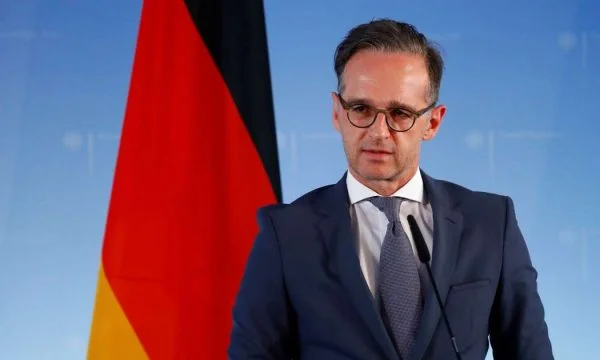
(5 years ago)Germany's Foreign Minister Heiko Maas stayed on a visit to Pristina to later visit Belgrade. He said that he said ideas for border change should be due to the past. Germany's Foreign Minister Heiko Maas said that ideas that have circulated recently about the possibility of changing [...]
Germany's Foreign Minister Heiko Maas said, the ideas that have circulated recently about the possibility of changing borders in the Western Balkans, except that they are unrealistic, they are also dangerous. In his view, it is also dangerous to discuss the matter. German diplomacy chief Heiko Maas made this statement at a press conference during the visit he made to Kosovo (22.04) before leaving for Belgrade.
Recently, media reported that Slovenia's prime minister, Janez Jansha, has handed over to official Brussels, a “non-paper”, in which it is believed to have been said that the process of breakup of the former Yugoslavia has not been finalised. But the chief of German diplomacy doesn't know if such projects exist.
I don't know if there are any such projects. The fact that it's non-paper is the right term. It's gotta stay that way. As for ideas for changes of borders, the German government strongly refuses them because such a solution does not lead to solutions to problems, but deepens them”, Heiko Maas said during a joint media conference with Kosovo President Vjosa Osmani. Even the latter said that after the circulation of these reports, she immediately contacted Slovenian authorities and confirmed that such a document does not exist.
German diplomacy chief Heiko Maas also spoke in Pristina about the Kosovo-Serbia dialogue, which was in fact the purpose of his visit to Pristina and later to Belgrade. According to him, the Kosovo-Serbia dialogue should end with mutual recognition, while in the process of dialogue, he said, of course there should be compromises until the final solution. According to him, Germany has consistently offered unconditional support for the dialogue mediated by the European Union.
“Of course, the recognition of Kosovo will be one of the elements of the solution, otherwise it will not be realised. It's natural that the dialogue for normality has to have and there are compromises. I don't want to put in red lines, but I know that on the other hand, the historical circumstances will be difficult and I don't want to push the process any further, but at the end of the process I want to find solutions for all questions”, Heiko Maas said.
Kosovo President Vjosa Osmani said, in turn, that Kosovo will develop dialogue with Serbia based on clear principles, meanwhile, “changing borders is a logic that belongs to the past century”.
“Dialogue with Serbia is the process in which Kosovo has been involved since the beginning. Our Republic has offered the hand of co-operation with Serbia, even though Serbia has yet to apologise for crimes committed in Kosovo and still has no justice for thousands of victims. We will conduct a dialogue based on clear principles, in which the Republic of Kosovo will refuse to enter dangerous adventures either with a change of borders, logic due to the past century, whether by changing the constitutional adjustment of the Republic of Kosovo, which would jeopardise our internal functionality and a dysfunctional Kosovo does not need either Kosovo or our partners”, President Vjosa Osmani said. And German diplomacy chief Heiko Maas said he “has heard the principles of the Kosovo side in this process and that they will forward European Union representatives to the dialogue, Miroslav Lajcak”.
Visa liberalisation
During his stay in Pristina, German diplomacy chief Heiko Maas also spoke of visa liberalisation for Kosovo, criteria that Kosovo has now fulfilled, but that still remains under the visa regime.
“E knows that for Kosovo citizens, visa liberalisation is most important. I told President Osmani once again that the German Government's position is clear that Kosovo has met all criteria for liberalisation and that it should be given. It is not only a matter of meeting the criteria, but also of having the European Union stick to the promised promise. We during the German presidency have put this issue at the top of the agenda, while we will continue to commit to visa liberalisation happening”, said Heiko Maas.
German diplomacy chief during his stay in Pristina also met with Kosovo Prime Minister Albin Kurti, before leaving for Belgrade, where he will meet with Serbia's President Aleksandar Vuciq. Kurti and Vuciq, next week, will stay for visit to Brussels, where at separate meetings they will talk to the EU's high structures.
Days earlier US President Joe Bidden in a letter sent to Kosovo President Vjosa Osmani, wrote that the US supports the continuation of the Kosovo-Serbia dialogue, which would focus on mutual recognition. According to the American president, the road to achieving this difficult goal is required, but “requires flexible and difficult compromise”, and the United States will be alongside Kosovo at any step”, Joe Biden said. /DW











