 35 minutes ago
The murder of Wessel: KKP does not offer access to investigative file against prosecutor
Periskopi(5 years ago)
(5 years ago)On October 20, 2020, the Constitutional Court in Pristina sentenced Sefedin Osmani, who was charged with repeated violations and the murder of 11-year-old by the Ashkali community, memory Veseli of Fushe Kosova, to 25 years in prison. In this case, family, lawyer and civil society sought criminal investigation into police officials as well as prosecutors who, according to them, [...]
On October 20, 2020, the Constitutional Court in Pristina sentenced Sefedin Osmani, who was charged with repeated violations and the murder of 11-year-old by the Ashkali community, memory Veseli of Fushe Kosova, to 25 years in prison.
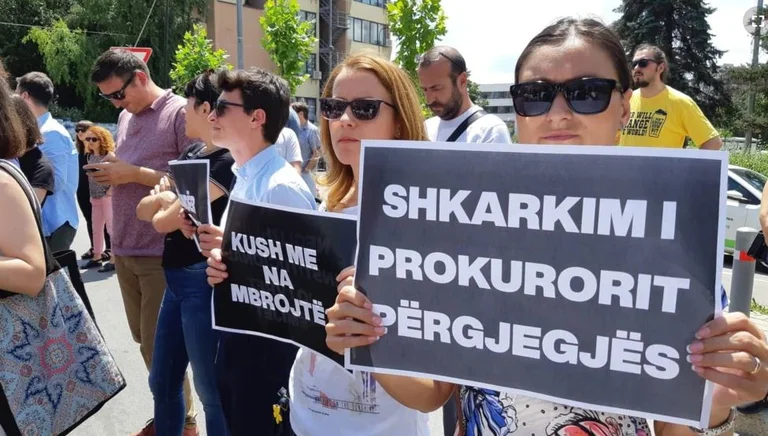
In this case, family, lawyer and civil society sought criminal investigation into police officials as well as prosecutors who, according to them, but also according to an ombudsman report, ignored the risk that memory was facing.
Despite the demands, police officials survived without prosecution, as did the case prosecutor, Ruhan Salihu.
Following an investigation that was conducted against him, dated November 12th 2019, the Kosovo Prosecutorial Council found that prosecutor Ruhan Salihu had committed disciplinary violations through his actions in the case of Kujtim Weselin.
“Temporary wage reduction to 30 percent over a period of 6 months” was said in the Prosecutorial Council's decision on this case.
But since this time, the Kosovo Prosecutorial Council is refusing to offer access to the investigative panel file, which established this disciplinary measure for prosecutor Salihu.
Record Retkocer, civil society activist, through paperwork owned by the REL, has asked that access to the investigative panel file, but the KKP has refused to enable that, although this issue is not clearly regulated by law.
Retkocer says the KPK's refusal to offer access to the investigative panel report led them to suspect “that there are data that the KKP does not want to become public, data that could highlight other irregularities in the investigative process”.
One of KKP's reasonings about not allowing access to the investigative panel report is that there is personal data there, but according to Retkocer, it's not enough argument.
“We in this case are more interested in knowing the concrete reasoning for the pronunciation of such low disciplinary sanctions, so we would be willing to accept it from the KKP and the investigative report where witness data is edited”, says Ratkocer.
Ombudsman parmes a letter on March 3, 2021, recommended that the KPK offer the Record Retkocer access to required documents.
In the KKP's response to the ombudsman's letter, it is said that “the investigation panel report cannot be made public because it does not allow the law”.
The KKP quoted Article 41 of the Constitution, paragraph 2, which says that “documents that hold public institutions and state-owned bodies are public, except for information that is limited by law due to privacy”.
The refusal to offer access to the investigative panel report, the KKP also reasons with the regulation for the prosecutor's disciplinary procedure.
Kika: KKP is acting illegal
The lawyer representing the tribunal's memory case, Rina Kika, says the KKP is acting illegal when it is unable to access the investigation panel documents.
The opinion, she says, has the right to know why prosecutor Ruhan Salihu has escaped with such an easy measure of discipline as reducing wages for six months, when, according to her, his neglect has resulted in murder.
“We have requested that we know how that prosecutor was convicted when he was exercising a public function such as prosecution of perpetrators of criminal acts, and in this concrete case, the prosecution of the person who has admitted to the police station that he has sexually violated the memory, while the prosecutor [Ruhan Salihu] has not demanded his detention or arrest”, Kika said.
Kika says the failure to contain a provision that forces the KKP to publish the document “is not the basis for refusing access to public documents”.
We're talking about the murder and sexual rape of a child, so we have the right to know from the KKP how they came to that conclusion, whether or not they've taken into account the consequence caused by the prosecutor's disciplinary violation and how it's probably pronounced such a low sanction”, Kika said.
From left: Hashim Thaci, Kadri Veselini, Jakup Krasniqi, Rexhep Selimi and Salih Mustafa former Kosovo Liberation Army leaders facing charges of war crimes and crimes against humanity.
On Thursday, April 1, 2021, Radio Free Europe has sent some questions to the KKP, but so far this institution has not returned answers.
REL has asked The KKP is reluctant to allow access to documents required by civil society and the random lawyer, as well as to why personal data is not anonymous so as to allow access to the investigative panel file.
However, in response to Kosovo Prosecutorial Council Chief-in-chief Jetish Maloku for the Ombudsman, Naim Celaj, as a topic for failing to access the investigative panel report and the rest of the file, the fact that publishing these documents is not legally defined.
What had happened?
Remembering Wessel an 11-year-old child belonging to the Ashkali community was found dead down the stairs of a residential facility in Fushe Kosovo on 11 July 2019.
According to the court, Sefedin Osmani, a neighbor living near the victim's home, had forced him to commit sexual acts and then killed him by hitting him with a strong means.
According to the indictment, Sefedin Osmani was accused of sexually raping memory on January 29, 2019, of what he was denounced to the police by his father and the victim's mother.
Despite the serious criminal work Osman was suspected of, an interview by Kosovo Police was conducted 65 days after the case had occurred.
At the police station, Osman had admitted having had sex with the victim, but no arrest warrant was issued against him, nor was the detention measure appointed.
He continued to move freely until July 11th, 2019, when it is believed that he first violated and then claimed 11-year-old memory.
Prior to the assassination, Pristina's Constitutional Prosecutor, had made a decision to launch investigations, but suspended them on June 26th, 2019, after Osman failed to respond to the prosecution's invitation.
He was a well-known person for the institutions of the order, as there were 15 acts active for various criminal acts.
On October 20th 2020, the Constitutional Court in Pristina sentenced Sefedin Osmani to 25 years in prison after he was found guilty of repeated violations and the murder of 11-year-old Kujtim Veseli.
But to that decision, the family as well as the prosecution have complained, demanding increased condemnation.











