2 hours ago
Mass cut: Now results are expected, no more dialogue for the sake of dialogue
Periskopi(5 years ago)
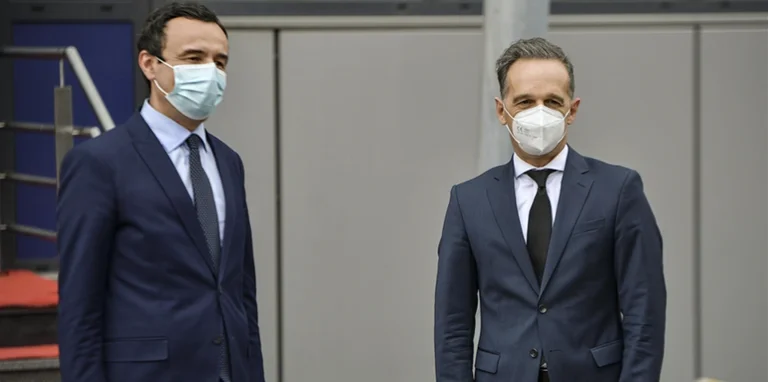
(5 years ago)German top diplomat Heiko Maas visited Kosovo and Serbia and left behind powerful messages regarding reports between the two countries. He said he now expects concrete results from the dialogue and not only dialogue for the sake of dialogue. I don't expect the dialogue to continue just for the sake of dialogue, some results [...]
“I do not expect the dialogue to continue only for the sake of dialogue, some concrete results now are expected, said German diplomacy chief Heiko Maas, after meeting with Serbian officials in Belgrade.
The German Minister of Foreign Affairs' visit to Belgrade was intended primarily as support for dialogue between Belgrade and Pristina. Heiko Maas, who was in Pristina prior to the visit to Belgrade, reiterated the importance of dialogue between the Serbian and Albanian sides, claiming Germany is aware that the Kosovo issue is a difficult issue for Serbia, but that reaching the agreement will have economic importance for Serbia and its path towards the European Union.
Serbia's President Aleksandar Vuciq stated after meeting with Maas that Serbia is ready to continue dialogue and will approach him constructively. Serbia wants a compromise solution. We do not want to refuse the reach of compromise and settlement, and we believe that the frozen conflict is not the solution “.
Responding to journalists' questions Maas stressed that “does not expect dialogue to continue only for the sake of dialogue, but that some concrete results now are expected.” The German minister, commenting on statements coming from Pristina that a reset of dialogue is needed, said there is no need for it, adding that Germany supports this process, the EU and Miroslav Lajcak, who mediate in the dialogue.
Serbia's president, for his part, added that “Serbia will insist on meeting all obligations from the Brussels Agreement.
Much of the presentation after the meeting between Heiko Maas and Aleksandar Vucic was dedicated to the issue of vaccine. Heiko Maas stressed that “this is the moment, when it can be seen how successful Serbia is in conducting the vaccine of the population”, which is being closely followed in the EU as well. “The more successful we are in the vaccine, the easier it will be to return to normal life”, the German Minister of Foreign Affairs stressed.
Maas said there will soon be more vaccines and that this has enabled the European Union to distribute 61,000 vaccines in the Western Balkans as well. This also serves to overcome economic and social consequences, Mass added, and stressed that “related to this EU has prepared a bailout for the 12 billion-euro region”.
Responding to the journalist's question, if Serbia now has vaccine surpluses, and if it will give them to others, Aleksandar Vucic stressed that Serbia has so far helped the region with about 200,000 vaccines, that in Serbia there are no lines of waiting to be vaccinated, but anyone who wishes can go immediately and take the vaccine.
Before meeting with Serbia's president, Heiko Maas also spoke with Serbian Foreign Affairs Minister Nikola Selakovic. As Serbia's Foreign Ministry announced, Maas expressed satisfaction over his first official visit to Serbia and the fact that it is being realised on the occasion of opening the new German Embassy building in Belgrade.
Selakovic said Germany is one of Serbia's most important economic partners and one of the biggest investors in the Serbian economy, and that there is interest in deepening economic co-operation from the Serbian side. This case also discussed the upcoming Berlin Process summit, to be held on June 8th. The conversationators showed interest in as many concrete projects and activities as possible within this initiative.
During the opening ceremony of the new German Embassy building in Belgrade, the German Foreign Minister stressed that the modern building is a symbol of relations between the two countries, citing that Germany is Serbia's biggest bilatheral trade partner and that German companies have invested huge sums in Serbia. Development co-operation in Serbia is intensifying, and through it two billion euros have been invested in Serbia.
Heiko Mas also referred to events from the past. He said April 6th marked the 80th anniversary of Belgrade's shelling by the Nazi Luftwaffe, during which thousands of people were killed and the city was destroyed: “It was only the beginning of major crimes during the German siege of Serbia, from which Jewish life in Serbia died. We are aware of the serious crimes committed on the territory of Serbia, and we will never forget that. The German government has a special responsibility to preserve the memory of all that happened then, and above all the memory of victims”, the chief of German diplomacy stressed
He said the answer to this dark part of history is European integration. European integration brought peace and prosperity to Western Europe after World War II. There has never been such a long phase of peace. I am convinced that European integration can also help Western Balkan countries in their aspirations for peace and prosperity. Therefore Germany is on Serbia's side as a reliable partner in the process of approaching the EU”, said Heiko Maas.
The German Foreign Minister's visit to Belgrade is also seen as continuing Germany's so-called diplomatic offensive for continuing dialogue between Belgrade and Pristina. Susan Grubjesic from the Centre for Foreign Policy says about DW, what can be expected from this diplomatic offensive:
“Fokus is certainly the continuation of the Belgrade Pristina dialogue. All other activities of Belgrade and Pristina officials, from visiting Brussels, await us in this context until the Paris meeting with French President Immanuel Macron. All of this, in my opinion, is a synchronized effort to enable the continuation of the” dialogue, Grubjesic says.
Both the president of Serbia and German Minister of Foreign Affairs talked about the need for a compromise solution to the Kosovo problem, but the main question is what such a solution would mean in practice.
This is the key issue” from the very beginning, notes Suzana Grubjesic, “because so far in this context we have had only those known sentences, that each gets from little or something, or that everyone should be satisfied by little or similar things. We still do not know what the EU bid is, or the EU's incentive for Belgrade and Pristina, to reach a compromise solution. Continued repetition, that mutual recognition is necessary, only turns us away from the compromise solution. Pristina's “Synnisation is recognition, while the goal for Belgrade is a compromise solution. It seems to me that these two goals are just leaving and not approaching”, the analyst from the Centre for Foreign Policy points out.
As a kind of presumption of Heiko Maas' visit to Belgrade and Pristina, a controversy circulated in the region about the so-called “non-paper” for defining borders in the Western Balkans. The German minister, even during these visits to the region, insisted that a compromise solution for Kosovo be sought, but without border redefining.
As Susan Grubjesic says about DW “paper lasted for as good luck as football superliga. That's not gonna happen, because against that America and Germany are first. I believe it was like a test balloon to test the opinion in the region, but even here they all rejected it as a way of solving the” problem.
When it comes to Serbia's position, the importance of meeting all obligations signed by the Brussels Agreement was again again again, and that will surely be the main obstacle to continuing the dialogue: “There is no point in continuing the dialogue, unless what was signed in 2013 is guaranteed for precisely the European Union. It is the EU's credibility question, why there has been no fulfillment of the most important part of the Brussels Agreement for eight years, and it is the establishment of the Orthodox Serb municipalities, for which it should not now be negotiated, because it is finished negotiating and signed on guarantees of the European Union”, concludes Susan Grubjesic. /dw