 3 hours ago
Maas visit, continuation of German stance against change of borders
Periskopi(5 years ago)
(5 years ago)It would be difficult to think that there could be a change of borders in the Balkans without violence and bloodshed, assessing Johhana Deimel, analyst for the Balkans and Valeska Esch, deputy executive director of the German Aspen Institute. They back the German foreign minister's stance, Heiko Maas, presented during his visit to the region, that ideas of [...]
It would be difficult to think that there could be a change of borders in the Balkans without violence and bloodshed, assessing Johhana Deimel, analyst for the Balkans and Valeska Esch, deputy executive director of the German Aspen Institute.
They back German foreign minister's stance, Heiko Maas, presented during his visit to the region, that ideas redefining borders in the Balkans are dangerous.
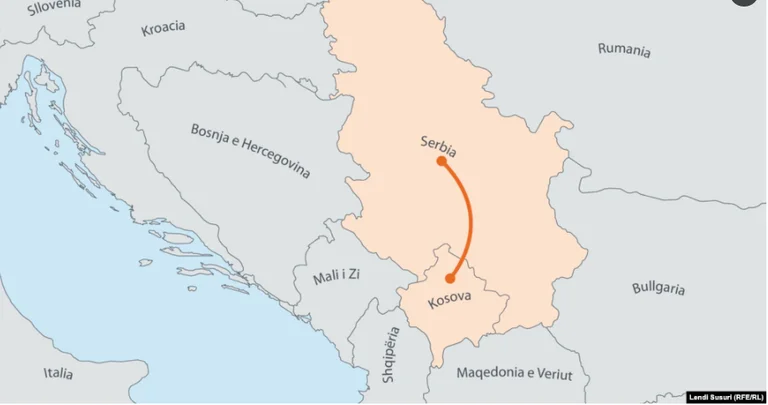
Besides calling these ideas unrealistic and dangerous, Maas during his visit to Pristina and Belgrade on April 22nd and 23rd, also said that dialogue between Kosovo and Serbia should continue and that the solution requires compromises, but must include recognition of Kosovo on Serbia's part.
This was the first visit by a foreign minister of any of the EU member states since the media in the Balkans reported on a letter Slovenia's prime minister, Janez Jansha, has handed over to official Brussels, where it says that the process of deintegration of the former Yugoslavia has not been finalised and as a way to solve the chronic problem among the six countries in the region, is the redefining of borders in the Western Balkans.
“E considers it dangerous, even only the discussion that is being made on this issue”, Maas said in Pristina.
Germany is a very influential country in the European Union, so the German top diplomat's messages on the issue of changing borders dominated media interest during his visit, which he had said the main goal is to manage COVID-19's pandemic.
Demiel: The ghost is out of the bottle again.
German analyst for the Balkans Johhana Deimel estimates that Minister Maas's statements show that the German position has not changed since the period of 2018, when discussions about changing the borders between Kosovo and Serbia arose.
The German location has not changed: Changes of borders will turn us back to the time of bloody dissolution, in population displacement that certainly would not be without violence, and that would lead us to ethnic cleansing and ethnically homogenous states. This would be in counteract with everything the international community has been working for decades to have multiethnic and multireligious states and societies in the Western Balkans”, Deimel told Radio Free Europe.
Commenting on the debate on Slovenian letter, however, the authenticity of which Radio Free Europe has not been able to prove, Demiel says this situation shows that national dreams of great powers have not ended in the region and that these ideas find fertile land especially in uncertain times.
We have seen this recently in 2018, when the borders between Serbia and Kosovo were at risk. The world was fatal because the idea of an exchange of territories was backed by the then EU Foreign Affairs and Security Policy representative Frederica Moghrini. No doubt, even the US administration played a role, at least tolerating the debate on territorial exchanges. Now, with Miroslav Lajcak (EU Special Representative for Kosovo- Serbia) dialogue between Belgrade and Pristina will resume, and Brussels and Washington are on the same line in their stance against border changes. However, the ghost has again emerged from the bottle and is now about Bosnia, but also about northern Macedonia and Albania, which would also be affected”, says Demiel, under which the key problem should currently be the integration of Western Balkan countries into the European Union, rather than the border issue.
Our response to these documents should be a clear strategy combined with the focus of EU enlargement. This should wake us all up in Berlin, Paris, Brussels or elsewhere within the EU. The EU must take a very firm stand against such scenarios. Also, it should not allow certain EU member states to abandon the idea of a common Europe in favour of national territorial dreams”, adds German analyst.
Even for Valeska Eschch, deputy executive director of the German Aspen Institute, The breakup of Yugoslavia in the 1990s was anything but peaceful, so it is hard to imagine how a restoration of borders would now not lead to new conflict.
There are good reasons why many experts and governments not only the German government reject the idea of ethnic borders. More than anything, these discussions are a distraction from what is really important these days: the fight against the COVIID-19 pandemic and its economic and social consequences”, Esch told Radio Free Europe, according to which, based on opinion research on the main concerns of people throughout the region, issues such as jobs, the fight against corruption and the strengthening of justice, are ranked highest and not the restoration of borders.
Asked to comment on the German foreign minister's statement, on the necessary compromises within the dialogue between Kosovo and Serbia, and on the fact that the solution should include recognition of Kosovo, expert Esch, estimates that the most important thing that must happen is for dialogue to continue, and politicians from both countries must avoid polarising discours and hate speech.
It is clear that both sides will have to make compromises and it would be important for Kosovo to implement the Association / Community of the Serbian Communities, which it has pledged, in line with the Constitutional Court's decision. Other compromises will have to be negotiated as part of the dialogue led by Brussels, but they should not include a compromise on recognising Kosovo's independence from Serbia, as such,”, says Esch.
The issue of continuing dialogue between Kosovo and Serbia has been discussed by German minister with Kosovo President Vjosa Osmani and Serbia's Aleksandar Vuciq. Kosovo, according to Osmani, needs to restart and not continue dialogue, while President Vuciq has said Serbia is ready to continue dialogue with Pristina and wants to reach a compromise solution.
What is known about the HINA-paper?
Less than three months before the start of the six-month Slovenian presidency of the European Union, claims regarding Jansa's alleged proposal for redefining borders in the Western Balkans appeared in the media as a way to solve the chronic problem among six countries in the region.
According to the published content, it is about redefining the border of Kosovo and Serbia, as well as predicting the possibility of secession of Republika Srpska's entity from Bosnia and Herzegovina, uniting the majority Albanian parts of Montenegro and Northern Macedonia with Albania, as well as joining a part of Bosnia and Herzegovina, so western Herzegovina with Croatia.
The “Kabinet of Republika Slovenia's prime minister, for now, will not comment on the subject for the so-called non-paper document for the Western Balkans”.
That is the answer to the request for an interview, which Radio Free Europe has sent to Slovenian Prime Minister Janez Jansha over the alleged document he sent to the European Council.
Janez Jansha, has sometimes been presented via Twitter on this issue, but he has never confirmed or denied non-paper claims.
He has stressed that these were actions targeting “to harm Slovenia in the EU”.
European Union officials are insisting that no non-paper of this nature has come to their institutions.
On April 13th, Peter Stano, spokesperson for the European Union, has told reporters that Brussels officials are reported to the media writings, but that “is not known such a letter exists”.











