3 hours ago
Freedom House report: Kosovo has suffered decline in democracy level
Periskopi(5 years ago)
(5 years ago)Freedom House concludes that elected leaders in Central and Eastern Europe are undermining the very institutions that brought them into office, rejecting democratic norms and promoting alternative systems of authoritarian governance. According to the annual report “countries at Transition 2021” that considers developments in the preceding year and that were [...]
Albania, decline in civil society, independent media
Albania, which even this year is in the category of hybrid/democracy regimes in transition, marked a decline in civil society and independent media. On a scale of between 1 and 7 points, where 1 is the lowest level of democracy is 7th highest, Albania of 3.82 points, which had a year earlier, this time it had 3.75 points.
What is noted is that Albania's overall grade is at the grade Albania received in 2013. So democracy in Albania is at the same levels that Albania has had in 2013, according to the same report of Freedom House<18x1>, says Gjergji Vrmo, programme director of the Institute for Democracy and Intermediation in Tirana, author of the chapter for Albania in the “Roads report in Transition”.
The assessment of civil society fell from 5 to 4.75 points.
The grade drop is dedicated to a series of acts that have limited the space in which civil society operates, the scope of civil society action with a host of restrictions on the right to rally, even the right to expression”, says Mr. Kameto.
More specifically, the decline is attributed to violence between protesters and rule forces in May, during frustrations over the collapse of the National Theatre, and because of the murder of young Klodian Rasa by police forces due to the breach of Ovidial restrictions.
The assessment of the media's independence situation dropped from 3.75 to 3.50.
“There has also been a deterioration in the dimension of media freedom, which for the next year has marked some very negative developments, but apparently last year, these developments were affected by both pandemics and other restrictions, but also by the partially entering into force of the anti-pronounced package, one of the two laws that entered into force, despite not actually materialising”, says Mr. Vumo, adding that there have been cases that journalists have also prosecuted, on the basis of spreading panic.
“The Albanian media environment, which has long been weakened by oligarchic control, as in most parts of the region, has also been affected by increased use of strategic court processes against public participation”, the report said.
In addition to falling into the categories of democratic governance and the election process, the two lower score indicators are corruption and judicial independence -- 3.25 and 2.75, respectively -- the same level as the previous year.
The report points to the tense political situation, corruption and pressure of businesses towards the government as continuing problems.
But the steps towards reform in justice are also appreciated, although they are said to be slow.
“We have also recorded very positive developments such as establishing new structures of justice, or other developments within several dimensions, as is the dimension of national governance”, says Mr. Vummo.
Report in context crystallisation of Albanian election outcome
The publication of this year's report coincides with a time when it has become clear that the Socialist Party in Albania will govern another mandate.
“The current majority have made history in that sense, received a third mandate, even received the second consecutive mandate, which has not occurred before in Albania's pluralistic history, as the only party”, says Mr. Vumo.
The assessment of their performance will be analysed in the upcoming reports of Freedom House. Mr. Vumo sees as a challenge trends and clearly outlined the strengthening of authoritarianism that openly and very seriously threaten Albanian democracy, institutions and democratic processes and Albanian society itself.
“I would call for all political actors, but not only political, but other Albanian society actors to read this report carefully, as it is really a wake-up call for the risks posed by some developments in the report, for democracy in Albania, as much as for Albania's bid to join the European Union and other reform processes”, he says.
It's a moment, says Mr. Vumo, that Albania can use to the maximum.
To get into a normal cycle of the political system, where it co-governs in some way, in the sense that opposition is also a very important part of governance, despite the majority leading the executive. But governance in parliament also envisions an essential role of the parliamentary opposition, just as it envisions an outstanding role of independent institutions, of institutions that do control (overall) other powers”, he says.
Fall in Kosovo, rise in northern Macedonia
Kosovo is also in the group of hybrid regimes/transitional democracies. This year it marked a decline from 3.18 to 3:14, unlike the previous year when it was up. The decrease was made in the country's democratic governance category, which was 2.75 points in last year's report, while this year is 2.50.
Estimates of judicial independence and corruption continue to be low, 2.50 and 2.25, respectively, unchanged by a year earlier.
Northern Macedonia was one of the countries with the greatest democratic progress in 2020.
Prime Minister Zoran Zaev's leftist “government has repaired some of the institutional damage caused by his right-wing populist predecessor, and still has a chance to bring to life the positive aspects of democracy”, the report says.
Speaking more generally for the region, a success story is said to be particularly necessary in the Balkans, where democratic advances have been reversed in most countries.
“Although significant transfers of power took place in Montenegro in 2020 and Kosovo in 2021, it is still unclear whether they will lead to an improvement of democratic institutions. And without such an institutional transformation, any political change is extremely difficult to keep stable”, the report says.
Antidemocratic Return
In the 29-nation area of Eurasia and Central and Eastern Europe covering the report Countries in Transition, the number of democracies has been the lowest since the first report was released in 1995.
The report highlights the deepening signs of autism in countries like Hungary and Poland, which helped lead the broader transition towards democracy in the 1990s.
These are not anomalies, but part of a systematic change towards authoritarianism in Europe and Eurasia that could have global consequences. Anti-democratic leaders are learning from one another how to consolidate power and suppress political opposition by avoiding punishments from international institutions”, the report said.
The general force of democracy in the region has fallen for 17 years in a row, according to “Vands in Transition”.
“Directors who have turned towards anti-democratic forms of governance follow similar strategies: Prime Minister Viktor Orbán in Hungary launched a model for printing independent media that has spread since Poland and Serbia, the ruling parties of Hungary and Poland are escalating attacks on the LGBT+ community and groups of ethnic and religious minorities, and all are trying to weaken rule of law through attacks on the independence of judiciary”, the report said.
Poland and Hungary are noted for their unprecedented democratic deterioration over the past decade, but most countries in the report are currently worse than they were 10 years ago.
The spread of autocratics in Europe and Eurasia has profound consequences, not only for the region, but also for the world,” says Michael J. Abramowitz, president of Freedom House.
The democraticly elected “Liders are being distanced from democracy and are creating their distorted realities to consolidate and retain power. Through their success thus far, these antidemocratic regimes are setting an example and promoting increased authoritarianism in neighboring countries. If not checked, they have the potential to undermine democracy and legitimise abuse of power in Europe and beyond “, he says.
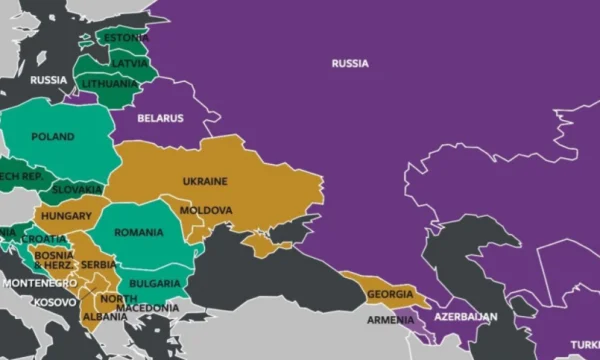
In Russia and Belarus, which the report classified as authoritarianly consolidated regimes, oppression intensified significantly over the past year. The violent crackdown on pro-democracy protesters in Belarus, the Kremlin's attempt at the murder of activist Alexey Navalny, and the last show of Russian military force along Ukraine's borders show how far these regimes are willing to go to stay in power.
Zselyke Csacky, director of research for Europe and Eurasia at Freedom House, says authoritarianism is not a purely national problem, but may spread to infect entire regions and even continents.
The “European democracies and civil society groups should be co-ordinated in support of pro-democracy movements in countries where authoritarianism is gaining ground. The change must come from within, but to give these efforts a chance and to stop the anti-democratic wave, European democracies and their partners should set the example and put the lie behind them that autocratia is an acceptable alternative to democracy “, she says.
Manage expectations for transformative elections
In its report, Freedom House says that during the “recession” of current democracy worldwide, most democratic systems have not been turned into authoritarian regimes in a flash.
The authors of the report, referring to democracy researchers, Thomas Carothers talk about a “gray area” of the status of hybrid countries.
Some countries such as Kosovo, Moldova or Ukraine have remained in the grey area for years, but others especially Hungary, Montenegro and Serbia have only recently been renamed as hybrid regimes and others are moving towards that status. ”
The report says that a characteristic feature of hybrid regimes is that their leaders continue to allow elections to a certain competitive degree.
“Garats are not necessarily free or fair, but neither are they entirely fraud, as is done in authoritarian regimes. Consequently, hybrid regimes can turn towards democracy through the ballot box if a sufficient number of voters are willing to support the new leadership.
However, says the report, as politicalologist Larry Diamond warned, “While an opposition victory is not impossible” in the grey area, “this requires a level of opposition mobilization, unity, skill and heroism beyond what would normally be enough for a victory in a democracy.
“The countries in Transition” say that at different levels “these features can be seen in the recent elections in Kosovo (2019 and 2021), Montenegro and Moldova (2020), as well as in the municipalities of Banja Luka and Sarajevo in Bosnia and Herzegovina (2020).
According to the report, in all these hybrid regimes, the political opposition exceeded expectations by removing the rulers. VOA