 3 hours ago
DW: In Brussels no official review will be considered “Slovenian document” for redefining of borders in the Balkans
Periskopi(5 years ago)
(5 years ago)The ideas of Yugoslavia's “final component” and a redefining of borders in the Western Balkans will not change the existing European Union policy. But that does not mean that European engagement in the region does not need an urgent awake. That the Western Balkans are still a fragile region, still prone to destabilisation [...]
That the Western Balkans are still a fragile region, still prone to rapid destabilisation due to wounds still open from the past, which now politically correctly call “open bilateral issues”, witnessed information about a text, which, due to informal character, cannot be called a document, not even a letter.
The so-called “non-paper”, without its head and signatures, was attributed to Slovenian Prime Minister Janez Jansha from the media. With his ambitious attitude neither of recognition nor denial, he further promoted a spark that, as we have seen before, soon “the entire region and spread -- quite suddenly, beyond the borders of the EU, writes DW, the edition in Serbian.
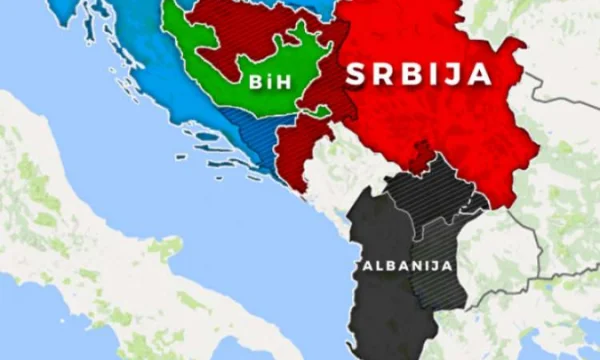
The text of the document proposes “the end of the breakup of Yugoslavia” or the completion “definition “of borders in the Western Balkans aimed at creating a fragmented Bosnia and Hercegovin, but “stable and functional”, Albania with united Kosovo and parts of northern Macedonia, Serbia with the United Republic of Srpska.
EU institutions have yet to confirm the achievement of such a text in Brussels, and perhaps they will never. Official Brussels reiterated only its position that “nothing should change, when it comes to the borders in the Western Balkans”, the Telegraph broadcast.
“needs to be worked on reconciliation and regional co-operation, which is also the logic of the European integration process. All open issues between states must be resolved in a process that does not enter dangerous territories and relie on EU laws and principles”, said EU spokesman Peter Stano.
German Secretary of State for Europe Michael Roth reiterated that the “extension of the new borders is a dangerous” and “reconciliation and regional co-operation is the key to peace, democracy and prosperity” in the Western Balkans.
The same messages came from the European Parliament, from which rapporteur for Serbia Vladimir Bilcik said that “changing borders and territory is a dangerous way in the explosive past of the region”.
Dangerous Compromises
However, publishing this text [the document énon-paper] is not random, that it has its own history, and that there are people who see the solution of all problems in the Western Balkans in changing borders, say Alexander Stiglajer from the European Stability Initiative and Bodo Webber from the Council for Democraticisation of the Policy in Berlin.
In a conversation with DW (the Serbian language edition), they remember that the exchange of territories not long ago was a topic in the region and the EU, when in 2018 they talked about the exchange of territories between Serbia and Kosovo.
Everything keeps coming up. They were also present during the war in the former Yugoslavia. But the reason for such wars must be considered. Therefore, it is very dangerous to believe that changes in borders, which would lead to ethnic exchanges, could lead to a solution in the Western Balkans”, Stiglmeier says.
She estimates that showing such an idea at the moment is a kind of professional balloon that is there to see the EU member states' response and see if this is the way to go.
My “My conclusion is that this is definitely not the way, because this would only lead to a conflict, and then an armed conflict in all affected Western Balkan countries”, the analyst from Brussels stressed.
Bodo Weber shows that in the past four years, the entire region was threatened with destabilisation due to the idea of exchange of territories between Serbia and Kosovo and that a new “opening has now been made to” that transfers the threat to the territory of Bosnia and Herzegovina.
“Over the past four years has been noted as the dynamic of dangerous radiation by several EU and US representatives negotiating in the Western Balkans region, which, first focused on negotiations between Serbia and Kosovo, threatened the stability of the entire region with the insane idea of exchanging territories. Bosnia and Herzegovina, out of sight, succeeded in agreeing to a bad “agreement on ethnic division at the local level, the so-called Mostar Agreement. All this shows that our Western negotiators in crisis situations are inclined to make any agreement, which means a bad compromise with dangerous regional agendas that would suit national leaders in the Western Balkans”, says Weber.
Radical document
Alexandra Stigloyer from the European Stability Initiative recalls the fact that, in the process of resolving the “issue of Kosovo”, some of the EU leaders supported the option of “any solution the two sides agree to”.
Analysts say even <x0non-paper”, the alleged Slovenian “and more radical “, without preliminary consultations with its affected countries.
I don't think that neither Bosnia and Herzegovina, nor northern Macedonia, nor Kosovo will agree to that. Perhaps Albania will, but that would mean its departure from the EU path”, says Stiglmayer.
At the same time, Albanian Prime Minister Edi Rama was the only one who confirmed that he had seen the document and that he had discussed “ide” with the Slovenian prime minister.
Analysts from Brussels and Berlin agree there is not nearly any majority support for a “ide”.
If such a document, in the form of how it is published in the media, exists, it would indicate that Mr. Jansha, in his radicalism, actually acts more counterproductively to promote his idea. I believe it's a very tough way of loosing for such dangerous ideas, if it's really the document is real and authentic”, Bodo Weber said.
He adds that he hopes the newly created situation will encourage EU countries to give the “more opposition” the dangerous way of negotiations of EU representatives, namely in Bosnia and Herzegovina, right now.
“These negotiations threaten further ethnic division of Bosnia and Herzegovina and that under the auspices of the EU, but also with the dissolution of the country and the destabilisation of the entire region, which we would also experience if an agreement on the exchange of territories between Kosovo and Serbia was concluded. The threat is real from the dirty and nontransparent negotiations of European representatives, and less of such an open-air-nationalist idea survey such as the famous lubyana “ .
Uninflicted Tests and unsurpassed Policy
The text, which raised dust in the Western Balkans and throughout the EU, is claimed to be sent to European Council President Charles Michel as part of announcing priorities Slovenia will represent when it assumes the presidency of the EU Council in the middle of the year.
After the reactions received, the Slovenian prime minister will not continue to insist on similar ideas and that we should not expect any radical twist in the EU's policy towards the Western Balkans”, Alexandra Stigloyer believes.
“I don't believe this could be the basis for any new EU policy towards the Western Balkans. Most member states support multiethnic states, based on human and civic rights. This will not be officially discussed further in Brussels”, she says, but she also adds that a new <x2th> momentum in EU policy towards the Western Balkans is necessary, but I do not see that there is a real call for enlargement. As long as the situation in the Western Balkans is dragging on, perhaps not in a very satisfactory way, but certainly without conflict, EU member states will not view it as a priority”.
Alexander Stiglaer called on the EU to finally offer the Western Balkans “something really reliable”, including a more functional accession process, “over what and what” would have to work on.
On the contrary, I fear there will be a conflict. Two particularly problematic situations are those between Serbia and Kosovo, and those in Bosnia and Herzegovina”, Stigloyer concluded.











