 2 hours ago
The Document for Happy Muslims Opposed by Activists
Periskopi(5 years ago)
(5 years ago)A young waterstone ethnic belonging has opened a cafe in the heart of the old historic town Kashgar and thus has fulfilled his dream. A young Muslim woman has moved from village to city for a better <x0Page”, which has enabled her to secure a [...]
A young waterstone ethnic belonging has opened a cafe in the heart of the old historic town Kashgar and thus has fulfilled his dream.
A young Muslim woman has moved from village to city for a better <x0Page”, which has enabled her to secure a comfortable life for her family.
A watermaker offers women to buy Western-style wedding dresses for their wedding day.
All the above claim to be satisfied with their lives. With prosperity, freedom of choice and many possibilities. They say they enjoy these in Xinjiang, their eastern region in northwest China.
This is how the Chinese documentary “goes beyond the mountains: Life in Xinjiang” represents the life of ethnic waters and other Muslim minorities in the region.
This documentary appeared at the Chinese Embassy in Kazakhstan. There is no mention of the brutal oppression China exercises against Muslims in Xinjiang. The region estimates that 1 million people have been held in mass exile camps since 2017.
The documentary was broadcast by China's Global Television Network, a state broadcaster. The documentary was broadcast in English and Russian in an effort to present Beijing's confession to Xinjiang in global audiences.
Through this television production, China aims to challenge the numerous accusations of Xinjiang residents who say Muslims live in a climate of fear and oppression until authorities target their culture, religion, family life and traditions.
The documentary allegedly presents the opportunities the Chinese government has created for young people in order to follow their dreams in music, sports, business and other directions.
Some Ksinjiang activists told Radio Free Europe that this documentary is a clear Chinese propaganda and represents a terrible distortion of reality.
Coffee account in Kashgar
The documentary speaks of a cafe in an old two-story building in the town of Kashgari.
The owner of this business, Mardan Abbim, describes himself as a true “Kashgari” that has a big dream.
Abbim says his idea was to offer a mix of his community's history and culture with modern elements.
The coffee he sells says to be a “perfect mixup of Western coffee and local plants”.
Abbim calls his coffee a “miniature Kashgarit” where old “bres are trying new things” and young people like him “are following their dreams”.
According to him, people in this city are embracing change and leaving behind their old thinking.
But it is hard to verify the success story of Abbim in a business he says is thanks to his community's history, culture and traditions.
The reality is different.
The Chinese government has closed Muslim cultural centres, damaged or leveled thousands of Muslim mosques and historical objects, and imprisoned community leaders.
In many areas Muslims are forbidden to enter the mosque until they are 18. Thousands more have been imprisoned because of Islamic prayers, or even the marking of traditional holidays.
Activists say authorities are doing “brainwashing” for many Muslim children who have been placed in private school dormitories.
Beijing has also sent more than 1 million civil servants from the majority of the Chinese population to live with Muslim families in Ksinjiang as part of their assimilation efforts, as well as to monitor their movements and contacts.
The U.S. Committee for International Religious Freedoms in a report released on April 28, 2020, said that “iddes are sent to the camps because of long beards, alcohol rejection, or other behaviors that authorities deem are signs of religious extremism”.
“grateful for the new job”
Much of the Chinese documentary is dedicated to young Muslim women, who appear to have challenged their community's stereotypes and led a modern life.
A young Muslim woman, Zileyhan Eysa, is featured in the documentary, which has found a job in a factory in the relatively wealthy northern Ksinjiang.
She earns about $600 a month, enough for her life in the city and to keep her poor family, in a village called Red.
From the money Eysa sends home, her mother, Tursulgüh Reeep, appears in the documentary paying her medical bills while her father is able to buy a car.
“I am grateful to the factory where I work”, says Eysa.
It has “learned many new things” in the city, according to the documentary, and does not intend to return to its village, as well as does not plan to marry soon.
In traditional water families, marriages are usually arranged by parents. But Eysa's family “will accept anyone she chooses to marry”, says her father.
Eysa, like all other young people in this documentary, speaks Mandarin.
The documentary presents members of her family, extremely well dressed, joyfully conversing together.
The production of the Chinese state network presents another Muslim woman, Samira Arkin, who is said to have broken the traditions of her community and “has set an example for many other young people”.
Arkin owns a store in Kashgar and helps Muslim women choose clothes for their marriage.
Arkin says that in 2010, she had chosen to put on a western - style dress despite doubts from her relatives.
Like many others in the documentary, it does not mention a word like that - Islam, Islam, or water. She says she was disappointed to see women covering their faces” and having no right to go out alone. Her protesten, she says she turned her business and opened her shop.
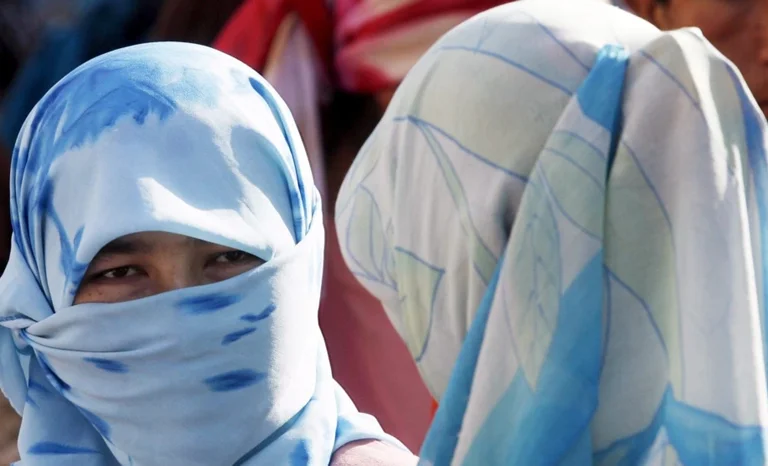
China has banned women from Islamic cover as a sign of religious extremism. The legislation is vaguely formulated. Beijing has also declared some Islamic names illegal and other <x0-seconds of extremism” undeserved.
Some Muslim women have reported being harassed by the police because of their clothing.
Do they have to talk?
It is impossible to find out whether Arkin, Eysa, Rayep, and others who were presented were speaking with their conviction or were forced by the authorities to say those things.
People are obliged to follow commands “from the Communist Party, says Qairrat Baytola, an activist from Ksinjiang who lives in Kazakhstan.
If they refuse, they face imprisonment even being shot to death”, Baitola says.
A Kazakh ethnic affiliation man who currently lives in Ksinjiang has told his relatives abroad that authorities were forcing him to object to a video, comments by former US Secretary of State Mike Pompeo for Xinjiang.
In January, Pompeii had declared that China was committing the ongoing “genocide against Muslims in Ksinjiang.
The man also said Chinese police demanded that he sue and divorce his wife, Altynai Arasan. She lives in Kazakhstan and participates in anti-Pekin protests in front of Chinese diplomatic offices.
According to Arasan, police warned her husband that she would be killed if she refused to make the statement in that video.
But, “also has many people” among the Muslim minorities that “blindly believe in the Communist Party”, says Beqzat Macqsukhan, an activist from Ksinjiang.
“Autorities select people with lower education who have never seen the outside world participate in such propaganda”, he told Radio Free Europe.
Maksutkhan, who now lives in Kazakhstan, says some members of Muslim communities become part of state propaganda only for financial benefits or for their career.
China denies all reports of human rights violations in Ksinjiang and insists that exile camps are educational and professional formation centres aimed at preventing religious extremism.
But many survivors say that in exile camps, Muslims are subjected to torture, rape, and forced labor.
Some women have reported having been forced into abortion, and others say they have been forced sterilized.
The documentary was presented at the time when the United States, Great Britain, Canada and the European Union imposed sanctions on several Chinese officials over reported human rights violations in Ksinjiang.
On April 22nd, the British Parliament adopted a motion saying that crimes against the Christians and Muslims in Xinjiang are being committed against humanity and genocide. / REL











