 4 hours ago
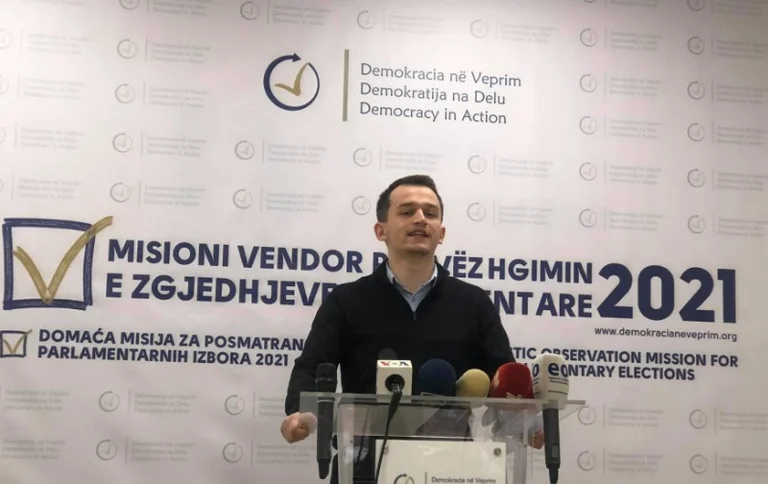
DnV with final report: February 14th elections in line with democratic standards
Periskopi(5 years ago)
(5 years ago)The local Election Observation Mission “Democracy in Action” estimates that elections held on February 14th have been held in line with democratic standards for free and fair elections, yet exemptions in this qualifications make up majority Serb municipalities where the registered and confirmed voting for two political subjects from the ranks [...]
DnV has published the final election report today, including the election monitoring report, the report on election campaign monitoring and the media monitoring report.
Eugen Cakoli, from DnV, said that election day is organised quietly and without any serious incident that could affect the integrity of the election process.
He said that even in these elections similar problems have been noted, as in previous elections, the assistance vote, which has been counted on quite a high scale, the difficulties of voters finding the name on voter lists, as well as some types of irregular voting.
As far as respect for measures against the spread of pandemic, Cakoli said the election day has been accompanied by a disapproving respect for these measures on the part of both commissioners and citizens.
“DnV estimates that elections held on February 14th are elections that have been held in line with democratic standards for free and fair elections. The exception to this qualification, however, consists of predominantly Serb municipalities where it is recorded and confirmed the vote by two political subjects from the community ranks, as well as an unusual voter exit, which has reached up to 85 per cent, which is twice the average at the country's level. As for civic participation it is noteworthy that with 48.78 per cent voter election appearance in this election, it is the highest in Kosovo's history after declaring independence, while added value has given the process itself political subjects with the acceptance of results that have been declared”, he said.
Cakolli said that the voting counting process, particularly those of candidates of political subjects, continues to remain one of the main problems of election processes in Kosovo.
He said the implications of persons suspected in criminal acts of counterfeiting and manipulation of election results that have also been witnessed through publishing an audio and video recording have significantly weakened the credibility of this process.
Work at the QNR, he said it has been generally fair, open and transparent to the public, but that the recount of 700 boxes that make up about 30 per cent of the total, according to him, pours out deep politicisation and lack of integrity among several CNR commissioners and staff.
The work of the Central Election Commission, DnV, has assessed as transparent, but that the work of this institution has been characterised by intervention by foreign acts, which, among other things, is mentioned at the time, by President Vjosa Osmani's task attorney.
The CEC's “Punion has been transparent, but what's a paternalist for this election process is polarisation and extreme clashes that have consistently characterised the work of the CEC, particularly among CEC members from the LVV and CEC chairman. Likewise, the CEC's work and independence in these elections are characterised by interventions that have come from external acts, in particular from the then-president's post-responsive. Vjosa Osmani, who through her public statements has violated the integrity and independence of the CEC's work.
He said the CEC's head as never before has been the target of numerous attacks from both political and citizens' ranks.
Despite the short term, according to the CEC, it has managed to complete all election operations, but stressing that voting abroad remains one of the most sensitive linkes of the election process.
The report also discusses the work of PZAP and the Supreme Court during these elections, where Cacol said the same acted professionally and impartially in handling the subjects addressed to them.
PZAP and the Supreme Court said they have cancelled the votes of political subjects of the communities won in Serb majority areas, where there has been no demographic concentration of communities in question. With this move, he said fair representation of the will of communities is guaranteed, based on both local constitutional norms and international good practices.
Visar Jamaica, from DnV, has presented the campaign monitoring report, where he said they have monitored 179 activities of political subjects. He said political subjects had mostly organised activities in the Pec and Prizren municipality.
According to him, the Vetevendosje Movement has largely organised election activities or 58, LDK with 44 activities and PDK with 35, AAK of 18 activities, while other parties have less than 18 organized activities.
Part of the monitoring has been the respect of anti measures - CO VID, for what he said they weren't even respected.
“In closed environments the maximum number has been 30, while in open environments the maximum number allowed has been 50. A disrepute is noted in reporting that in closed environments almost 78 activities from 179 sosh have not respected any anti-scale measures - CO VID or pandemic management. While, in respect of measures in open environments, this number is significantly smaller or only 8 cases which have not respected measures”, he said.
Jamaica, said that women's participation in the election campaign continues to remain low, he said that as far as women's overall participation is concerned, there are only 22 per cent of women in the report with men, while women have been speakers only in 27 per cent of the cases related to men.
The most mentioned topics in the election campaign, he said there have been economic development, agriculture, employment and education. While, he said that during the election campaign in 23 per cent of the cases there were hate speech, where political rivals have been called extortioners and traitors.
While the Media Monitoring Report has introduced the DnV's Demili-Niman Medition from DnV, which said that during television monitoring, major political subjects that have had more space in election chronics or even television debates have dominated them.
“From monitoring shows that mostly coverage of election chronic television has had LDK in 238 minutes, followed by AAK with 228 minutes, LVV 223 minutes, Initiative by 211 minutes, The PDK with 209 minutes, the 57-minute Serbian List and other minority subjects, as well as smaller Albanian parties have been introduced in electoral chronicles with 49 minutes... Livestrem from the portals we've been monitoring how many pages have been used in front of the portals, which have a large number of their followers from political parties in this case that even have been used in addition to their official pages for broadcast, from live monitoring through Facebook leading AAK with 1000 and 491 minutes out of 5 portals, followed by the LDK with a thousand and 393 minutes in 6 gates, the initiative with 1 000 and 141 on the 6th portal, with a 6th portal. The PDK, with 1 000 134 minutes at 6 portals, already has 433 minutes in only 4 portal”, she said.
Eugen Calcolly has presented recommendations from this report, which according to him aim primarily to initiate an election reform process.
“DnV estimates that electoral reform as the process should be one of the key priorities of the political spectrum in the country, but that the same must be accompanied by the principle of inclusion and transparency by avoiding any initiative or opportunity that would violate these two principles, since it would translate into a change of the electoral system or its elements without a broader compatibility in this process. DnV estimates that among the main elements of the electoral system that should be subject to electoral reform are preferential voting of up to 5 candidates, which must be reduced, its election threshold for different categories, in this case, political subjects and independent candidates, which must be recategorised respectively. Also, the manner of electing the president of the country with the aim of avoiding various political crises” needs to be reviewed, he said.
Within the framework of key elements of the electoral system, Cakoli said that Kosovo's partition in electoral areas should be considered in order to ensure a fair representation of citizens.











