3 hours ago
Research: These are the sexist stereotypes of Google
Periskopi(5 years ago)
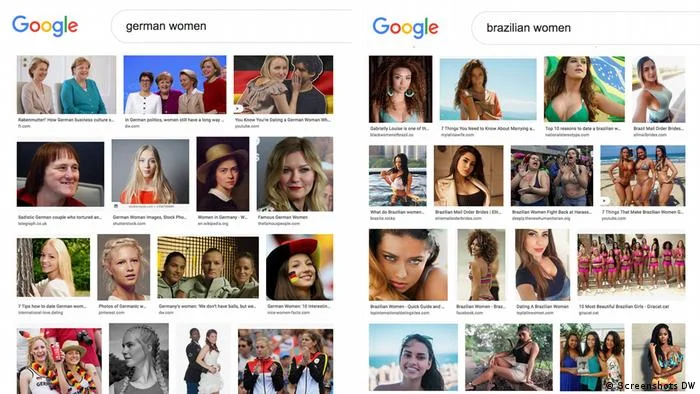
(5 years ago)Women from Eastern Europe or South America are very sexy and care about love meetings? A Deutsche Welle analysis shows that Google serves as a catalyst for sex cliche. “Google Images” gives face to world: Who wants to see what he looks like or she'll go looking for Google once. One [...]
“Google Images” gives face to world: Who wants to see what he looks like or she'll go looking for Google once. A review of Deutsche Welle concludes on what distorted results lead to algorithms of the research giant.
Deutsche Welle journalists' newspapers have analysed more than 20,000 images and web pages. Output: English wordic photo research such as “Brazilian woman”, “domedian qemen”, <x4-day Dutch woman”, Ukrainian “ ” lead more young girls to screens and provocative clothing than Google search for the American <x8f> <x8f> ”. And if you look for the German “ ”, more images of sportsmen and politicians appear. This is a pattern that is readily understood because they confirm simple research. But analyzing the results is harder. Determining what makes a sexist view, of course it's subjective and depends on the cultural, moral and social context.
What makes it a provocative sight?
To classify thousands of images, DW analysis relied on Google itself mechanism “Cloud Vision Safesearch“, an artificial intelligence app. This visual processing software is programmed to detect images with a certain content. Google uses it to target “provocational” in sexy clothing, where the nakedness hidden with strategies is exposed to provocative pose. Also identified are images of certain body parts. In a verbal search for Dominican or Brazilian women, Google offered up to 40% provocative images. The result of American women's verbal research has drawn only 5% of these images, German women's wordic research only 4%.
The use of such algorithms is controversial because the use of such software is subject, perhaps even more, to prejudice or to various cultural dictatorships than to human eyes. At another point this special software has produced racist results. The artificial intelligence of Google working as a closed system may result in deviations in results. On the other hand, the mechanical verification of images that Culud Vision classified as explosive, showed that the result was worth it: They're a look at how their Google technology appreciates the images shown by the research program.
Links for specific web pages
Any footage showing the results leads to the same time on the web page that first published it. Many of these pages offer images that reduce females as sex objects. Latin women or those from Eastern Europe are shown on the basis of the cliche for them. To find out how many photo results lead to such pages, it was introduced as an addition to the short description that comes under the resulting picture as also the wordic “dating”, “ex”, or “heat”. All pages with at least one of these key words were viewed mechanically if they really had sex content. The results showed how females from some countries are completely reduced to sexual objects. Of the 100 results of research for Ukrainian “gras”, 61 of them lead you to the page with such content.
Stereotypes reinforce web results
Keywords are very important, but they don't tell the whole story. Much of the results are found on the address website like “toprusian brides. com”, “Hotlatinbrides.org”, “topasapades.net” These offers promise to connect men and women from certain nationalities. It soon becomes clear that customers are Western men who either seek a submissive foreign wife or a sex partner.
Existing stadiums influence, according to Professor for Multicultural Studies Sirie Sunanta at the University of Bangkok Mhidol in the way Thai women are shown online. Bayand is considered a world of Disney for sex prostitution and tourism. This continues online through research programmes”, Sunanta tells Deutsche Welle. If stereotypes are related to women and a nationality, they are harmful. It reduces women's complexity, women everywhere are different. ”
A Language Issue
Even the language used in research can affect the results. If you search in English “brasian women” or in Portuguese “mulces brasileiras”, which is exactly the same thing, then Google offers different sexualised content. In English, 41 out of 100 images are provocative if you look for Portuguese, that figure is reduced to 9. The data, which algorithms feed on, reflects perceptions, prejudices and consumption patterns of a single part of humanity”, says Renata Avila, a researcher at Stanford University Institute for “Human-Centeficated Intelligence”. “These prejudices can be related not only to technology but also to cultural factors. Women of certain nationalities are given a sexual and service role from a male, English - speaking culture.” According to Avila, these are not just cases but part of a deeper systemic problem. The algorithms “feir” do not match the concert business pattern “big-tech”, because it's about collecting data and increasing profit laps.

The sexist plates in Germany ad of an Imobiliare firm with the inscription “mos look at it but rent it”
Joanna Varon, Brazilian lawyer and founder of the Institute “Codding Rights” says algorithms tend to reproduce those content that are very popular online. It requires more monitoring, transparency and competition. “There should be no monopolys for services. Major technology concerts must be fixed.” At the same time, more algorithms must be introduced that do not always serve the same paradigm.
Deutsche Welle offered the Google press office a list of questions on the question of the photo algorithm. The concert did not answer questions in detail, but it did give an explanation, stressing that the results of research really show the specific or disturbing “content”, “including results reflecting negative stereotypes or prejudices that exist on the internet. ” Google points out that this is the problem, because it has non-equal consequences for black women and women. ”