 4 hours ago
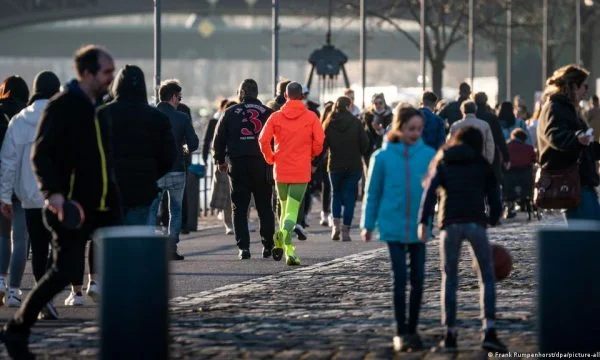
How great is the risk of coronary infection in nature?
Periskopi(5 years ago)
(5 years ago)The possibility of virus infection in nature is considerably lower than in closed environments either by the original variant or by mutations in the virus. Air aerosols play a crucial role in the spread of the coronary. According to experts outside the airport, they soon lose their risk. This is about the fact, [...]
This is about the fact that the air flow outside is greater. With wind currents very quickly occurs the effect of halving”, explains about DW, Nico Mutters, director of the Institute of Hygiena and Public Health at the Bonn University Clinic.
Birgit Wehner, aerosolous researcher at the Leibniz Institute for Troposphere Studies, also says that the pins, which emerge from the respiratory process, dry out and dilate faster. In a statement by the Association for Aerosolous Studies, also signed by Wehner, however, it is said that small - distance groupings of people cannot be ruled out in the wild.
So even abroad, they have to respect the distance rules of 1.50 to 2 meters. If you don't keep your distance and stand face to face and speak aloud, sing or spit, then you can get infected through infectious aerogens, says DW virologist Alexander Kakule in an interview. He is known in the media for his contacts over government measures. According to him, we should communicate with the virus without being restricted in our lifestyle.
Adjusting distance must also be respected for mutations in the virus. Keculé points out: “Muttants do not fly any further, this is important to say.” They're a little more contagious, but that makes no difference to restrictive measures.
Kisses and hugs must also be avoided. There's almost no danger in normal movement as a shortcut to each other. Studies confirm that the risk of getting infected outside is minimal. A study by China, for example. It proves, that out of 7324 registered infections, only one occurred outside. Even the Robert Koch Institute in Germany on the website writes that infections abroad in space are very rare.
The more wind there is, the more the cloud of aerosols that man extracts”, explains a physicist and aerosol researcher Gerhard Scheuch. If distance is respected, there is no possibility that it will have aerosol contagious effect.
In an interview for DW Scheuch says that „alone through body warmth in the atmosphere creates an air current, normally going up like a chimney.” Because body temperature is generally 37 degrees so higher than environmental temperature. The warm sky goes up and the aerosol cloud goes up.” Another study in Iran proves that the wind doesn't play a role in the transfer of infectious aerosols.
Does it make any difference whether it's cold or warm outside?
That question has not yet been answered by scholars. American researchers have researched infections in cold, warm, and wet regions in China and have not found any collation between climate conditions and the number of infections. While an Austrian study confirms that ultraviolet radiation destroys viruses. „Ultraviole exhumation has a minimal effect on human infection to”, researchers point out, however, the infection can occur in a few minutes.
Even the experts questioned by the DW have different opinions. Nico Mutters notes that it cannot be stated generally that in the hot season danger is lower than in the cold season. There is really higher ultraviolet radiation in summer, but the same values through reflection can also be achieved in snow skiing. And worldwide there are infections despite the warm or cold climate in various regions. But virologist Alexander Kakué says that infections even in warmer countries occur in closed environments rather than outside the wild.
Does it make sense to wear the mask out?
Outside it is reasonable to wear masks when the distance between humans cannot be respected. If people are densely populated and there is no possible deviation, they should wear masks. Even at shows or concerts, at train stations and buses, or during a row, experts recommend keeping distance and wearing a mask. / DW











