 7 hours ago
Montenegro: Inferno Situations Out of Control
Periskopi(5 years ago)
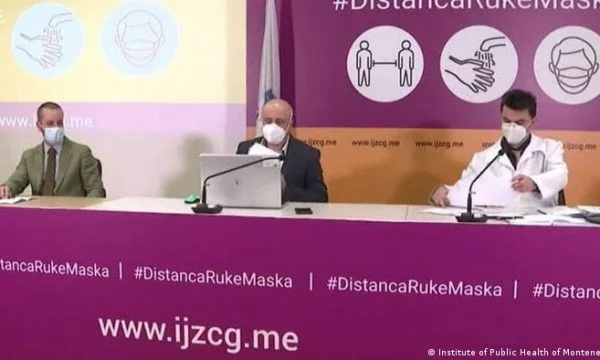
(5 years ago)Public Health Institute Director Igor Galic at a press conference (12.03) said the epidemiological situation in Montenegro is very serious and complex. “We can no longer control the epidemic, because the number of victims with the virus and those who lose life is constantly increasing. He said every 2 minutes on the mountain [...]
“We can no longer control the epidemic, because the number of victims with the virus and those who lose life is constantly increasing. He said every 2 minutes in Montenegro infects one person, while every 150 minutes a person loses his life.
The number of patients affected by coronarys over the days of last week is over 500, while the number of deaths of 64 “. According to Galic, about 13 per cent of Montenegro's population are affected by coronarys, adding to local broadcasting, which also marks growth. The newly registered “Rasts of infection in terms of the tested number is 28.7 per cent. In order to be able to say that we control the epidemic, this report must be five percent. This is about the mass, in which we do not control the” epidemic, Galic said.
Montenegro does not close borders, but seeks EU, NATO assistance
Despite disturbing indicators of the situation with the epidemic, health authorities and Montenegro's government are keeping the borders open for the four neighbouring countries. “Arsyet are largely economic,” said State Secretary at the Ministry of Health Borko Bajic, citing a smaller number of infected people in those countries as additional reasons and the fact that they keep their borders open with Montenegro. Current epidemiological measures allow entry into Montenegro from Serbia, Kosovo, Albania and Bosnia and Herzegovina without a test of the PCR test. At the same time, residents of 11 cities in Montenegro are barred from leaving their cities, moving from 9 to 5am, and traffic between towns is banned on weekends. Montenegro ranks first in the region with the number of active patients (1.448) for 100,000 people.
Since the beginning of the pandemic, 82,029 cases of infection have been recorded, and 1,113 people have lost their lives. Situated in such an epidemiological situation, Montenegro has called for the help of the European Union (BE) and NATO to cope with the situation created by Covid-19. Montenegrin Diplomacy chief Djordje Radulovic urged Brussels to send doctors and nurses to come to the aid of the medics, who have been facing the individuals infected with Avid-19. The delegation of the European Union (BE) in Podgorica has announced that it has granted Montenegro 200 thousand euros in aid to provide medical equipment in the fight against corruption. The European Union from the beginning of the pandemic has granted Montenegro a 53m-euro bailout package of unreturned means, and 60m euros as micro-financed assistance.
Tests in Montenegro
The vaccine is moving slowly.
Although Montenegro leads almost all the negative epidemiological parameters, the number of vaccinated persons is 3.062, or 0.5 per cent of the population. On average, 170 people are vaccinated daily. Public Health Institute epidemiologist Milko Joksimovic sees the slow pace of vaccine in the country as the reason for increasing the number of infections and hospital admissions. This has to do with the small number of vaccines available. “Retami was initially conditioned by the insurance of vaccines and then by bureaucratic arrival procedures in the country”, epidemiologist Joksimovic said. In Montenegro, the vaccine was initially offered to medical personnel, while in the coming days, the vaccine of people over 80, named as the most endangered groups by COVID-19, will continue.











