 6 hours ago
First meeting between Kurt and Vuciq we can wait very soon
Periskopi(5 years ago)
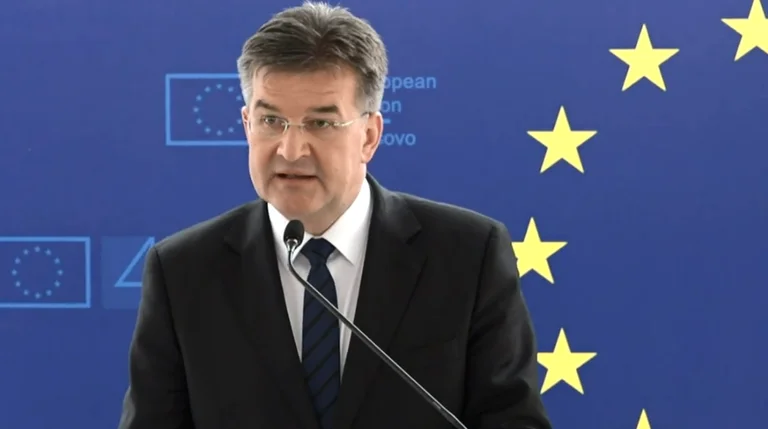
(5 years ago)The European Union's special representative in the Kosovo-Serbia dialogue, Miroslav Lajcak, says in an interview for Radio Free Europe that the first meeting between Kosovo's new prime minister, Albin Kurti, and Serbia's president, Aleksandar Vuciq, is expected to take place within weeks. He says he has been encouraged by the recent visit to Pristina [...]
The European Union's special representative in the Kosovo-Serbia dialogue, Miroslav Lajcak, says in an interview for Radio Free Europe that the first meeting between Kosovo's new prime minister, Albin Kurti, and Serbia's president, Aleksandar Vuciq, is expected to take place within weeks.
He says he is encouraged by the recent visit to Pristina and Belgrade, where, as expressed, he has received guarantees that leaders are willing to continue the dialogue.
With Kurt at the head of Kosovo's delegation, Lajcak believes there is a new situation, because, according to him, the two participants now have very powerful mandates.
Last Friday, the European Council has extended Lajcak's mandate until August 2022.
Radio Free Europe: Mr Lajcak, Kosovo, is recently done with the new Government, and this is exactly what you need for continuing the Kosovo-Serbia dialogue. When can we expect the first meeting between Kosovo Prime Minister Albin Kurti and Serbia's president, Aleksandar Vuciq?
Miroslav Lajcak: I think we can wait for our first date very soon, without unnecessary delay. Kosovo, as agreed with Mr. Kurti, must end with the establishment of institutions. The president's election and the new team's preparation remain now. After that, we expect them to be willing. He [ Kurti] has told me he is ready to come to Brussels to meet with President Vuciq. I was told he was willing to come whenever he got cold.
Radio Free Europe: You will now have new conversationors from Pristina. Among them are those who think we should resume dialogue and not continue the process that has stalled in September. How do you imagine this first meeting between the new prime minister of Kosovo and the president of Serbia, in the context of the process you already lead a year?
Miroslav Lajcak: The important thing is that during my last stay in Pristina and Belgrade, partners have confirmed that they know the importance of dialogue and that they are willing to continue with this process. Of course, dialogue is not only [the process] of normalising relations but also a platform where life's problems are resolved. Yes, we have a new team, and when I met Mr. Kurti in Pristina, he told me that it should be announced with the whole process, with what has been agreed, and this has been one of the main objectives of my visit. We agreed to meet once again once again after being announced [with the process], so we can figure out how to continue the process.
I now look forward to the next meeting, to discuss in what form we will continue, because what is agreed on is agreed by the last government. We need to see how much the new government will be identified with what is agreed on, or will come with new proposals. Of course, the agenda -- the content of the talks -- is determined by two sides, Pristina and Belgrade.
“We don't have time to waste”
Radio Free Europe: Do you have a deadline until you wait? What you said takes time, while dialogue has stalled almost a year.
Miroslav Lajcak: We had a very productive period between July and September last year. Then, the political situation in Kosovo has not been one to allow the continuation of talks on these topics. Now, as I said, we have guarantees that both sides are willing to continue. We don't have time to lose because the political calendar is such that there are no major elections, there are no in Serbia, there are local elections in Kosovo in the autumn. So we should use this political calendar and, as I said, approach negotiations without delay. Prime Minister Kurti has received these messages from his European partners, from EU High Representative [Josep] Borrell. He knows this [continuous dialogue] is expected of him.
I've said we don't want anything artificially; of course, all necessary institutions should be formed. We have the Government, we have the Parliament, and the [Kosovo] president must be elected as well. I think we have the main conversationor. On the team, I think there will be more or less people who have led this process so far, that historical experience. So, I don't think there's any reason why we're not going on in a couple of weeks.
Radio Free Europe: When we're on the calendar and the deadline of a few weeks, your mandate expires on March 31st. When Albin Kurti and Aleksandar Vucinq come to EU headquarters, will they meet Miroslav Lajcak or anyone else?
Miroslav Lajcak: It seems so, because last Friday, the European Council has extended my mandate until the end of August 2022 - 17 months. So I think we have enough time for a serious job.
Radio Free Europe: A person will come from Pristina who has officially supported more than half of Kosovo's population. How much this facilitates the process, in the sense of what is agreed upon, will be approved by Kosovo institutions and society?
Miroslav Lajcak: This is very important. Of course, the support Mr. Kurti has gained in the elections is truly historic - over 50 percent of the vote is unprecedented. This gives him the power to negotiate, negotiate, and agree on. This is very important. We know well that President Vuciq also has a very powerful position in Serbia. So we have two partners with very powerful mandates. This will be a new situation.
Mr. (Avdullah) Hoti [former Kosovo prime minister] has been responsible, constructive, very serious partner, but his political power has been smaller and that has been a factor.
Radio Free Europe: Mr. Hoti has agreed to open the issue of the Association of Serb majority municipalities in Kosovo, and there has been no political support to return to Brussels and continue these negotiations. But you have in some cases said that the issue of association is inevitable in the process you lead. Are you still after this?
Miroslav Lajcak: There is a very well-known principle of international law, which says “pacta Sunt servada” What is agreed upon must be accomplished. That's what I can say. That [the association] was agreed upon long before my arrival in 2013, 2015. We can't act like this doesn't exist. I expect negotiations on how to do this.
Change of borders to ethnic bases “is not the concept of 21”
Radio Free Europe: There have been some topics that the parties have opened. They didn't agree to it, but they agreed to talk. I'm talking about exchanging territories. The then holders of the process, Hashim Thaci, who is no longer present physically or politically in Kosovo, and Aleksandar Vuciq, have acknowledged that at one point they have talked about the possibility of exchange of territories. Your predecessor, Federica Moghrini, has allowed the opening of this topic, arguing with the fact that the European Union will not prevent whatever parties agree on. You, that world, were foreign minister of Slovakia and you rejected this idea. Now, as the EU representative, are you left behind the stay you've had in Bratislava or will you allow the opening of contractive topics if the parties agree?
Miroslav Lajcak: I haven't changed my attitude. I don't think the European Union's role in this process is to take notes. The European Union's role is to ensure that the process [of negotiations] is European, is the 21st century process is the process that draws Kosovo and Serbia closer to the European Union. Changing borders on ethnic grounds is not the concept of the 21st century is not the concept on which the EU is built. So I really feel that my role and the EU is to seek solutions that are European.
I am convinced that changing the borders meant opening the Pandora Box, which would be very dangerous and, at the same time, would imply that the EU, in some way, has given up its ambition to attract the Western Balkan region to its ranks, building European standards, European culture. [On the contrary] we would go in another direction, in a very dangerous direction. As long as I am on this task, I will try, engage, and guarantee that all solutions are European solutions and that they surround Serbia and Kosovo with the EU, not the other way around.
Radio Free Europe: Does this mean that you, as mediator or a facilitator, will not allow the opening of what you consider Pandora's Box, regardless of whether it is about exchanging territories or any other subject that would cause such contradictions?
Miroslav Lajcak: I don't think I should make any powerful statements, because this issue is not in order, it's not on the table and it won't pass. So nobody puts it on the table because we've seen the reactions they've been in the region. Powerful negative reactions. Partners are realistic and know well that we have to find solutions that help stabilise the region and further Europeanisation of it. So, I shouldn't say I won't let you, because there's nothing I can't allow, because that [the exchange of territories] right now nobody proposes.
Radio Free Europe: You said you engaged in a legally binding, comprehensive agreement that would resolve all open issues between the two sides. You also said that you would agree to anything until you agreed to a full agreement. In your mandate there is new in the sense that you talk about elements, which will eventually be round with the comprehensive agreement. How do you see that deal? How do you imagine the text of that agreement between the parties? What will be those issues that will be resolved permanently between Pristina and Belgrade?
Miroslav Lajcak: I would not publicly present those issues, but I can say President Vuciq and the prime minister [then] Hoti agreed last year with our mediation. Both sides have known exactly what is negotiated, how many steps lead to the comprehensive agreement. Now of course we need to hear from the new administration in Kosovo, how much you identify with those agreements or with that plan, with that programme, are there new proposals or elements in which he is correct...
It is not the European Union that decides what the outcome will be, it is Belgrade and Pristina that agree, while we are there to help. So, as I said, we're entering a new phase and we have to wait for the first meeting of the two leaders, to know exactly if there's any change in this process.
Radio Free Europe: When you were appointed last year, there was also a process of dialogue that led Washington. You've even been waiting with the then American administration's <x0dus cold,” and Brussels-Washington relations have been completely polarised. Now we have a new administration, which in some cases has confirmed that it fully supports the Brussels dialogue and your personal efforts. Is Washington enough to come up with just these positive signals of support, or do you expect that during the process there will be a more active role of American officials?
Miroslav Lajcak: I think we have very powerful signals coming from the current US administration, which show that they support the European Union, support the enlargement process, support the dialogue, support my mission. This won't be passive. They do so even actively - in communication with partners. I don't want to go back to the past, but I've seen how badly the region has admitted when it noticed that Brussels and Washington don't speak the same language. Of course, this has been damaging to all.
I'm so glad we're back in a situation that we've been used to over the years working closely with Washington. Washington also uses his influence to repeat the same philosophy - the same principles that we do. I think this is great for the region.
Radio Free Europe: However, an agreement has been reached in Washington, called the Washington Agreement. Representatives of the new US administration, in public presentations, no longer refer to that document. There is still no confirmation of how they will approach that agreement. But what does that agreement mean to you and your efforts in the Brussels dialogue?
Miroslav Lajcak: It's not up to me to comment on something that's been accomplished in Washington. But, I mean, there is no competition, and some points in those dialogue-related political obligations documents are no longer seen as competition for our process. It is very important that the American administration is fully with us and supports the process leading the EU. This is very important.
Radio Free Europe: In some cases you have said that the comprehensive agreement can be reached within months. Now say your mandate was extended until August 2022. Is this any sign that the parties will not be able to agree and that you will have a lot of work over a year and a half, or even longer?
Miroslav Lajcak: I've tried several times to explain my thesis. I'll try again. I've said technically, in an ideal world, what we want to agree on if we have full effort on both sides it can be achieved within a few months. We don't need the next ten years, not five, not three. But I also said that for the speed of the process the two sides decide, so Serbia and Kosovo. We're here, I'm here 24 hours a day, seven days a week. We're willing to go at the speed with which the two sides go.











