 5 hours ago
Kosovo is our “, chief Serbian opponent shows his position on the final agreement
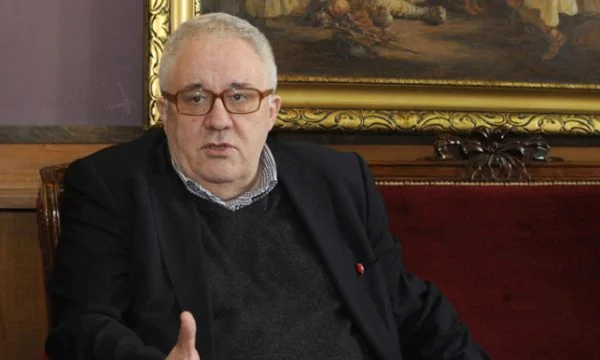
Periskopi(5 years ago)
(5 years ago)Speaking of Kosovo, Serbia's Academy of Sciences and Arts Chairman Vladimir Kostic stated that in no public presentation, interview or text has he mentioned signing any agreement or giving anything easy, and that he himself would not sign and give anything. But I thought and wrote that in [...]
“But I thought and wrote that in such state and national overthrows, the most rational approach is to divide responsibilities (talks, talks, talks at different levels of state and society, not any disagreement) in determining the red lines of state and national interests, then it should also be written in the decision whether anything will be accepted through any compromise or nothing will be accepted”, Kostic stressed in a weekly Vreme art.
As he stressed, the deal should be reached “just so that any of these decisions can be ours and think well”, stating that this “is not a matter for an individual or a group of individuals”.
And the suspicious persistence and intentions of those who call us for quick deals on centuries-old problems are simple and dangerous. I mean, as an ordinary citizen, it seems to us that for our mutual conversations and, I want to believe, agreements, we always have more time than good will. I am sure, however, that regardless of who is and who will be the president of the Academy, there is good will and time for this kind of problem”, Kostic said.
He claimed that the attacks on him took him “automatically to that extreme end of the spectrum in which there are those who would unthinkingly accept, sign and give everything, unlike the other extreme, in which there are those who would not do anything of it”.
The statement by the head of Serbia's Academy that “Kosovo is not ours” has prompted numerous reactions in Belgrade. Despite attacks towards Kosic, however, the Executive Board has given support to the head of the Academy to continue working away.
This response came in the wake of earlier statements by the Serbian Chief Academy, Vladimir Kostic, who had said that “someone should tell these people that Kosovo is no longer de facto or de jure in our hands” and that at this moment, the only political “is how to leave Kosovo with dignity”.
A group of 93, called Serbian intellectuals, had sent an open letter to the Serbian Academy of Sciences and Arts demanding that its chairman, Vladimir Kostic, resign over his statements that “Kosovo was and will be our”.
But in the course of criticism of fierce attacks in the direction of Kostic, he had sided with Serbian politician Nebojsa Zelenovic.
“I support Academy Chairman Vladimir Kostic's proposal for the start of a serious and effective debate on Kosovo. The requirement for Kostic to leave the head of the Academy is, in essence, an invitation to escape reality and to surrender to fate, which we will not influence” had Zelenovic written on Twitter.
Recently, even the prominent Serbian historian Milan Protic came to the defense of the Serbian capital, saying Kosovo is independent, despite the fact that there is no comprehensive international recognition and no country in some of the international organisations.











