7 hours ago
Concern research, 19% of Albanians convinced that political system must be changed by violence
Periskopi(5 years ago)
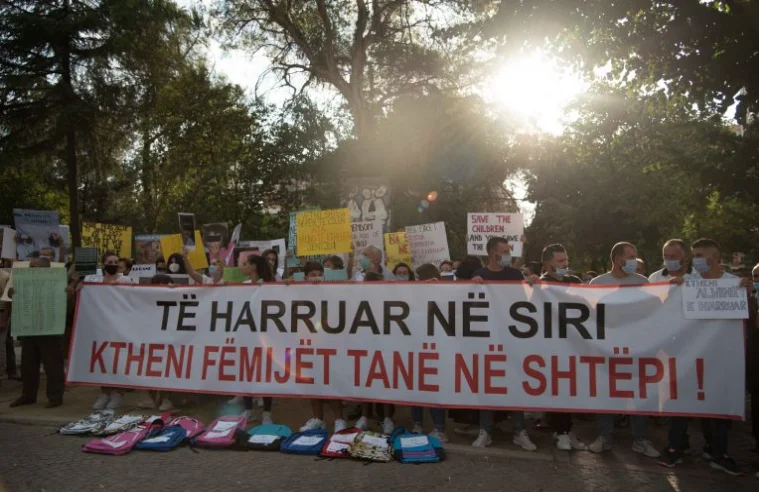
(5 years ago)A new study raises concerns that a small part of Albanians feel excluded from the country's political system and that those who believe violence is the legitimate instrument for changing the situation are numerous. In this picture of September 14, 2020, family members and relatives of Albanians blocked [...]
In this photo of September 14, 2020, family members and relatives of Albanians stranded in Syria are protesting to encourage the government to try to repatriate them. A survey conducted by the IDM found that more than half of the population supports the suggestion that the government should help their return home.
The number of Albanians who have gone to Syria to join extremist Islamic groups has dropped to zero after 2015 as a result of increased awareness among the general population, but another source of violent extremism is being formed, fed by the feeling of social exclusion as a result of poor levels of democracy and rule of law. These are the conclusions of a broad study conducted by the Institute for Democracy and Mediation, (IDM), an organisation in Tirana, which was released online on Wednesday 24 March.
Through 1600 face - to - face interviews across Albania, the study revealed that Albanians are now far more aware of the danger of Islamic radicalisation than they were in 2011, when Civil War began in Syria, which drew thousands of foreign fighters from many parts of the world, including about 144 Albanians. Part of them, mostly women and children, continue to be in refugee camps in Syria, and only a few were managed to be repatriated by a diplomatic effort by the Albanian government. Albanians are puzzled over this problem, partly convinced that it is the government's duty to carry out their repatriation and partly convinced that they cannot be saved from the clutches of violent extremism.
The half of the population believes that the government should work for the repatriation and reintegration of former fighters. However, more than half believe it is impossible for them to be rehabilitated,” declared Leonie Wrugtmann, one of the authors of the study.
Currently it is known that about 70 Albanian individuals should withdraw from Syria camps.
Political Extremism
While the danger of violent religious radicalism has diminished, the study notes that there is another type of risk that is growing and comparatively greater: the risk of political radicalism. According to the study, a considerable part of Albanians feel alienated by the political system and the weaknesses of Albanian democracy, and as such, justify the use of violence as a moral tool in changing the situation. This is combined with the statement of nearly one third of those interviewed, that they are willing to do anything, including the enterprise of illegal activities, to get rich.
About 54% of respondents believe that everyone wants to get rich quickly regardless of what means, while about 32% say they are willing to do any kind of activity, including illegal ones, in order to survive, the study says.
The report notes with concern that this high degree of tolerance toward creating wealth through illegal means is a significant source of violent extremism.
The situation does not seem to be improving over time. Over the past decade, Albania has seen the prosperity of political parties or individual politicians who apparently do not have political philosophy but who support electoral success in political corruption.
According to the study, around 44% of Albanians believe the Albanian political system is unfair and should be changed. About 19% are convinced that it should be changed, even through violence. Religion evidently does not have to do with this because among more believers, there is more acceptance of the system of things as right and less tendency to change the system of violence.
Anti-Islamic EU
Another concern is related to the perception of a small part of Albanians that the country's poor performance in travelling towards membership in the European Union comes in part because of the majority belonging to Islamic Islam.
According to the General Chance of Populations and Dwellers, in 2011 about 56% of Albanians claimed to belong to the Muslim religion. If it joins the EU in the near future, Albania will likely be the first predominantly Muslim country in this bloc.
Fabian Dzilla, an Albanian expert, said during the report's presentation that the belief the EU is penalising Albanians because of religion is particularly disturbing because <x0-reducing the necessary public pressure on politicians for carrying out the reforms needed for membership” and helping them justify lack of progress by blaming the EU.
About 28% of Albanians believe that countries with Christian populations in our region have more support from the West because of religious affiliation compared with us, while 44% believe that the European Union has been unfair to Albania, Bosnia and Kosovo because of the religious affiliation of these countries.