 6 hours ago
That's how the Commissions will be divided in the Assembly
Periskopi(5 years ago)
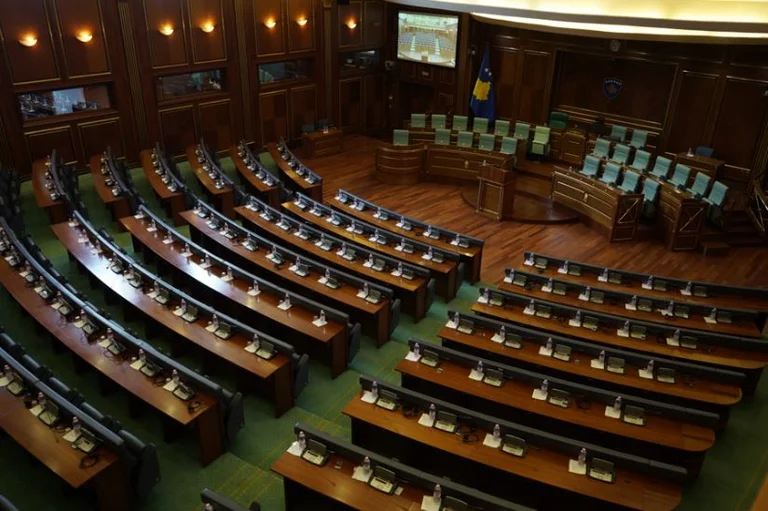
(5 years ago)V Legislate Constitution III of the Kosovo Assembly, which took place the day before, where its majority president was elected Glauk Konjufca from the Vetevendosje Movement (LVV) ranks, has remained to be functional overall after 14 parliamentary commissions are also formed by Parliamentary Groups of Political Subjects in the Assembly. [...]
Eugen Cakoli from the Kosovo Democratic Institute in a proposal for Telegrafi has said that Kosovo's Assembly, even though it has been constitutionalised, has not been fully functional.
Cacol said that to this day the Assembly had 14 Parliamentary Commissions and if this number will remain then the LVV as the largest parliamentary party will receive seven commissions, The PDK and the LDK as opposition belong to two commissions, while the AAK, the Serbian List and the non-party communities' parties will have one commission.
He also explained that there are 11 members in the Parliamentary Commissions. But in this case, the LVV with its coalition will be represented by the majority of members on these commissions, which will be expected to have at least six members.
“The LVVV, respectively, will have half the members in almost every commission, with the exception of the Commission for Rights, Community Interests and Kthim. Of the 11 members each has commissions, LVV and the ruling coalition will have at least 6 members in each of the commissions. As the Largest Parliamentary Group The LVV will chair 7 commissions, if the number of commissions remains the same as it has been so far, followed by the LDK and the PDK, which will be led by two commissions as well as the AAK, the Serbian List, the 6+ Parliamentary Group that will be led by a” commission, Cakoli has clarified.
He also said that for the first time in the Kosovo Assembly there will be no problem with securing votes for passing the bills.
For the first time, perhaps there will be no problems with securing votes for passing any legal initiative, and in this direction, the fact that a subject has managed to win half the mandates and the same without having a formal coalition with other parties will have the majority in the Assembly makes up a positive element. There will already be an added dynamic of work in the Assembly, as well as most likely we will not have multiple-type blockades of the last two legislatures, where much of the legal initiatives have failed to be voted in the absence of quorum”, Chakoli said.
However, as he put it, there is a principled danger that the Assembly will become a kind of evulleʹ of bills more than a filter of their own.
The Parliament is now expected to pass all the bills, although there is a principle of risk that the Assembly will be transformed into some kind of law-designment rather than a filter of them that should be, but that will still have to implement such proposals and legal initiatives from the executive side of”, Eugen Calcoli from KDI said among other things.
Unlike the Kosovo Assembly regulation, it is said that the member of headship cannot be chairman of the Parliamentary Commission.
Just as it becomes known in regulations, the Parliamentary Headship requires each parliamentary group, represented in the Assembly, to propose mayors, deputy speakers and commission members
Meanwhile, an MP cannot be a member of the parliamentary commission, as well as parliamentary groups propose to the mayors for commissions, in accordance with the agreement reached in Headship.
“In the agreement on the appointment of commission chair positions, the chairmanship takes into account the proportion of the force of parliamentary groups”, the Kosovo Assembly regulation said.











