3 hours ago
Wesley Clark: If Serbia wants closer to West, I should recognise Kosovo
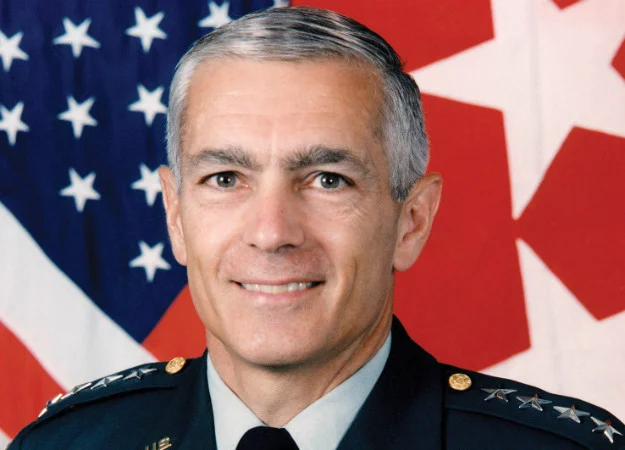
Periskopi(5 years ago)
(5 years ago)Former High Commander of NATO, Wesley Clark, says a mutual recognition between Kosovo and Serbia is the way to progress and integration, and that this brings benefits to both countries. In an interview with Voice of America, Mr. Clark says the new administration of President Joe Biden will increase attention to [...]
Former High Commander of NATO, Wesley Clark, says a mutual recognition between Kosovo and Serbia is the way to progress and integration, and that this brings benefits to both countries.
In an interview for Voice of America, Mr. Clark says the new administration of President Joe Biden will increase its attention to Southeast Europe and the Balkans. In a conversation with colleague Keida Kostreci, retired general said recent political developments in America show the strength of democracy rather than its weakness.
Voice of America: General Clark, in a letter to Serbian President Aleksandar Vucic, President Joe Biden spoke of mutual recognition between Kosovo and Serbia. Serbia's president, meanwhile, said this will not happen and that his position on Kosovo has not changed. Do you think mutual recognition will be possible during Mr. Beden's administration?
Wesley K. Clark: I think that the future of relations between Serbia and Kosovo and whether there will be mutual recognition depends on leadership in Serbia. I think and hope that leadership in Serbia will understand the importance of a greater approach to the West, and that means recognition of Kosovo as an independent state. This meant putting the past behind us and looking to the future. I have met wonderful people from Serbia, they are very close to Western values, and I hope that the Serbian leadership can see that it is in its interest and that it wants a stronger relationship with the West and that means recognition of Kosovo.
Voice of America: With the new Beden administration saying normalisation must have mutual recognition, what must be done to convince Serbia of such a thing?
Wesley K. Clark: The question has always been whether Serbia wants to see more from the West or from the East. So as Mr. Biden's administration returns to the traditional American foreign policy course, we will seek closer co-ordination with our European allies. We know that the EU is important to the security of the United States in the world and our ability to work with China. So we will make all efforts to strengthen the European Union, and that means it will be increasingly in Serbia's interest to be guided westward. I think this is the biggest push for Serbia. Where is the greatest benefit for her people? Clearly, it'll be the West.
Voice of America: The previous administration, regardless of its methods, brought the issue of Serbia and Kosovo to the spotlight, with the meeting of leaders of the two countries at the White House last year. What can the new administration do to increase that attention, and can we expect greater commitment?
Wesley K. Clark: I think the economic drive is positive and beneficial. The White House's next effort (in the Trump administration) was about the relationship with Israel, which is also positive. I think we will see a much larger commitment from the United States to work with European allies and friends, and I think we will see an effort to help Europe improve its situation, strengthen its investment programmes and economic incentives toward the East. If we look at history, they realize that the essence of economic growth and innovation is in the West and that the benefits of sharing with the West will come.
Voice of America: You talked about the decision Serbia must make and how the United States should engage and co-operate with the EU. One of the questions Serbia has posed is what Kosovo will give, while that (Serbia) is asking for mutual recognition. How would you respond to such reasoning?
Wesley K. Clark: I think that a mutual recognition is in the interest of both countries culturally historical, economically, both would benefit from this. So I don't think it's a matter where I can say “I give you this, then what will you give me in exchange?” I think it's mutually beneficial for both countries. Hostility and tensions are not in anyone's interest. So the benefit for Serbia is the biggest draw with the West. The benefits for Serbia are the end of lowering tensions with Kosovo. So do Kosovo. So I think Serbia benefits double because Kosovo is already on a line with the West. So I hope that leadership in Serbia sees this as it is: An excellent opening by the United States towards Serbia and I encourage the people of Serbia to move forward and seize this opportunity.
Voice of America: Despite the challenges facing the United States, do you foresee an increase in engagement in the Balkans? Not because there are no more important priorities, but because few are the regions where engagement brings more benefits...
Wesley K. Clark: I think you're right because if you look at the history of East-West competition, if you look at the Cold War, the main challenges and progress that have been achieved, it's always been in the suburbs. I am very pleased that the administration and Mr. Putin have agreed to extend the new START treaty for five years. I think that's important. Negotiations and relations with ideological and cultural opponents like China and Russia will always have a central place in American diplomacy. But the greatest benefits and the greatest impact on these relationships have really been on the suburbs. And the United States understood that. We know that periphery is important, and we know that this tectonic tablet of humanity that is the Balkans where Islam, Christianity and Catholicism have been interlocked historically from the Ottoman Empire, the Roman Empire and to Greece and Macedonia, there have always been conflicts and conflicts often open in this region of Europe. And we know this region is very important.
Historical memory is long in this region. And it may seem to some that it's a trivial region, but actually that's the effect. Conflicts have begun, and there may be the greatest effect of American diplomacy.
Voice of America: How do you predict the approach of the new US administration to this region?
Wesley K. Clark: I think the administration will work closely (with countries) through its ambassadors in the region, negotiate between the countries' different ambitions and interests. We are encouraged to resolve the Macedonia name issue has been resolved. It's really important. Much progress has been made in these 20 years, but much remains to be done. I know this administration will consider Southeast Europe and the Balkans with many priorities.
Voice of America: In recent years because of domestic politics in the United States and because of the worldwide wave of populism, it has been difficult for the United States to talk about democratic values, for example, or anti-corruption efforts, or free press. Do you foresee to change that trend?
Wesley K. Clark: I think that actually anticorruption has been in the center of the United States' attention. Every American ambassador urges the country's government where it serves to strengthen the anti-corruption measures, because we have it clear that corruption is always destabilising for democracies, undermines people's will and destroys people's trust in the government, in their votes and so on, and as such should be addressed. I have not seen the faintness of American diplomacy in this direction. I believe this will continue. I also think that we will see an increase of emphasis on democratisation and human rights with Mr. Biden's administration. I think that the US ambassadors, American diplomacy in general, will seek to respect the standards of their constitutions and keep the promises they make to their people. I think the Biden administration will put more emphasis on political, human and cultural values.
Voice of America: One of the questions or issues raised by the public in these countries during the election period and after the elections here was if the United States still has moral authority to lecture countries with less democratic tradition, with what we're seeing happen here. What would be your answer?
Wesley K. Clark: All human institutions are essentially fragile. The dictatorships are fragile. They are constantly afraid of their own people. If you look, Russia, the Soviet Union under Stalin, and successive cleansings, they were taken out of fear, out of doubts about the loyalty of humans. China may look like a strong and stable country, but like any country, such as any institution has internal pressures and dynamics. The question is whether they appear openly or not.
In democracy, our strength is to display these tensions and pressures and competitive interests openly, where they can be solved peacefully not through midnight killings or other measures often used in authoritarian regimes. So I think what we're seeing in the United States today, what you've seen since January 6th, shows not the weakness of democracy, but its strength, such as that members of the president's own party in Georgia rejected it and respected the law, instead of giving in to its autocratic tendencies. And in Congress, evidence is emerging and the American people and the world are emerging. We're not hiding this, it's being made public. The American people decide their future through their elected representatives. And it is true that there are some of these elected representatives who worry about their political future, as it should be, because American representatives should represent their voters. We know that in the American system we have to deal with the impact of social media, disinformation, these algorithms that attract people to conspiracy theories, unless they find a way to avoid it. Many of these people have publicly admitted to being misled. And so the fact that all of this comes to light is not a sign of weakness, it's a sign of strength. It is the ability of democratic systems to be self-reforming that makes them sustainable. So, what seems fragile from the outside actually has extraordinary inner stability. What looks strong on the outside can actually be very weak.
Voice of America: But someone with a more pessimistic view would say, for example, that this trial (of Mr. Trump) for blaming and all that happened after January six, would have consequences in the years to come. Clearly you embrace a more optimistic view...
Wesley K. Clark: I see it from an optimistic perspective because I believe in the strength of the American people and institutions. Democracy runs through different cycles. The United States has passed three main cycles since the Civil War itself in the 1860s. We had the Golden Age, the progressive era that ended around 1980 actually, and then we had Reagan's age for 40 years. And each period brings its progress and then it has its own excesses and then there's a corrective movement. So, what you're seeing in the rise of the American left, warns the end of Reagan's era. Our last president (Donald Trump) took advantage of all the different economic and social forces, immigration forces, excessive privatisation and so on, to create a solid base of supporters with certain groups of people, and if this is not successfully handled by the American political system, there will be other options. But I think if you put it in the historical context, democracy wins. It's the most enduring expression of the human heart's desires for freedom and self-repression, and those longings can also be crushed with force, but they will always be resurfaced.