6 hours ago
SUFFECTION: Mysterious anomalies are weakening the magnetic field, scientists say
Periskopi(5 years ago)
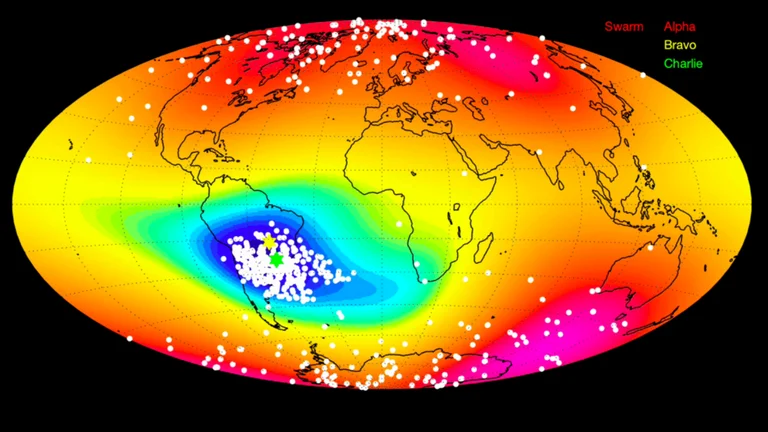
(5 years ago)A piece of Earth's magnetic field, known as the South Atlantic “Anomalia, ” is weakening and can be removed, new data indicates. The strange phenomenon is also causing technical problems in satellites orbiting the earth. The magnetic field of our planet is an important part of protecting us from [...]
Our planet's magnetic field is an important part of protection that protects us from cosmic radiation and particles from the sun. The field is also why GPS works. It is generated from the ocean of liquid iron to the outer core of the planet, about 1800 miles below our feet. Iron behaves like a “Messiah to a bicycle dynamo dynamo,” is explained in a press launch by the European Space Agency. [ Footnote] The ESA has done this research.
The iron flows the electric streams that then generate the ever - changing electromagnetic fields of the planet. The magnetic iron nucleus behaves like a giant magnet, which causes the existence of the South and North politics, writes BTh.
Scientists have been able to decide that the planet's entire magnetic shell has been reduced by 9 percent in power over the past 200 years.
South Atlantic Department <x0). The satellites from an ESA mission that saw anomalies managed to detect a very serious weakening in southwestern Africa, which tells of the possibility of this area being divided into two different low points.
While the changes observed do not necessarily imply that the sun will eat up our planet, or any similar disaster, it insulates that something is happening in the nucleus of the Earth.
That's exactly what the agency is hoping to find out with other research. One possibility that North and South Poles are changing positions, with South Atlantic Anomaly the origin of this transformation [which happens every 250 thousand years].
Jurgen Matzka, a geomagnetism researcher at the German GZF Research Centre, explained through a statement that the weak new point “was presented during the last decade and in recent years was developing strongly. ” /Periscope