a few seconds ago
Prime Minister's favourite Rama, but both Basha and he do not enjoy youth support
Periskopi(5 years ago)
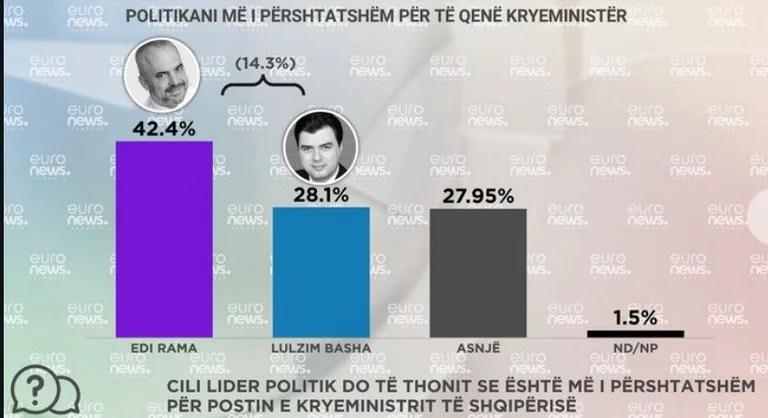
(5 years ago)Albanians see more Edi Rama than Lulzim Basha as eligible to be prime minister, while more than a quarter of them mostly young people value none as such. This was noted by the second Euronews Albanian survey conducted by the prestigious MRB company and published in [...]
Albanians see more Edi Rama than Lulzim Basha as eligible to be prime minister, while more than a quarter of them mostly young people value none as such.
This was noted by the second Euronews Albanian survey conducted by the prestigious MRB company and published on the Barometer Political Programme.
For Rama 42.4% of respondents have indicated they see it adequate to run the country's government, while for Basha 28.1%.
The current prime minister had the highest support in the 25-34 age group (47.1%) and age 55-64 and 65-75 (46.5 and 44.7%).
The DP chairman, although at a lower percentage point, has the highest support in the 45-54-year-old group (35%) and 55-64 years old (31.2%).
Among those who view the two political leaders as inadequate (27.95% of the respondents) is noted that the 18-24-year-old group, which includes the category of voters seen in this parliamentary election. This age group has the highest rejection rate of the two leaders (43.9%), followed by 35-44-year-old group (31.7%).
Asked about their most appropriate party to govern the country, most have responded to the SP (46.4%), with an increase of 1.7% compared to the first January 21st poll, while for The DP has responded almost the same as in the first (30.1%) survey, with growth of only 0.1%.
In this question, the LSI drop to 7.2% (-4.1% from 11.3%) and the growth of the PDIU to 2.8% (+1.3% from 1.5%).
Methodology
Euronews Albania's national survey in co-operation with the prestigious MRB company conducted 1,600 interviews face-to-face with people eligible to vote (over 18) in 12 urban and rural electoral areas from January 25th to February 12th.
Of those interviewed, more than half were female (51%).
The preference for coalitions, government performance and opposition, as well as the trend in the vote were some of the main thematics taken under analysis, about two months before the country's general elections.