 2 hours ago
Hooper finds gap between June communiqué and indictment against Thaci
Periskopi(5 years ago)
(5 years ago)Michele Picard, Kai Ambos and Nina Jorgensen are the three Appeals judges operating under the Specialised Chambers of the Court and Prosecutorial in The Hague. All three of these judges hold the appeal course of the KLA leaders who have rejected the decision of the preliminary procedure judge for release from custody. [...]
Hashim Thaci, Jakup Krasniqi, Rexhep Selimi and Kadri Veseli have led to Apel's decision by the pre-procedure judge, who rejected their requests for release from custody. The requests in question have been addressed from February 4th, but that have recently been made public, writes the news.net.
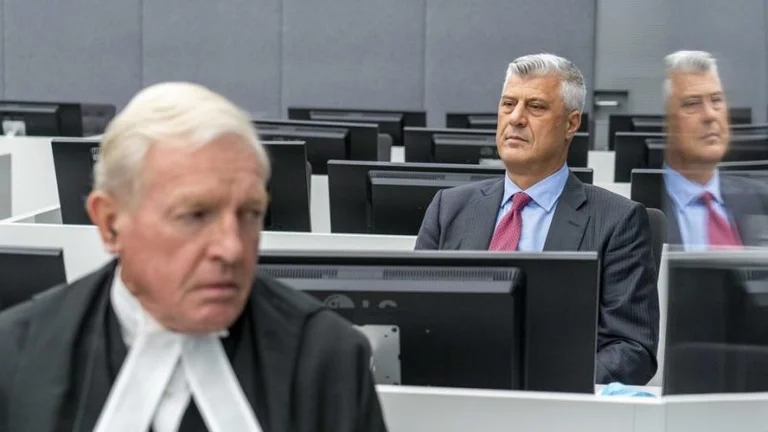
Former President Thaci's lawyer, David Hooper, in his appeals parachutes, says the pre-procedure judge has demanded an impossible thing when he argued that Thaci would have to eliminate exactly all the risks related to the procedure, noting that this is a violation of the right to provisional release in anticipation of the trial. Hooper further cites the controversial prosecution's argument, which was reasoned by the judge of the preliminary procedure, which concerns the fact that Thaci based on charges weighing heavily on him, could be sentenced to life imprisonment, and that this poses a risk of escape if he is temporarily released.
Hooper has said these claims by the Special Prosecutor are completely groundless, citing the fact that Thaci was a potential suspect of serious war crimes since 2011, when Dick Marty's report was published.
“specifically, the fact that he was a possible suspect in committing serious crimes had been disclosed to Mr. Thaci has since published Marty's 2011 Report, as well as the reality that his status could differ from the potential suspect in reality through the establishment of KSC”, says the Hooper attorney's parachutes.
Thaci's lawyer backed up strong criticism even of the communiqué issued in June last year, which had been named political, which involved the fact that the prosecution has handed over an indictment to the Court of Thaci and Wessel.
Hooper stresses that in that communiqué, Thaci was given a leading role in claims that he has committed war crimes.
Meanwhile, Hooper says the opposite occurs in the indictment, where Thaci is mentioned only in 24 of her 173 paragraphs.
The “actually, setting aside the entry paragraphs regarding the accused's personal and professional status, Mr. Thaci appears in only 24 out of 173 Aktakuza paragraphs, including only four out of 115 paragraphs addressing fundamental crimes. In her face it probably suggests a more limited role than in the June 2003 press release 2020”, Hooper's paradents say.
The former president's lawyer further rejects all claims, which were considered based by the Court, that if Thaci is linked to the OVL-KLA. Hooper says there is no basis that confirms the fact that his defender, has a position in the OVL, or has used the people of this organisation as he calls it, the wrong “action” in the past.
Hooper is even more harsh with the tribunal and the prosecution when he says that all claims that Thaci could mobilise networks of supporters to undermine the tribunal's work are speculation.
There was no evidence before the Judge that Mr. Thaci, either directly or indirectly, has influenced witnesses or tried to influence witnesses contrary to Article 41 (6) (b) (i). That's because no one exists. Instead, The PTJ again incorrectly relied on the “past and influentially Mr. Thaci” to conclude that this “could cause the mobilization of a wide network of supporters” aimed at obstructing procedures. This is pure speculation. PTJ assumed the risk of mobilization was especially due to the current phase in procedures where Mr. Thaci is progressively informed of the evidence against him. This reasoning, as evidenced by continued support in “May”, is wrong. No concrete “database” was identified which correctly and reasonably bind Mr. Thaci with “the modernisation of a wide network” of the third unbounded and unidentified parties whose goal is to prevent these procedures. The absence of any concrete “bases”, that is, evidence, to support this element of the PJ assessment for Article 41 (6) criteria (b) (i) constitutes a legal error”, says the former president's lawyer.
Lawyer Hooper at the end of his predecessors says that the Judge of Pre-Procedure Procedure has not even considered the terms proposed by Thaci's defense for the release of the latter, which has to do with house arrest, where he would have limited access to the internet, or Sıdo would have access at all, then limited use of the phone, with the phone register that will always be forwarded to the court.
For these and other reasons, lawyer Hooper has demanded that the demand in question be accepted and Thaci guaranteed provisional release.
A decision by the Appeal Rooms made by three judges is expected to be taken in the next few days.
Who are the Apel judges who will deal with the Apel issue of former KLA leaders?
Kai Ambos From Germany, he was head of the country's international criminal law and professor of criminal law, criminal procedure, comparable law and international criminal law at the University of Gettingen (Göttingen) in Germany since May 2003.
In 2013, he was appointed director of the Research Centre for Rights and the Latin American Criminal Procedure (CEDPAL) at the University of Gittingen. He has also worked as a defence lawyer and consultant at the International Criminal Tribunal for the former Yugoslavia and the International Criminal Court.
Since March 2006, Judge Ambos has been working as acting judge at the Special Court of Downfire in Gittingen, of which he was delegated to the Brownshiweg Appeal Court (Branunscheweg) for 2015.
Judge Ambos has conducted his studies of jurisprudence and political science at the University of French in Brajzau (Freiburg my Braisgau) in Germany, and at Oxford (Great Britain), Munich (Germany).
In 1990 he passed his first state exam, and in 1994 the second state exam that enabled him to exercise his attorney's profession. In 1992, Judge Ambos was promoted, and in 2001 he gained professional training as a university lecture (both from Munich University). It has been widely published in the area of law and criminal procedure, equal rights and international criminal law.
Nina H. B. Jorgensen From Norway, she has been a professor of international public law at Southampton University since 2019 and has been serving as vice-deciman of the Jurydic Faculty (research).
Prior to that, she was law professor (2014-2018) and law assistant (2010-2014) at Hong Kong Chinese University. Between 2001 and 2010, she has worked on various tasks at the Sierra Leone Special Court, including as senior lawyer for appeals and senior legal adviser to the Prosecutor's Office, as well as in the extraordinary rooms at the Cambodia Court, and at the International Criminal Tribunals for the former Yugoslavia and Rwanda.
It has also worked for the OSCE Office for Democratic Institutions and Human Rights in Warsaw as the legal adviser for tolerance and non-discrimination. It has also advised the UN and nongovernmental organisations on issues related to international criminal law. Judge Jergensen has a science degree from Oxford University and graduated from the University of Bristol (MB). She has been admitted to the Association of Lawyers of England and Wales in 1999 and has her license as a lawyer. It has widely published in the area of international criminal law and procedure rights.
Michel Picard From France it is the Court of Appeals judge in Paris since June 2013. From 2008 to 2013, she was a judge at the International Criminal Tribunal for the former Yugoslavia.
From 2007 to 2008, she was appointed a member of the Kosovo Human Rights Consultative Panel, and during the period 1996-2003, she headed the Human Rights Chamber in Bosnia and Herzegovina.
In 2005, she was appointed an independent human rights expert in Uzbekistan.
She also worked for the Council of Europe as an expert on local legislation approach projects with the European for human rights in Macedonia, Albania and Bosnia and Herzegovina.
Judge Picard is a lawyer from the University of Paris. In 1992, she attended a court school in Bordeaux.
Otherwise, the third statuteial conference on the performance of the issue in Thaci's case, Wessels of others, will be held Tuesday of next week.











