7 hours ago
EU Summit: Vaccination Takes High Priority
Periskopi(5 years ago)
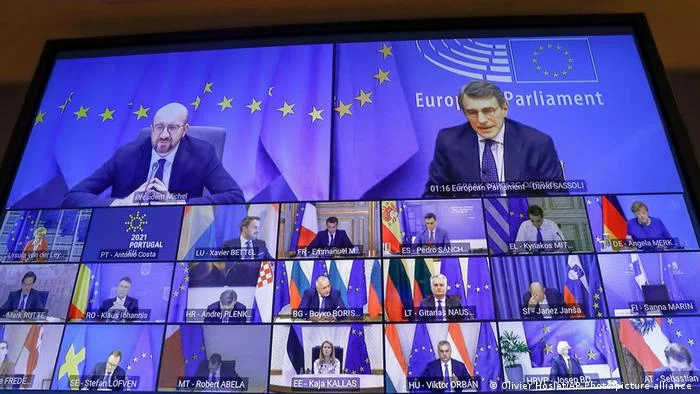
(5 years ago)At the EU's special summit through videoconferencing again, the situation with the choreographer was consulted. States basically want more vaccines and a vaccine certificate. The EU's inoculation campaign against Coronervirus must be accelerated. Production capacity must be expanded in co-operation with large vaccine producers. The EU also wants to support [...]
At the EU's special summit through videoconferencing again, the situation with the choreographer was consulted. States basically want more vaccines and a vaccine certificate.
The EU's inoculation campaign against Coronervirus must be accelerated. Production capacity must be expanded in co-operation with large vaccine producers. The EU also wants to financially support adapting vaccines to virus mutations, as well as to license new vaccine variants faster than usual. This has top priority”, EU Council President Charles Michel said.
“We must improve access to the production of vaccine”, Belgian Prime Minister Alexander de Cruo said. “The fastest access to more vaccines is crucial, to protect people and to return to normal life.” In seven EU countries, the number of infections is increasing despite various restrictive measures, said EU Commission President Ursula von der Leyeen. In the other 20 member states, the infection figures are declining or have remained constant. Chancellor Angela Merkel in the context of high-risk infection mutations has been expressed for a third “>”, which we are currently in.
Growth in Powers
The heads of governments and states of EU countries during the video conference approved on Thursday (25.02) the EU Commission's proposals for a better supply of vaccines. In Marburg The EU supports the construction of a new vaccine plant, which is projected to produce about a billion vaccines annually. The Commission in the future will co-ordinate the fight against pandemic through a new authority for the <x0 health emergency” appointed Hera. Member states again promised to intensify the search for the virus's variants so that dangerous mutations can be found faster. In parallel with the summit of 27 heads of state and government in the EU Parliament in Brussels was discussed with the heads of the six biggest EU vaccine suppliers. They promised to do as much as possible to supply the promised vaccines. Also designed to co-operate in the development of vaccines adapted to mutations in the virus, said Pascal Soirot, chief executive director of the firm AstraZeneca, which has been sharply criticised by the EU because of business policy.
„relabled quickly”
Basically, the heads of state and government of the EU agreed to develop a unified passport or certificate of vaccine, through which vaccinated persons can be allowed in leisure activities as well as participate in activities or trips. „Political decision on what can be done specifically with the vaccine certificate has not yet been taken, Chancellor Angela Merkel said at a news conference in Berlin. Also asked by DW, if such an electronic certificate may be available by summer, she said, „I am not programer”, adding „to a relatively fast time”. Only the development of the national inoculation certificate -- later integrated into a European certificate -- could take three months. Austria's Chancellor Sebastian Kurz, along with his colleagues from Greece, Cyprus and Spain, engaged in this. Kurz prior to the summit said that the „green passport” for vaccinated or cured by the Coronavirus is appropriate to enable „ply freedom” and a gradually organised „translation towards normality”.
But that doesn't mean that, in the end, only the vaccinated will be allowed to travel”, Chancellor Merkel confirmed. Cross-border circulation into the EU could be eased. But eventually tests can be applied to COVID for travelers. In essence, its competence remains as to how member states want to use their inoculation certificate in the future. “Certificiation certificate is politically neutral”, said EU Commission President Ursula von der Leenen.
The chairman of the Christian group of Democrats in the European Parliament, Manfred Weber (CSU), urged the heads of state and government to speed up more. It would be „a bureaucratic nightmare” for vaccinated now to want to release a vaccine certificate later, Weber told DW.
No border controls between France and Germany
French President Emmanuel Macron in the video conference round reaffirmed his proposal, which doses of vaccines purchased by the EU be given as donation to the poorest countries in Africa. Macron spoke of a 5 per cent quota. Merkel welcomed this proposal, but said, the deadline could not yet be determined when their surrender could begin. Today, the first contingents purchased from the UN COVAX Initiative were supplied in Ghana and in Côte d'Ivoire. These doses should be used for vaccination next week in these countries. This is a global pandemic, everyone must be vaccinated. No one is sure if they're not all safe”, EU Council President Charles Michel underlined.
Chancellor Merkel made it clear that there will be no closure of the border with France. „The border closures are not in the order of the day”, the Chancellor said. Although France has instructed the ban on travel and the intensifying of tests on the Saarland border, the circulation of persons working and living between the two countries and the flow of goods will continue. Border controls are in effect with regions where there are „mutation zones” like Tirol and Chekhia. “in certain cases we are obliged to apply specific restrictions”, Angela Merkel said. People who work and live between the two countries have to keep working, but they have to be tested. The EU Commission criticised border controls in Germany and five other EU internal market countries as disturbing. /DW