 7 hours ago
EU must be judge of historical disputes in the Balkans
Periskopi(5 years ago)
(5 years ago)Last December, Slovakia and Chekhia did not support the European Council's draft on the enlargement of the union, and to our surprise we were labeled saboteurs who were trying to complicate the whole process. Rather, we were forced to act that way, to prevent Brussels' involvement in historic issues. So [...]
Last December, Slovakia and Chekhia did not support the European Council's draft on the enlargement of the union, and to our surprise we were labeled saboteurs who were trying to complicate the whole process.
Rather, we were forced to act that way, to prevent Brussels' involvement in historic issues. So we need to clarify our motives. A strong EU needs a strong and stable neighbourhood.
This has always been one of the main goals of EU enlargement policy, helping aspiring countries embrace union legislation and its values, as well as offering them an equal partnership. Thanks to this approach, Chekhia and Slovakia are in the EU today.
For us, enlargement is not just a pragmatic element of the European Union's ambitions, that is, to expand its weight as a player on the global stage, which cannot tolerate the malicious external influence on its <x0-lagen”. Furthermore, we feel morally obliged to offer the prospect of EU membership to other European countries, who are willing to meet conditions as we did in the past.
That is why we have supported the advancement and deepening of enlargement policy since our EU membership in 2004. Now, our focus now is on Western Balkan countries, aimed at ensuring security and stability for our closest neighbours.
We must keep their European prospects clear and open. The opposite would mean leaving open doors for outside powers, which are too eager to penetrate the region with the aim of decomposing and destabilizing the European project.
That is why we have always been firm supporters of the EU membership process. And this approach is making not only our neighbors, but also all of us stronger and safer. Keeping the enlargement process alive has always called for times when we must take seriously the consequences of our decisions, and be honest with ourselves.
In this context, an example when the EU sends mixed signals to aspiring countries is its approach to northern Macedonia. With this country, Brussels has had a two-fold stand for 15 years. In time, Skopje fulfilled all the required conditions, even the most difficult ones associated with its name.
We suspect that any current EU member state would have the capacity and will to do the same. Yet, the promised reward of the opening of accession talks did not come. In 2019, the European Council's decision on opening negotiations was postponed not once but twice.
Then, last year, northern Macedonia faced another obstacle, and again was asked to meet new requirements regarding its national identity. Moreover, in the fall of last year, a new and quite surprising request was made to turn the EU into a collective judge of historical interpretations of what is right, wrong, true and false, in the past hundreds of years of Balkan history.
Meanwhile, at the end of 2020, there was a demand to make this trial official part of the accession criteria. This would turn the EU into an arbitrator of national history. And under these conditions, Brussels will have to think at every stage of enlargement negotiations on the compatibility of several countries with historical interpretations of other countries. Modernisation and mediation is a natural role of the EU. But the union should not become an arbitrator of disagreements and misunderstandings that are rooted hundreds of years ago.
This would be a major deviation from the principles that have guided the enlargement process so far, and which are a part of our approach: transparency and predictability. So we do not support any direction that would sanction the interpretation of historical issues.
The concept of the obligation of northern Macedonia to correct the alleged misinterpretation of history is unacceptable. Additional conditions would pave the way for further bilateral requirements in the future, potentially complicating the entire process for years or even decades to come.
Not long ago, the enlargement process was EU policy. It was the main example of Brussels' ambitions and capabilities, its story of success. Now, we must admit that for some time the enlargement policy will come down further on the list of EU priorities.
We do not object to objective reasons for this, since we acknowledge their existence.
However, enlargement had become something to be postponed for a better season when our home is completely fine. The possibility of joining the EU seemed less accessible and the process was being halted in every mini-phase. Along with the European Commission, we have worked hard on our new and extended approach to counteract this approach, and bring a new impulse to our efforts.
If the EU curbs the enlargement process, fails to respect principles, and keeps its promises, this would be a really lost chance. Such uncertainty would certainly benefit nationalist and insulting rhetoric in the Balkans, which would not be in the EU's interest, and which in turn could foster a number of dangerous frictions, while not excluding possible conflicts here.
We need a direct and predictable process of EU enlargement based on measurable criteria, clear commitments and political will. The conditions are numerous, the membership process is already very complex and demanding, so we must avoid introducing elements that include a high degree of historical interpretations and emotions.
The EU is not here to determine who is right or wrong in disagreements concerning history, language or identity. The EU is based on unity in diversity, not on judgment and classification. Bilateral historical disputes must be resolved bilaterally.
It is not an easy or short process, but it can be accomplished. We know that from our own experience. But we are sure how always obstacles will be overcome, and we will be able to move on to the next steps, for example working under the leadership of the Portuguese presidency of the EU, to reach consensus on the start of negotiations with northern Macedonia and Albania.
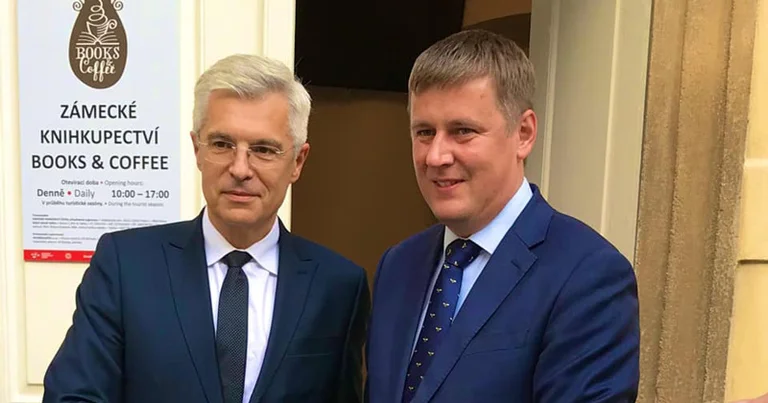
Note: Tomákh Petíček is the foreign minister of the Czech Republic. Ivan Korqok is Slovakia's foreign minister.











