 5 hours ago
EU chief in Kosovo shows what Kosovo institutions must do for visa liberalisation
Periskopi(5 years ago)
(5 years ago)The chief of the European Union Office in Kosovo, Thomas Szunyog, sees candidate statements for prime minister Albin Kurti as positive, that dialogue with Serbia will be in his government's first four priorities, as according to him from scratch to four is a good signal for the process. Szunyog said dialogue [...]
Szunyog said dialogue is not only important for Kosovo, but for the entire region.
I understand that there is a positive development in those statements from not being a priority at all, on being a priority number six, now it's a fourth priority, so I think we're seeing good signs, because dialogue is important not only for Kosovo but also for the entire region”, he said.
Kosovo is still the only country in the region, which has failed to provide any kind of referral against the Devi-19 disease, which causes the virus. But according to Szunyog, the first container of shipments of vaccines against Coronavius is expected to arrive in March.
“We are expecting the first distribution of vaccines, I hope in the weeks or days to come. I repeat, it is my hope, but in March”, the chief of the EU Office in Kosovo said.
The European Union is working to create an institutional stability in Kosovo. Szunyog says he is holding meetings with party leaders in order to reach an agreement on electing the president, as he says the EU is interested in working with a stable and long-term government.
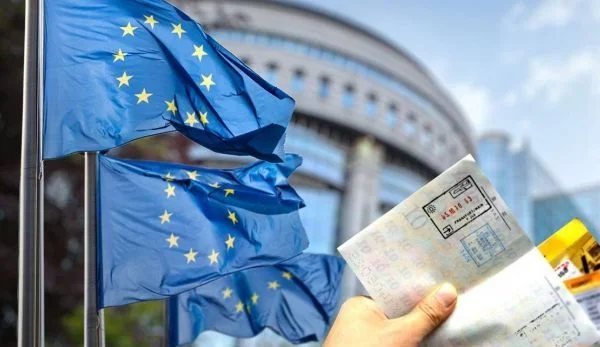
As for visa liberalisation, Szunyog says the European Union as an institution has committed its obligations to Kosovo, while now it is up to local institutions to hold meetings with the states which oppose this process, in order to convince these countries of visa liberalisation for Kosovars.
On the other hand, he said the opening of the embassy in Jerusalem is not in line with EU policy, adding that Kosovo should follow the European Union's foreign policy priorities if it aspires to join this institution.
Next, read the full interview:
How do you assess the election process in Kosovo, and just as you comment on the actions of politicians who during the election campaign have held electoral gatherings without respecting preventing the spread of Ovid 19?
Szunyog: For the elections, I think it was a big challenge for the Kosovo institution because the time was short, of course, the Padd-19 pandemic is still here, but it was also wintertime. I have to say that I have visited five polling places during election day and was very impressed by the professionalism of the Electoral Commission, and I was also impressed by a large number of people who came to vote, so I think that in general, we value the technical part of the election as well organized and turnout was really impressive in view of the difficulties. As for the Quaddy-19 measures and the election campaign, we are really disappointed because the pandemic is still here, it is not disappearing, and if you see the numbers they've grown up, I now have to speculate that these are the results of the election campaign, so we are disappointed that the political parties organised those big gatherings that were against the rules and we would like all to respect the measures and really try to avoid further infections.
What are your expectations with the new government binding, and what should be its priority in your opinion?
Szunyog: First, what we would like to see is a rapid establishment of institutions, including the constitutionalisation of parliament, of the government, but also the election of president. Of course, of course, we would like to see a government that will last longer than this current one. Ideal is a full four-year term. Also, a party that has a clear majority in parliament and that can adopt legislation. What I'm hearing from political leaders is that they all confirm that EU integration is one of the priorities, I'm also encouraged by the increased focus on issues of rule of law, which is really important, on economic development, job creation, but also on education and improving the health system and others. So all priorities stand and are very much in line with the Association-stabilisation agreement, but also with our priorities, but we still need a partner with whom we can work long-term for strategic priorities for Kosovo and its people.
How did the winning party's statement comment that dialogue with Serbia is not a priority for their government?
Szunyog: I think that Kosovo is certainly not an island and I think it can only develop in a specific region with all neighbors. And I think that therefore the process of EU integration dialogue is inevitable, so I think the road leading to the EU is through dialogue. I understand there's a certain positive development in those statements from not being a priority, being a priority number six, now it's a fourth priority, so I think we're seeing signs that there's a better meaning than dialogue is important not only for Kosovo but also for the whole region, and a developed region is what we want to promote.
Kosovo has agreed to open its embassy in Jerusalem as part of Washington's agreement. For that, the European Union opposes, while the United States is pro. Are you putting Kosovo in a difficult position, as I must choose between the two allies?
Szunyog: Well, I can only say that I am clearly communicating to my Kosovo counterparts that the intention to open an embassy in Jerusalem is not in line with EU policy, is not in line with external security priorities, and that the European Union also believes it is not in line with other international Kosovo commitments and also not in line with UN security resolutions, and of course it can create a certain dilemma. But we are very clear on this, and I also assume that after Kosovo declares its goal to integrate into the EU, it will follow EU foreign policy priorities.
Kosovo could enter a deep constitutional crisis, if the mandate of the president's task leader expires, and the Assembly failed to vote on the new president within the constitutional deadline. Will the EU take action so this situation does not happen?
Szunyog: Mainly are the responsibilities of Kosovo political parties, which have been elected to Parliament to find the solution. For our part, what I'm doing is I'm meeting political leaders and I'm telling them that they are their responsibilities in finding a solution that will ensure the stable institutions of Kosovo and I think it's important that both parties that will certainly be in the coalition, but also parties that will be in the opposition behave constructively and all together can find a solution that will be sustainable and that will allow Kosovo institutions to work for a longer period of time. It would be an ideal government with a full mandate.
Neighboring countries have already provided the vaccine for Coddy-19, while Kosovo is not yet. What is the EU working on helping Kosovo secure the vaccine?
Szunyog: We have already helped Kosovo since last spring when the pandemic became truly global. Last year we gave Kosovo 68m euros in grants, 63 for negative economic consequences and 5m direct equipment and emergency assistance. We also offered and a share of 100 million were taken for the Government of Kosovo to stabilise Kosovo's finances macroeconomically. What we're doing now is essentially being focused on two tracks, the first lead is that the EU is the biggest donor for Covax, so we're helping Covax with all the necessary preparations and distribution of vaccines as soon as possible. We actually found 1/3 of Covax. We also specifically considered increasing Kosovo's capacity to restore the vaccine, because some of them require special refrigerators for that, and my understanding is that, together with the UN, in particular, should be mentioned U n NICEF and the WTO that we have achieved that Kosovo is now ready and prepared to receive vaccines with new refrigerators, new warehouses and capacities. Just yesterday. NICEF enabled the distribution of syringes so I think it was the first necessary step too, we work together with the Government of Kosovo and the Institute of Public Health to prepare the vaccine plan for it and I think it's done. We're expecting the first distribution of vaccines, I hope in the coming weeks or days. I repeat, it's my hope but it's Mars. And those shipments will continue throughout the year and finally, I hope more than 50% of the population can be vaccinated. The second course is that we are working with the Government of Kosovo to facilitate both: remittances of necessary equipment and vaccines. The European Commission actually announced that, specifically, for the Western Balkan region, it will provide 70m euros and 10 per cent approximately that should go to Kosovo. Now we are negotiating with the Government of Kosovo on this agreement between the EU and Kosovo, for this grant of close to 70m euros, and we hope that this will go to supply equipment and also supply the vaccine. We are also working with member states, some of them are willing to share the vaccine, we have some preliminary agreements with some member states that they have an adequate number of vaccines that will share vaccines with Kosovo. Unfortunately, the vaccine insurance process is slower than expected, but member states also suffer from the relatively slow distribution of vaccines. I am confident that once the surrender comes for EU countries we will be solidified with Kosovo.
As Kosovo continues to remain the only country in Europe isolated, will steps be taken this year for advancing the visa liberalisation process for Kosovo citizens?
Szunyog: I personally understand the frustration of the people of Kosovo with this inability to travel freely; at the same time, on behalf of the EU institution, I can only say that the European Commission has already stated that all conditions have been fulfilled in 2018, the European Parliament reaffirmed this position several times, is also involved in this recent draft resolution, and now it is up to the EU Council to decide, and that decision is taken by member states, all 27 members must agree to that and then vote for it. I can say that the organ that is responsible for it is preceded by the next presidency, which means that the first half of this year is Portugal and the second half is Slovenia, and that depends on the presidency country how I will plan this meeting and when I put it on the agenda and then it depends on 27 member states on how they decide on this issue. But I am also telling my Kosovo counterparts that they should be even closer to these member states. Especially for those with certain issues or questions, but I would underline that it is important to work with 27 member states. Of course, I understand that with the pandemic situation it's hard to travel and come out and dialogue with states, but I think that's something that needs to be done.
Since you also suggested that Kosovo has met the conditions for liberalisation, should the states which are pro-regulation help Kosovo convince the states that are against this process, as citizens are feeling disappointed because Kosovo has completed its duties while the EU is doing so?
Szunyog: The EU institution is believing that the conditions have been met, but it is still not the job of member states to communicate with member states, it is more the work of the Government of Kosovo to go and dialogue and present its case. And again, like I said, a more active approach. According to my knowledge there are some dialogues developing with several member states, but I would underline there are 27 of them. I think that the Government of Kosovo should work harder with the 27 states, I must prove that it is continuing to meet the conditions because those criteria and conditions are not something you can just take the box and then say it is done and forget about it. Most of these criteria require constant attention, and of course, some of those criteria have to do with immigration issues, some of them have to deal with legal issues including the fight against organised crime and corruption, and then more effort should be made for content, but also communicate those results in the 27 member states. / EO











